
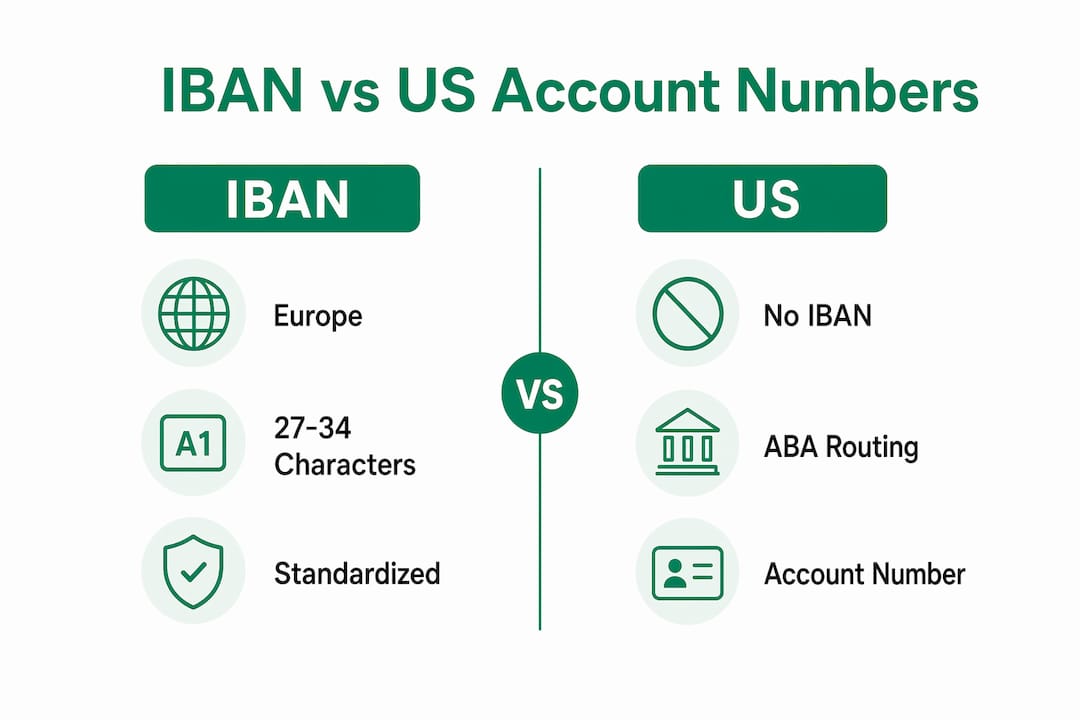
You cannot convert a US bank account number to an IBAN. The United States does not participate in the IBAN system, so no calculator, formula, or tool can produce a valid IBAN for a US account. When an international payer asks your company for an IBAN, the correct response is to provide your routing number (ABA), your domestic account number, and your bank's SWIFT/BIC code instead. Attempting to generate an IBAN from US account details produces a structurally formatted string that will fail on actual payment networks, potentially misdirecting funds or triggering bank fees.
Here is what US-based finance teams need to give international payers:
- Routing number (ABA): a 9-digit code identifying your US bank
- Account number: your domestic checking or savings account number
- SWIFT/BIC code: your bank's international identifier for cross-border wire routing
- Bank name and address: often required by foreign banks to complete the transfer
The US relies entirely on ABA routing numbers and SWIFT/BIC codes for international transfers because it has not adopted the IBAN standard. Canada, Australia, China, Japan, and most of Asia are in the same position.
Table of Contents
- What is an IBAN and why does it matter for international payments?
- Why IBAN calculators cannot help with US accounts
- How to verify IBANs and protect your payments
- Specialized tools for IBAN verification and validation
- Key Takeaways
What is an IBAN and why does it matter for international payments?
An IBAN, or International Bank Account Number, is a standardized identifier defined by ISO 13616 that wraps a country's domestic bank details into a single, validated string. It does not replace your account number. It contains it, along with a two-letter country code and two check digits that catch transcription errors before a payment is sent.
The structure breaks down like this:
- Country code (2 letters): identifies the country, e.g., "DE" for Germany
- Check digits (2 digits): calculated via the MOD-97 algorithm to catch typos
- BBAN (Basic Bank Account Number): the country-specific portion holding bank code, branch code, and account number
IBANs are used across 80+ countries, primarily within the SEPA zone covering the Eurozone and several neighboring nations. The check-digit system catches the vast majority of transcription errors before a payment leaves the sender's bank, which is why SEPA and many national payment schemes mandate IBAN usage. For accounts payable teams sending payments into Europe, verifying an IBAN's format is the first line of defense against costly routing failures.

Why IBAN calculators cannot help with US accounts
IBAN calculators work by applying country-specific rules from the SWIFT IBAN Registry to format domestic bank details into a valid IBAN structure. Germany has an 18-digit BBAN. The UK has a 22-character format. Each country's rules are fixed and published. The problem for US accounts is simple: the US has no registered IBAN format in the SWIFT IBAN Registry, so there is no rule set to apply.
Any string a calculator produces for a US account is a fabricated format guess, not a real IBAN. The risks of using it are real:
- Payment failure: receiving banks in IBAN-required corridors will reject the transfer outright
- Misdirected funds: a structurally plausible but incorrect IBAN can route money to a real account that belongs to someone else
- Bank fees: rejected or returned international wires typically incur charges on both ends
- Fraud exposure: fraudsters sometimes supply fake IBANs knowing the payer will not verify them independently
Automated calculators also struggle with banks that use non-standard internal numbering, such as certain cooperative or savings institutions. For those banks, direct bank confirmation is the only reliable path even in countries that do use IBANs.
Pro Tip: Never rely on a calculator-generated IBAN alone. Always confirm the IBAN directly with the payee or their bank before initiating a payment, regardless of whether the format looks correct.
How to verify IBANs and protect your payments
Format validation is not the same as account verification. An IBAN can pass the MOD-97 checksum and still point to an account that does not exist, has been closed, or belongs to the wrong person. Finance teams need both layers.
Here is a practical verification workflow:
- Step 1 — Format check: confirm the IBAN length and structure match the country's registered format; the MOD-97 calculation should return a remainder of 1
- Step 2 — Payee confirmation: ask the payee to provide their IBAN directly from their bank statement or online banking portal, not from a third-party calculator
- Step 3 — Name matching: verify that the account holder name on record matches the IBAN provided; a mismatch is a fraud signal
- Step 4 — Live network check: use a real-time verification service to confirm the account is active and the name matches the bank's records
- Step 5 — Document the result: log the verification outcome in your accounts payable system before releasing payment
For US accounts on the receiving side of an international payment, the same discipline applies in reverse. Provide your ABA routing number, account number, and SWIFT/BIC code in writing, and confirm the details with your bank if the sending institution requests additional documentation.
A structurally valid IBAN is a necessary condition for payment, not a sufficient one. Incorrect IBANs cause misdirected payments and bank fees that fall on your accounts payable team to resolve.
Specialized tools for IBAN verification and validation
Format validators and IBAN calculators serve a purpose: they confirm that a string is correctly assembled and passes the MOD-97 checksum. What they cannot do is confirm that the account exists or that the name on the account matches your payee. Batch processing tools offer API access for large-scale conversions but still cannot guarantee account existence without live bank data.
| Verification type | What it checks | What it misses |
|---|---|---|
| Format validation | IBAN length, country format, MOD-97 checksum | Account existence, ownership, active status |
| Live network check | Account active status against bank records | May not return name in all countries |
| Full payee verification | Name, IBAN, account match in real time | Nothing, when the service covers that country |
Vopify sits in the third category. It matches a provided IBAN against the account holder's name in real time, checking live payment networks across 20 Eurozone countries with a response time under two seconds. Finance teams can run single or bulk verifications via CSV upload, making it practical for accounts payable departments processing large supplier payment runs. Coverage extends beyond SEPA to India, Indonesia, South Korea, and China via Alipay, which matters for teams managing global supplier bases.
The platform's payee verification service is built around compliance with the EU Instant Payments Regulation and equivalent regional schemes, so the verification result carries regulatory weight, not just operational convenience. For high-volume teams, API integration is on the roadmap for programmatic checks at scale.
Key Takeaways
US finance teams cannot generate a valid IBAN from a domestic account number because the US has not adopted the IBAN standard, and any calculator-produced string will fail on live payment networks.
| Point | Details |
|---|---|
| US accounts have no IBAN | Provide ABA routing number, account number, and SWIFT/BIC code to international payers instead. |
| Format validity is not enough | An IBAN passing MOD-97 can still point to a nonexistent or wrong account. |
| Calculator limits are real | IBAN calculators cannot generate valid IBANs for non-IBAN countries like the US. |
| Verify name and account together | Matching the payee name to the IBAN is the step that catches fraud before payment is released. |
| Bulk verification scales the process | Tools like Vopify handle CSV uploads for large supplier runs, covering 20 Eurozone countries in under two seconds. |
Finance teams that regularly pay international suppliers need more than a format check. Vopify's real-time payee verification confirms that the IBAN you have on file actually belongs to the person or business you intend to pay, before the wire goes out. With over 10,000 verifications processed and coverage across 20 Eurozone countries, it is built for the volume and accuracy that accounts payable departments require.