
Add real-time IBAN and account-holder name verification to your AP payment run before the next batch goes out. That single control stops misdirected payments before funds leave your account, cuts recall costs, and satisfies the name-matching requirements now embedded in the EU Instant Payments Regulation. The Bank for International Settlements (BIS) identifies limited interoperability between national payment systems as the primary friction keeping cross-border payments slow and costly. SWIFT's UETR standard gives end-to-end traceability once a payment is in flight, but it cannot fix a wrong IBAN or mismatched payee name before the wire leaves. Vopify has processed over 10,000 verifications across 20 Eurozone countries with response times under two seconds, which means you can run name-to-account checks at batch speed without slowing your payment cycle.
Before you read further, do these three things:
- Run an algorithmic IBAN format check on every payee in your supplier master.
- Perform a name-to-account verification (Verification of Payee / Confirmation of Payee) for all high-value or new payees.
- Batch-verify your full supplier file before the next payment run using a CSV upload workflow.
Table of Contents
- How the main cross-border rails actually move your money
- Primary frictions and risks that AP teams actually face
- What to require from your bank and payment vendors
- AP checklist: step-by-step verification before every cross-border payment
- How to implement verification: in-house, bank-provided, or third-party API
- Integration checklist: adding verification to your AP payment run
- Key Takeaways
- The part most AP teams get wrong
- Vopify gives your AP team production-ready verification today
- Useful sources and further reading
How the main cross-border rails actually move your money
Cross-border payment systems are not a single network. They are a stack of overlapping rails, each with different settlement speeds, fee structures, and visibility levels.
- SWIFT / correspondent banking. The dominant rail for B2B international transfers. A payment hops through one or more correspondent banks before reaching the beneficiary's institution. Each hop can add fees, delay, and opacity. SWIFT gpi introduced the Unique End-to-End Transaction Reference (UETR), which gives participating institutions full transparency and immediate status updates across the chain.
- CHIPS (Clearing House Interbank Payments System). The primary U.S. large-value clearing system, settling the majority of dollar-denominated international transactions. CHIPS nets positions throughout the day and settles final balances across Fedwire.
- Fedwire. The Federal Reserve's real-time gross settlement (RTGS) system. Used for same-day finality on domestic USD transfers and as the settlement backbone for CHIPS.
- Card rails. Visa and Mastercard networks handle cross-border consumer and B2B card payments. Settlement is fast but FX conversion and interchange fees accumulate.
- Local instant payment schemes (IPS). RTP (The Clearing House) and FedNow in the U.S., SEPA Instant in Europe, UPI in India, and similar domestic networks. These settle in seconds but are typically domestic-only.
- Hub models (Project Nexus). The BIS Innovation Hub's Project Nexus aims to interlink domestic IPS networks so a payment can cross borders in under 60 seconds by standardizing APIs and ISO 20022 messaging between IPS operators. The Nexus blueprint reduces the integration challenge from thousands of bilateral links to a single connection per IPS.
Payee verification sits at the start of this flow, before the payment enters any rail. A name-IBAN mismatch caught at verification costs nothing to fix. The same mismatch discovered after a SWIFT wire has left costs days of investigation and recall fees.
Primary frictions and risks that AP teams actually face
The four challenges the Financial Stability Board identifies for cross-border payments are high costs, low speed, limited access, and insufficient transparency. For an AP team, those abstract challenges translate into concrete operational problems.
- Interoperability gaps. National systems use different message formats, settlement windows, and access rules. BIS analysis confirms that harmonized messaging protocols are the primary technical fix, but adoption is uneven. Routing exceptions land in your exception queue.
- Correspondent-bank opacity. Each intermediate bank in a SWIFT chain can deduct fees. The amount that arrives at the beneficiary often differs from the amount sent, which breaks automated reconciliation.
- Payee-mismatch risk. A wrong IBAN or a name that does not match the account holder triggers a return or, worse, a completed payment to the wrong account. Recalling a cross-border wire typically takes 5–10 business days and involves manual coordination across multiple institutions.
- AML/KYC and sanctions friction. Payments to new payees or high-risk corridors trigger compliance holds. Early verification that confirms payee identity reduces false positives and the volume of manual reviews.
- FX risk. Multi-hop routing means FX conversion can happen at an intermediate bank rather than at a contracted rate. The timing and rate applied are often invisible until the payment settles.
Pro Tip: Flag any payee where the IBAN country code does not match the expected payment corridor. That mismatch is the single most common trigger for both compliance holds and misdirected payments.
Global remittances reached approximately $905 billion in 2024, and the G20 Roadmap targets reducing average global transfer costs to under 1% by the end of 2027. The gap between current costs and that target is largely a transparency and routing problem, not a technology one.
What to require from your bank and payment vendors
The right contracts and vendor requirements cut friction before it hits your queue.
- ISO 20022 messaging. Require it from any bank or PSP handling your cross-border transactions. Richer data fields mean fewer repair stops and better reconciliation matching.
- SWIFT gpi / UETR support. Require a UETR on every outbound wire. It is the only way to trace, and if necessary recall, a transaction across the correspondent chain.
- API-native connections to local IPS. API-native platforms reduce reliance on correspondent banks and lower unpredictable fees. Wise Platform reports that 77% of payments complete in under 20 seconds and 96% complete in under 24 hours when using direct access to local payment systems.
- Real-time name-to-account verification (VoP/CoP). Require this as a pre-submission control, not an optional add-on. The EU Instant Payments Regulation mandates it for SEPA Instant; the same logic applies to any high-value corridor.
- Bulk/batch verification SLAs. If you run payment batches, your verification vendor must handle bulk CSV inputs and return results within your payment-run window.
- Audit logs. Every verification result should be logged with a timestamp, verification status, and matched-name field for audit and dispute purposes.
AP checklist: step-by-step verification before every cross-border payment
Run these steps in order. Skip one and the next step's output is unreliable.
- Standardize supplier master data. Confirm that every payee record has a full legal name, IBAN, and country code. Remove duplicates and flag incomplete records before verification.
- Run an algorithmic IBAN format check. Validate length, check digits, and country-code structure. This catches typos before they consume verification credits or reach the rail.
- Perform name-to-IBAN verification (VoP/CoP or API). Match the payee name in your ERP against the name registered to the IBAN at the beneficiary bank. A SEPA-compliant VoP check or a Confirmation of Payee flow returns a match, close-match, or no-match result.
- Run sanctions and AML screening. Screen against OFAC, EU, and UN consolidated lists. Do this after payee verification so you are screening a confirmed identity, not a potentially wrong one.
- Triage by risk. New payees, amounts above your internal threshold, and corridors flagged as high-risk require manual review before submission. Existing verified payees with no data changes can proceed automatically.
- Submit to the payment rail with UETR tracking. Attach the verification token and UETR to the payment record in your ERP for reconciliation and audit.
- Log and feed results back into the vendor master. A verified payee should not require re-verification on the next run unless their data changes.
Verification result fields to capture per payment:
| Field | Description |
|---|---|
request_id | Unique ID for the verification call |
verification_status | Match / close-match / no-match / error |
matched_name | Name returned by the beneficiary bank |
iban | IBAN submitted for verification |
response_time_ms | Time to result in milliseconds |
verified_at | Timestamp of the verification |
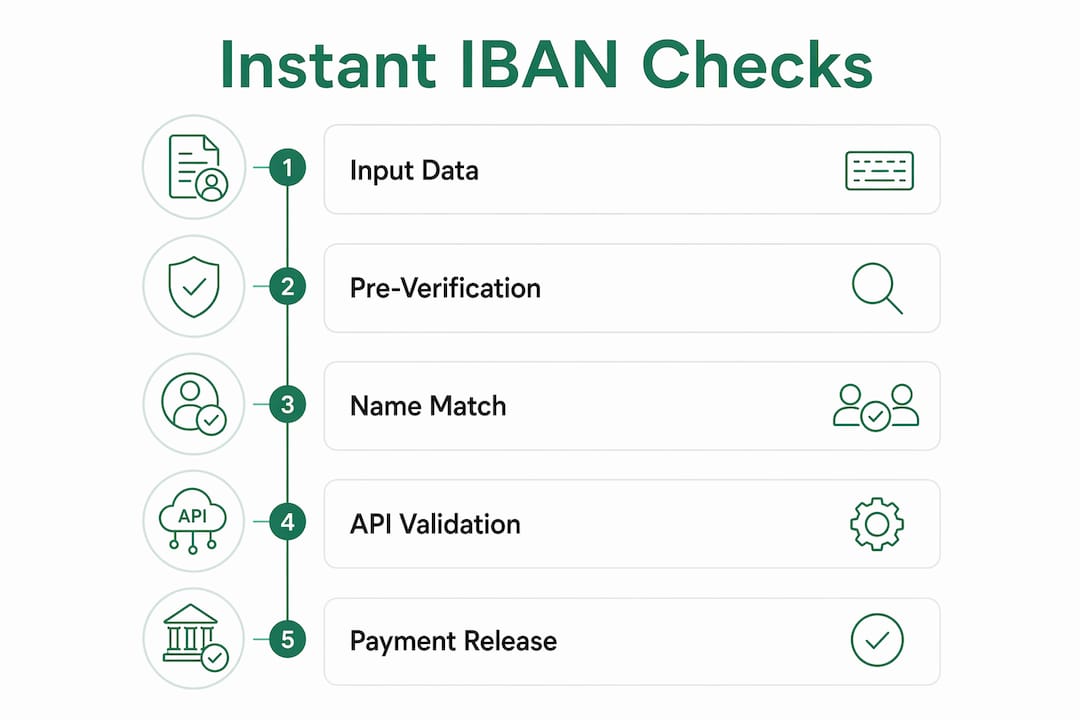
Pro Tip: Implement a hard pass/fail/needs-review policy at step 3. Feed the result back into your ERP vendor master immediately so the next payment run inherits the verified status and skips re-verification for unchanged records.

How to implement verification: in-house, bank-provided, or third-party API
Three implementation paths exist. The right one depends on your volume, technical capacity, and corridor coverage needs.
- In-house. You build direct connections to beneficiary bank APIs or national scheme APIs. Full control over data and logic, but engineering cost is high and maintenance is ongoing as scheme APIs evolve. Sensible only for very large treasury operations with dedicated payments engineering teams.
- Bank-provided verification. Your bank may offer payee name-checking for specific corridors. Coverage is typically limited to the bank's own network, SLAs are slower, and the service rarely supports bulk processing. Adequate for low-volume, single-corridor operations.
- Third-party API vendors. The practical choice for most AP teams. A good vendor connects directly to local rails across multiple countries, returns results in under two seconds, supports bulk CSV uploads, and provides audit logs. Evaluate vendors on: coverage map (countries and rails supported), response-time SLA, bulk API support, audit log format, and data-processing agreement terms.
When selecting a vendor, require a documented coverage map, a contractual response-time SLA, and explicit confirmation that verification data is not retained or resold.
Integration checklist: adding verification to your AP payment run
A minimal integration has five steps. Engineers can implement this in a single sprint.
- Export the payment batch from your ERP as a CSV or structured JSON containing
payer_id,payee_name,iban,country, andamount. - Call the IBAN format-check endpoint for each record. Discard or flag malformed IBANs before proceeding.
- Call the name-to-account verification API for each valid IBAN. Pass
payee_nameandiban; receiveverification_status,matched_name, andverification_token. - Apply rules-based decisioning. Match → proceed. Close-match → route to manual review queue. No-match → block and notify AP team.
- Submit approved payments to the payment engine with the
verification_tokenand UETR attached. Store both in the ERP payment record.
For bulk jobs, use a webhook callback pattern: POST the batch, receive a job_id, and listen for a webhook event that delivers results per record when processing completes. Build in a retry with exponential backoff for timeout errors, and log every API response regardless of status for audit purposes. The IBAN verification API documentation covers the synchronous single-check and async bulk patterns in detail.
Key Takeaways
Real-time IBAN and name verification, integrated before payment submission, is the single most cost-effective control an AP team can add to a cross-border payment workflow.
| Point | Details |
|---|---|
| Verify before the wire leaves | Name-to-IBAN mismatches caught pre-submission cost nothing; post-wire recalls take 5–10 business days. |
| Require UETR on every outbound wire | SWIFT's UETR is the only way to trace or recall a cross-border payment across the correspondent chain. |
| Prefer API-native vendors | Direct local-rail connections return results faster and cover more corridors than bank-provided checks. |
| Feed results into your vendor master | Log verification_status and matched_name per payee so verified records skip re-verification on unchanged data. |
| Vopify for production-ready verification | Vopify delivers real-time IBAN and name verification across 20 Eurozone countries in under two seconds, with single-check and bulk CSV options. |
The part most AP teams get wrong
The conventional wisdom on cross-border payment risk focuses on fraud detection after the fact: transaction monitoring, anomaly alerts, post-settlement reconciliation. Those controls matter, but they are expensive to run and they operate on money that has already moved.
The more effective intervention is earlier and cheaper: confirm that the IBAN and the account-holder name match before the payment instruction reaches any rail. That is not a compliance checkbox. It is the moment where a $200,000 supplier payment either goes to the right place or disappears into a recall process that ties up your AP team for two weeks.
What I see consistently is that treasury and AP teams treat payee verification as an IT project and wait for a full ERP integration before running a single check. That delay is unnecessary. A bulk CSV upload against your existing supplier master takes an afternoon and surfaces the mismatches that have been sitting in your data for years. Start there. The API integration can follow once you know the scale of the problem.
The other underestimated factor is stakeholder alignment. AP wants speed, treasury wants control, and IT wants a clean integration spec. Verification sits at the intersection of all three, which means it stalls unless one team owns the decision. Assign it to AP with a clear SLA, and the implementation moves.
Vopify gives your AP team production-ready verification today
Finance teams running cross-border payments need verification that works at batch speed, not a multi-month integration project. Vopify delivers real-time IBAN and account-holder name matching across 20 Eurozone countries, with results in under two seconds and no long-term contract required to get started.
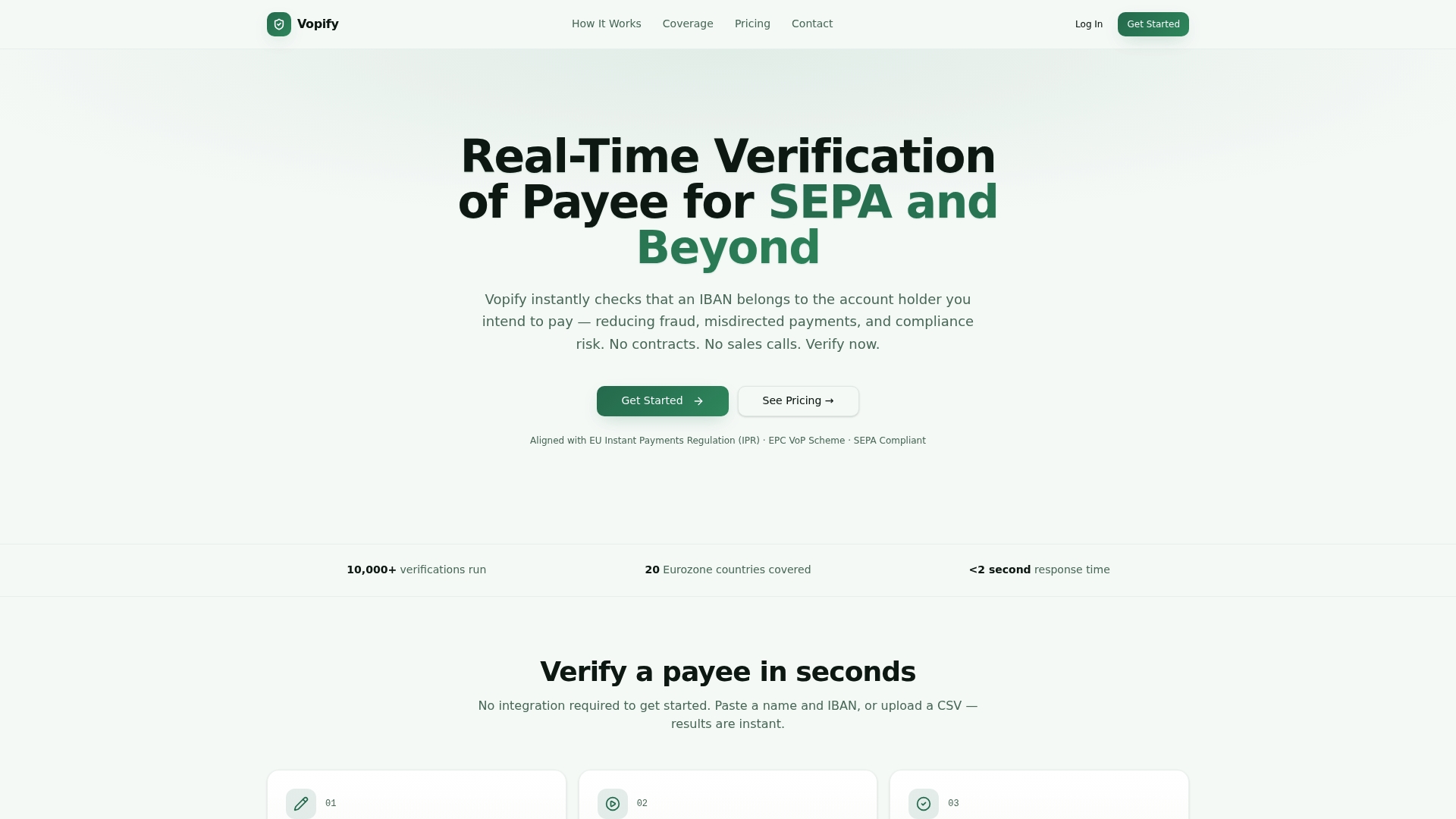
Single checks run through the dashboard. Supplier master cleanses run through bulk CSV upload with results returned per record. High-volume AP workflows connect via API with full audit logging. Vopify has processed over 10,000 verifications in production and covers SEPA, India, Indonesia, South Korea, and China (Alipay), so your non-SEPA corridors are not left out.
Run your first bulk verification or review the API documentation at vopify.io.
Useful sources and further reading
- BIS: Cross-border payment technologies: innovations and challenges — primary analysis on interoperability frictions and the case for harmonized messaging.
- BIS Project Nexus overview — the IPS interlinking initiative and its 60-second payment target.
- BIS Project Nexus blueprint (July 2024) — technical design, hub-and-spoke model, and scalability analysis.
- SWIFT gpi and UETR — SWIFT's end-to-end tracking standard; consult when negotiating bank SLAs.
- Stripe: Global remittances and cross-border payment technology — analysis of API-native infrastructure and remittance cost trends.
- Financial Stability Board: Cross-border payments — G20 Roadmap targets and FSB coordination framework.
- World Bank Remittance Prices Worldwide — corridor-level cost data across 367 remittance corridors.
- Vopify IBAN verification — single-check and API documentation for programmatic integration.
- Vopify VoP service — SEPA Verification of Payee compliance details.
When negotiating contracts with banks or PSPs, reference the ISO 20022 standard pages and SWIFT gpi documentation directly. Vendors who cannot point to these standards in their technical specs are unlikely to meet the SLAs that modern AP operations require.