
What are cross-border payments, and how do they work?
Cross-border payments are financial transfers between a payer and a recipient located in different countries. They span everything from a worker in Texas sending money home to family in Mexico, to a multinational corporation settling a trade invoice with a supplier in Germany. The category covers both retail payments (individuals and small businesses) and wholesale payments (large transactions between financial institutions), including remittances, international trade settlements, and interbank transfers.
Several components define how these transactions move:
- Correspondent banking: The dominant model, where banks hold accounts at one another across borders to route funds through a chain of intermediaries.
- Currency conversion: Most transfers cross at least one currency boundary, requiring foreign exchange at a rate set by the processing bank or provider.
- Payment messaging networks: SWIFT is the primary global standard for transmitting payment instructions between financial institutions.
- Alternative channels: Digital wallets, mobile payment apps, and card networks (Visa, Mastercard) handle a growing share of retail volume.
- Regulatory compliance: Each jurisdiction applies its own anti-money laundering (AML), know-your-customer (KYC), and sanctions screening requirements.
The jurisdictional complexity is what separates international transfers from their domestic counterparts. A payment from New York to Tokyo may pass through three or four intermediary banks, each applying its own compliance checks and taking a fee before the funds arrive.
Why cross-border payments matter for the global economy
The scale of this market is hard to overstate. The global cross-border payments market approached a value of approximately $1 quadrillion in 2024, with the vast majority handled by traditional banking infrastructure. Financial institution-related payments account for roughly four-fifths of that total Swift payment value, dwarfing customer-initiated transfers in dollar terms.
Beyond raw volume, these payments underpin real economic activity:
- International trade: Importers and exporters depend on reliable payment channels to settle goods and services across borders.
- Foreign direct investment: Capital flows between countries require efficient interbank payment systems to move at the speed markets demand.
- Remittances: Migrant workers send money home to families who often rely on it as a primary income source, making cost and speed directly tied to household welfare.
- Financial inclusion: Access to affordable international transfers can bring unbanked populations into the formal financial system.
The Financial Stability Board and the G20 Roadmap, launched in 2020, identified four persistent challenges: high costs, low speed, limited access, and insufficient transparency. The G20 Roadmap consists of 19 building blocks designed to address these frictions, with the FSB coordinating progress and reporting annually to the G20. That level of institutional attention reflects how central efficient international money transfers are to global economic stability.
The cost gap is stark: The global average cost to send $200 in remittances was $12 (6%) in 2024, down only from $18 (9%) roughly 20 years ago. Domestic payments, by contrast, are nearly free for end users in most advanced economies.
How the correspondent banking model actually moves money
Funds in a cross-border payment are never physically shipped. What moves is information: a chain of debit and credit instructions passed between banks that hold accounts with one another. This is the correspondent banking model, and it is the backbone of most international money transfers today.
Here is how a typical payment flows:
- Originating bank receives the payment instruction from its customer and debits their account.
- Correspondent bank(s) in the originating currency country receive the instruction via SWIFT and pass it along the chain.
- Intermediary banks in intermediate currency hubs (often USD-clearing banks in New York) convert and forward the funds.
- Beneficiary's correspondent bank credits the local bank's nostro account.
- Beneficiary bank credits the recipient's account.
Each link in that chain adds a fee, a compliance check, and time. Correspondent banking creates a daisy-chain of intermediaries that increases cost and slows settlement, particularly when data formats between institutions are not standardized. The ISO 20022 messaging standard is gradually replacing legacy formats, with 76% of fast payment systems already processing ISO 20022 messages as of 2024, but adoption across RTGS systems still lags.
Payment corridors with high transaction volume (say, USD to EUR) tend to have shorter chains and lower costs because direct relationships exist between major banks. Less-traveled corridors (USD to a smaller African currency, for example) may require three or four intermediaries, each adding latency. Settlement times can take multiple days depending on the length of the intermediary chain, time zone differences, and the compliance workload at each node.

The main types of cross-border payments and who uses them
Not all international transfers look alike. The two primary categories are wholesale and retail, and they differ in volume, value, speed requirements, and the infrastructure that serves them.
Wholesale cross-border payments move between financial institutions: central banks, commercial banks, and large corporates settling interbank obligations. These transactions are typically large in value, lower in volume, and handled through RTGS (Real-Time Gross Settlement) systems and SWIFT's financial institution message types. While still slower and more expensive than domestic equivalents, wholesale payments are relatively efficient compared to retail.
Retail cross-border payments cover:
- Person-to-person (P2P): Remittances sent by individuals to family abroad. High volume, low individual value, extremely cost-sensitive.
- Person-to-business (P2B): Consumers paying foreign merchants online. Card networks and digital wallets dominate here.
- Business-to-business (B2B): Companies paying suppliers, contractors, or subsidiaries in other countries. Wire transfers and trade finance instruments are common.
- Business-to-person (B2P): Payroll for international employees, insurance payouts, or marketplace seller disbursements.
Remittances sit in a category of their own within retail payments. They are high-frequency, low-value, and sent by people who often have limited banking options. The cost burden falls hardest on this group, which is why the UN Sustainable Development Goals specifically target reducing remittance costs.
Real-world scenarios that show where friction appears
Consider a US-based staffing firm paying contractors in South Korea, India, and Indonesia. Each payment requires a different local banking relationship, a different currency conversion, and compliance with each country's inbound payment regulations. The firm's bank may route each payment through a different correspondent chain, meaning arrival times and net amounts vary unpredictably.
A simpler example: a freelancer in the Philippines receives payment from a client in Germany. The German bank sends a SWIFT message to its correspondent in the US (because USD is the clearing currency), which forwards to a correspondent in the Philippines, which credits the local bank. By the time the freelancer receives the funds, two or three intermediaries have each taken a cut, and the exchange rate applied at each step may differ from the mid-market rate the freelancer saw quoted online.
Wholesale scenarios carry their own friction. A US investment bank settling a securities trade with a counterpart in Japan must coordinate across time zones, RTGS operating hours, and currency cut-off times. A missed cut-off means the settlement rolls to the next business day, creating overnight counterparty risk.
These scenarios share a common thread: the more intermediaries involved, the less predictable the outcome for the end user.
Methods and solutions used to execute international transfers
The market for global payment solutions has expanded well beyond traditional wire transfers. Finance teams and business owners now have several categories to choose from:
- SWIFT and correspondent banking: The default for large-value B2B and wholesale payments. Reliable and globally accepted, but slow and expensive for smaller transactions.
- Card networks: Visa and Mastercard process cross-border consumer and B2B card payments. Fast and widely accepted, but foreign transaction fees typically add 1%–3% on top of the exchange rate margin, and the cost to merchants is higher than domestic card acceptance.
- Digital wallets and mobile platforms: Services like PayPal, Alipay, and regional mobile money platforms handle P2P and P2B transfers with faster settlement and lower fees in specific corridors. Coverage is uneven globally.
- Fintech payment providers: A growing category of non-bank providers that use technology to reduce intermediary steps, often offering better exchange rates and faster settlement than traditional banks for retail and SMB payments.
- Blockchain and distributed ledger technology (DLT): DLT and stablecoins offer potential for real-time settlement and greater transparency, but require strong regulatory frameworks and interoperability with legacy systems to function at scale. Several central banks are piloting wholesale CBDC arrangements for this purpose.
- Payment orchestration platforms: Software layers that route payments through the optimal provider or corridor based on cost, speed, and success rate. Particularly useful for businesses operating across multiple countries.
Pro Tip: Before selecting a provider for a specific corridor, request a full cost disclosure that includes the exchange rate margin, not just the transfer fee. A provider advertising zero fees may embed a 2%–4% margin in the exchange rate, making it more expensive than a provider charging an explicit fee.
Benefits and challenges: what finance teams need to weigh
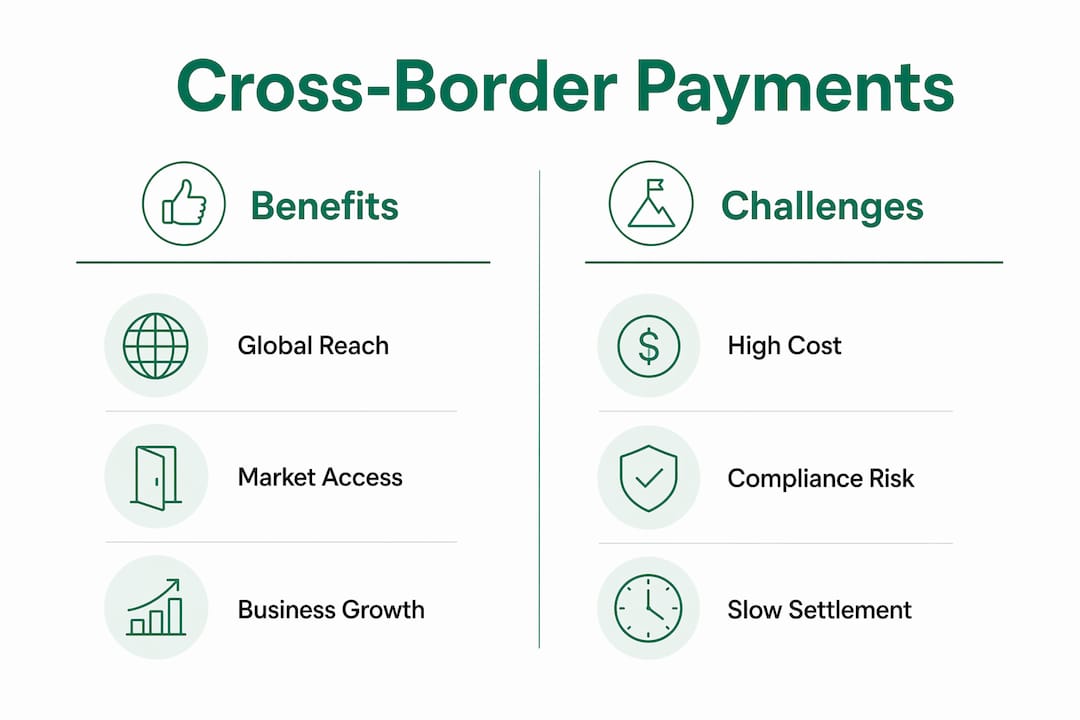
Cross-border payments unlock real commercial value. They let US businesses source globally, pay international talent, and sell to customers in markets that would otherwise be inaccessible. For individuals, remittance channels are often the only mechanism for supporting family across borders.
The challenges, though, are persistent and well-documented:
- Cost: Retail cross-border payments remain significantly more expensive than domestic payments, with only limited improvement over the past two decades. The $12 average cost to send $200 cited earlier reflects a structural problem, not a temporary inefficiency.
- Speed: Settlement times of multiple days are common in correspondent banking chains. Even in corridors where same-day settlement is technically possible, compliance holds and cut-off times frequently push delivery to the next business day.
- Transparency: Senders often cannot see the full fee breakdown or the exchange rate applied until after the transaction is complete. This opacity makes it difficult to compare providers on a true all-in basis.
- Compliance complexity: AML, KYC, and sanctions screening requirements differ by country. A payment flagged for additional review at any point in the chain can be delayed or returned without clear explanation.
- Fraud risk: Misdirected payments and account fraud are elevated in cross-border contexts because verification of the beneficiary's account details is harder across jurisdictions. Payee verification tools that check IBAN and account holder name in real time address this directly.
The speed gap: Cross-border payments often take several days due to multiple intermediaries, compliance checks, and fragmented data formats, while domestic transfers in many countries settle in seconds.
Strategies to manage and improve cross-border payment efficiency
Finance professionals who treat international transfers as a fixed cost are leaving money on the table. Several approaches consistently reduce cost and improve predictability:
Choose shorter corridors where possible. High-volume currency pairs (USD/EUR, USD/GBP) have more direct banking relationships, meaning fewer intermediaries and lower fees. Routing a payment through a major hub currency rather than a minor one can cut both cost and settlement time.
Adopt a local-first approach. A local-first strategy using payment orchestration platforms lets businesses operate as local merchants in target markets, accepting and disbursing in local currencies and payment methods. This reduces cross-border friction, improves payment acceptance rates, and avoids the exchange rate markups embedded in wire transfers.
Evaluate all-in cost, not headline fees. Providers with "zero fees" embed their margin in unfavorable exchange rates. The only way to compare providers accurately is to calculate the total amount received by the beneficiary for a given send amount, factoring in both explicit fees and the exchange rate spread. Understanding hidden payment fees is as important in cross-border transfers as in any other payment context.
Verify payees before sending. Misdirected payments are expensive to recover internationally and sometimes unrecoverable. Verifying that an IBAN corresponds to the intended account holder before initiating a transfer prevents fraud and eliminates costly payment errors. Vopify's real-time IBAN verification checks live payment networks across 20 Eurozone countries and additional markets including India, Indonesia, South Korea, and China, returning results in under two seconds.
Standardize data formats. Payments that carry complete, correctly formatted beneficiary data are far less likely to be held for manual review. Adopting ISO 20022-compliant data fields reduces straight-through processing failures.
Understanding the true cost of sending money abroad
The pricing of cross-border payments is deliberately opaque in many parts of the market. Two fee structures account for most of the cost:
- Explicit fees: A flat charge or percentage stated upfront by the sending bank or provider. These are visible and comparable.
- Exchange rate margin: The difference between the mid-market rate (the rate banks use with each other) and the rate offered to the customer. This margin is often not disclosed as a fee, even though it functions as one.
A provider charging $5 to send $1,000 but applying a 3% exchange rate margin costs the sender $35 total. A provider charging $15 with a 0.5% margin costs $20. The headline fee is misleading without the full picture. This is the core transparency problem the Financial Stability Board and G20 Roadmap are working to address through mandatory disclosure requirements and pricing comparison tools.
Industry data tells a sobering story. The global average remittance cost has dropped from roughly 9% to 6% over two decades, but the pace of improvement has been slow given the scale of technological change in payments broadly. For businesses managing high volumes of supplier payments, even a 1% improvement in all-in cost across a large payment book translates to material savings. Understanding investment account fee structures follows the same logic: the stated rate is rarely the whole story.
Regulatory efforts are pushing for greater clarity. The EU's Instant Payments Regulation, for example, requires that euro transfers within SEPA be processed at the same cost as domestic transfers, removing one layer of fee discrimination for businesses operating across European borders.
How Vopify reduces fraud risk in cross-border payment workflows
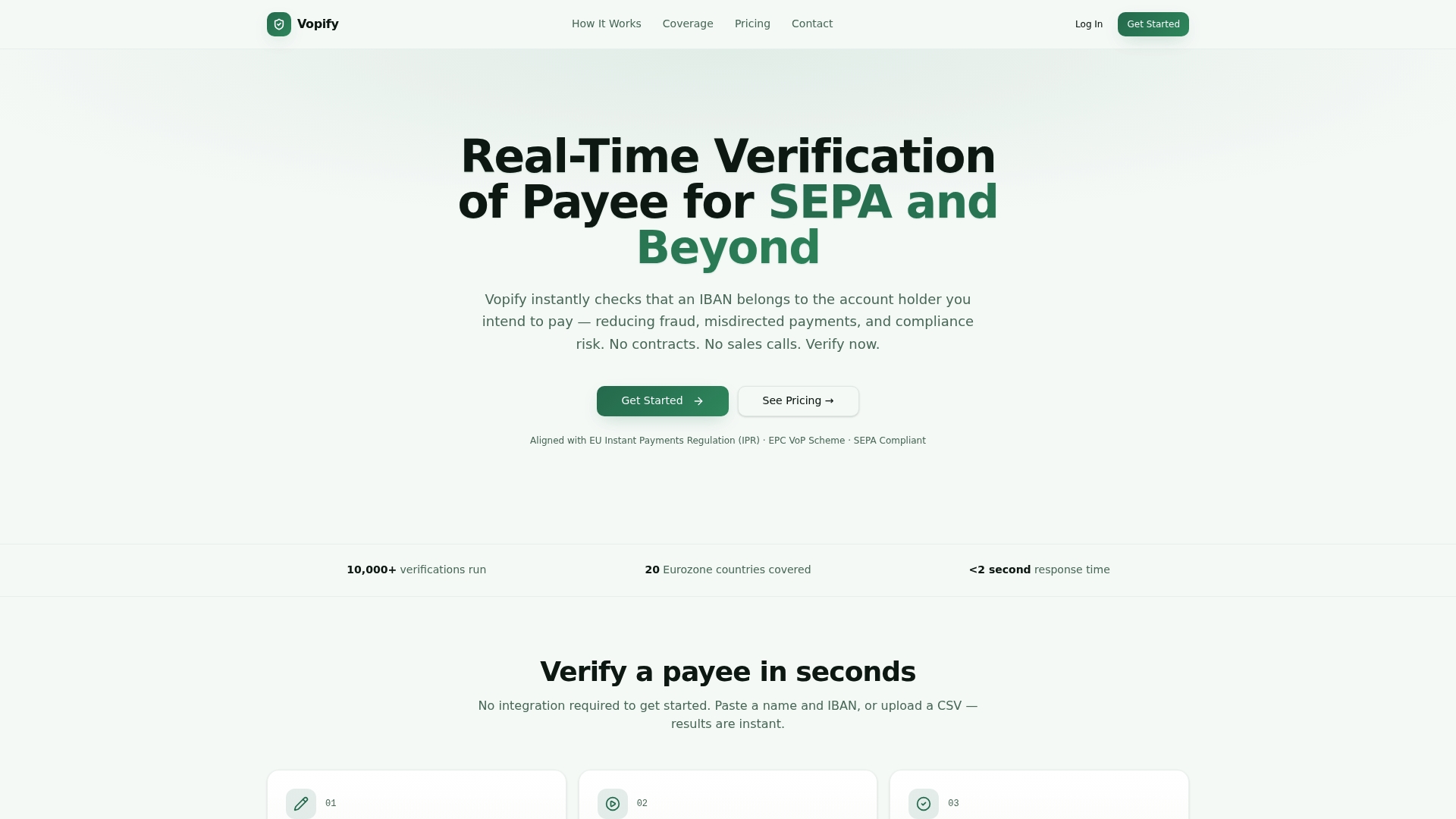
One of the most preventable costs in international payments is the misdirected transfer. Once funds leave through a correspondent banking chain, recovering them from the wrong account can take weeks and often requires legal action across jurisdictions.
Vopify addresses this at the source. Before a payment is initiated, Vopify's payee verification checks that the IBAN and account holder name match on live payment networks, covering 20 Eurozone countries plus India, Indonesia, South Korea, and China. The check takes under two seconds and works for both individual and business accounts. Finance teams processing large supplier lists can use bulk IBAN verification via CSV upload to screen thousands of payees at once, catching discrepancies before they become payment errors.
For businesses operating under the EU Instant Payments Regulation or SEPA compliance requirements, Vopify's Verification of Payee service is built to meet current regulatory standards. The platform runs on a pay-as-you-go credit model or tiered subscription, with no lengthy contracts required to get started.
Key Takeaways
Cross-border payments cost more, settle slower, and carry more compliance risk than domestic transfers, but the right combination of corridor selection, payee verification, and all-in cost analysis can help improve efficiency.
| Point | Details |
|---|---|
| Market scale | The global cross-border payments market approached $1 quadrillion in 2024, dominated by financial institution transactions. |
| Persistent cost problem | The global average cost to send $200 in remittances was $12 (6%) in 2024, down only from $18 (9%) roughly 20 years ago. |
| Correspondent banking friction | Intermediary chains add fees, delays, and compliance holds; ISO 20022 adoption is improving but incomplete. |
| Hidden exchange rate costs | "Zero fee" providers embed margins in exchange rates; always compare all-in cost, not headline fees. |
| Payee verification prevents loss | Verifying IBAN and account holder name before sending eliminates misdirected payments that are costly to recover internationally. |