
An IBAN is your domestic account number wrapped in an internationally standardized format; a non-IBAN account number is the raw domestic identifier used inside one country's banking system. The core structural difference: an IBAN adds a 2-letter country code, 2 check digits, and a BBAN (Basic Bank Account Number) on top of whatever local account details already exist. For U.S. users, this distinction is immediately practical — the U.S. doesn't use IBAN, so sending money abroad means supplying an ABA routing number, account number, and SWIFT/BIC code instead.
Key trust signals worth knowing upfront:
- ISO 13616 is the international standard that defines IBAN structure and format.
- SWIFT acts as the official registration authority for national IBAN formats and publishes the IBAN Registry.
- SEPA (Single Euro Payments Area) requires IBANs for all euro transfers within its member countries.
Table of Contents
- What's the difference between an IBAN and a non-IBAN account number?
- What does an IBAN actually contain?
- How do U.S. bank account details work without an IBAN?
- When does the IBAN vs. non-IBAN distinction actually matter?
- How do you find and validate an IBAN or domestic account number?
- Why payee-name verification matters beyond format checks
- What to do if you only have a domestic account number and no IBAN
- Key Takeaways
- Vopify makes live IBAN and payee-name verification fast for finance teams
What's the difference between an IBAN and a non-IBAN account number?
| Dimension | IBAN | Non-IBAN (Domestic) Account Number |
|---|---|---|
| Structure/components | Country code (2 letters) + check digits (2) + BBAN (bank, branch, account) | Bank-specific account number; may include routing code separately |
| Length/character set | Up to 34 alphanumeric characters; fixed length per country | Variable; U.S. account numbers typically have varying length; routing numbers have a fixed length |
| Primary use case | Cross-border payments to IBAN countries; SEPA transfers within Europe | Domestic transfers; international wires from non-IBAN countries use SWIFT + local details |
| Built-in validation | Mod-97 check digit algorithm verifies the full string | No universal check; validation is bank-specific |
| How to find it | Online banking, bank statement, or call your bank | Printed on checks (routing + account), online banking dashboard |
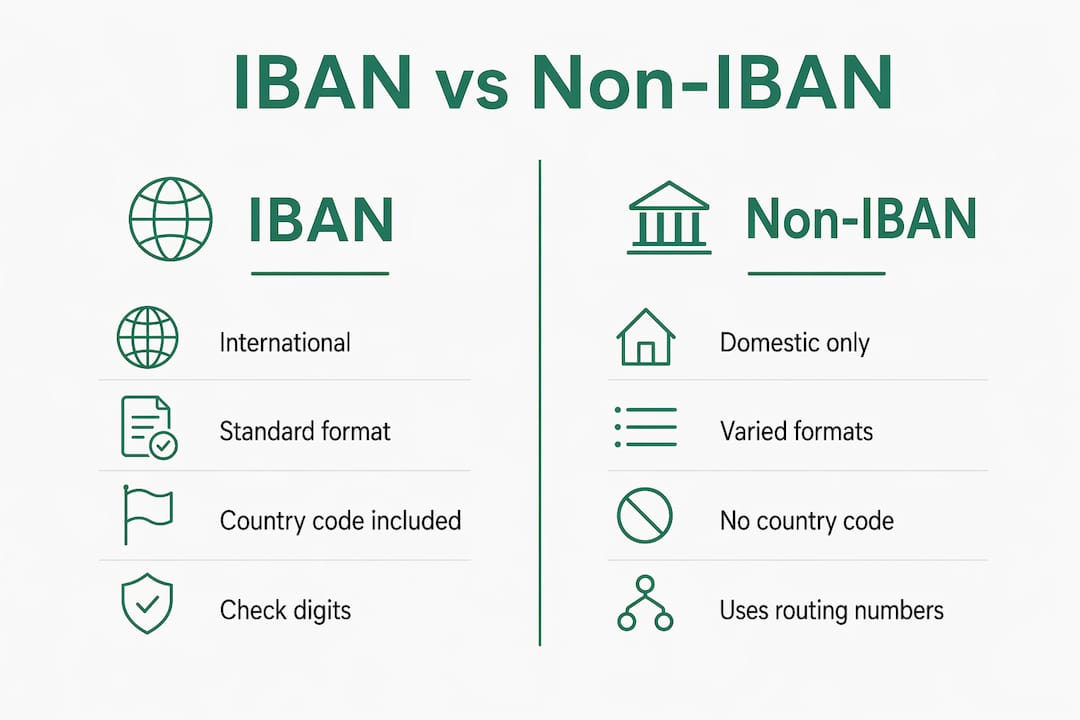
A few points worth clarifying. For SEPA transfers within the Eurozone, an IBAN alone (sometimes plus a BIC) is all you need. For SWIFT wires to non-IBAN countries like the U.S., you skip the IBAN entirely and supply the recipient's ABA routing number, account number, and the receiving bank's SWIFT/BIC. U.S. banks don't issue IBANs, so if someone asks for your IBAN and you bank in America, the honest answer is: you don't have one.
What does an IBAN actually contain?
The IBAN is built in three layers, and each one does a specific job.

Country code: Two uppercase letters identifying the country (GB for the United Kingdom, DE for Germany, ES for Spain). This tells the payment system which national format to expect in the rest of the number.
Check digits: Two numeric digits calculated using the mod-97 algorithm. Before a transfer is submitted, the sending system runs this calculation against the full IBAN string. If the result doesn't equal 1, the IBAN is invalid. This catches typos before money moves.
BBAN (Basic Bank Account Number): The country-specific portion that embeds the domestic account number along with branch identifiers and routing information. The BBAN format is decided by each country's central bank or designated payment authority, which is why IBANs look different from country to country.
Here's a sample UK IBAN broken down:
GB29 NWBK 6016 1331 9268 19
- GB = country code (United Kingdom)
- 29 = check digits
- NWBK = bank identifier (sort code prefix)
- 60161331926819 = sort code + account number (the BBAN)
Typical IBAN lengths by country
| Country | IBAN Length | Example format |
|---|---|---|
| Germany (DE) | — | DE + 2 check + 18-digit BBAN |
| United Kingdom (GB) | — | GB + 2 check + bank identifier + BBAN |
| Spain (ES) | — | ES + 2 check + 20-digit BBAN |
| France (FR) | — | FR + 2 check + BBAN |
Not every country follows the same BBAN structure. Some countries include their own national check digits within the BBAN itself, layered on top of the IBAN-level mod-97 check. Mexico, for example, uses a completely different system: the CLABE, an 18-digit standard used domestically and often required for international transfers to Mexican accounts.
How do U.S. bank account details work without an IBAN?
The United States runs on a different system entirely. U.S. banks use ABA routing numbers, a fixed-length numeric code, to identify the financial institution, and a separate account number to identify the individual account, the length of which varies by bank. These two numbers together are the domestic equivalent of what an IBAN packages into a single string.
For an international wire transfer into a U.S. account, a sender abroad needs three pieces of information:
Required details for an international wire to a U.S. account:
- ABA routing number, a fixed-length numeric code — identifies the receiving bank
- Account number — identifies the specific account
- SWIFT/BIC code of the receiving bank — routes the payment internationally
The SWIFT/BIC code is what connects the U.S. bank to the global messaging network. Without it, an international sender has no way to route the payment to the right institution. The ABA routing number alone only works within the U.S. domestic ACH and wire systems.
You can find your routing and account numbers on a paper check: the routing number is the first 9-digit string in the bottom-left corner, and the account number follows it. Most online banking dashboards display both under account details or settings.

Why didn't the U.S. adopt IBAN? The short answer is timing and scale. The U.S. banking system was already deeply standardized around ABA routing numbers and ACH before IBAN gained international traction, and the cost and complexity of migrating thousands of financial institutions to a new format never produced a compelling enough case.
| Feature | U.S. Domestic System | IBAN System |
|---|---|---|
| Institution identifier | ABA routing number, a fixed-length numeric code | Embedded in BBAN (bank/branch code) |
| Account identifier | Separate account number (variable) | Embedded in BBAN |
| International routing | SWIFT/BIC required separately | Country code in IBAN handles it |
| Validation | Bank-specific | Mod-97 universal check |
When does the IBAN vs. non-IBAN distinction actually matter?
The difference between these two account formats becomes critical the moment money crosses a border. Here's when each applies:
Situations that require an IBAN:
- Sending a euro payment within SEPA (covers 36 European countries)
- Wiring money to most European, Middle Eastern, or Caribbean bank accounts
- Receiving payments from European businesses or individuals who need to enter your account details into their banking system
Situations where SWIFT + domestic details is the right combination:
- Sending money to the U.S., Canada, Australia, Japan, China, or India — major economies that don't use IBAN
- Receiving international payments into a U.S. account (provide routing + account + SWIFT/BIC)
- Transfers to Mexico (use CLABE instead of IBAN)
What happens when you get it wrong:
- Submitting an incorrect IBAN can result in the payment being rejected outright, delayed while the bank investigates, or in the worst case, sent to an unintended account that happens to match the erroneous IBAN string
- Reversing a misdirected payment is slow, expensive, and not always successful
- Missing or wrong SWIFT/BIC codes on transfers to non-IBAN countries cause similar delays and rejection fees
Pro Tip: Before sending any international wire, confirm with the recipient's bank whether they require an IBAN, a SWIFT/BIC, or both. The answer depends on the destination country, not just the bank.
How do you find and validate an IBAN or domestic account number?
Finding your IBAN (if your bank issues one):
- Log into online banking and look under account details or account information
- Check a recent bank statement — IBANs are usually printed near the top
- Call your bank's customer service line and ask directly
Finding U.S. routing and account numbers:
- Bottom of a paper check (routing number first, then account number)
- Online banking dashboard under account settings
- Call your bank if you need to confirm the correct routing number for wire transfers specifically (some banks use a different routing number for wires vs. ACH)
Validating an IBAN:
Format validation using the mod-97 algorithm confirms that the IBAN string is structurally correct. Free online IBAN checkers run this calculation instantly. What format validation cannot do is confirm that the account belongs to the person you intend to pay. A structurally valid IBAN might belong to a completely different account holder.
For routine low-value payments, format validation is a reasonable starting point. For high-value or recurring business payments, it's not enough on its own.
Pro Tip: When setting up a new supplier or vendor payment, always verify the IBAN against the payee's name through a live verification service before the first transfer. Format checks catch typos; name verification catches fraud.
Why payee-name verification matters beyond format checks
Format validation is a floor, not a ceiling. Banks and payment experts consistently flag that matching IBAN format alone is insufficient for high-stakes payments — a structurally valid IBAN can still route funds to the wrong person if the account holder name doesn't match.
Consider a straightforward scenario: a finance team receives updated payment details from a supplier via email. The IBAN passes every format check. The payment goes through. But the email was a spoofed message from a fraudster who had substituted their own IBAN. The format was valid; the payee was wrong.
The core risk: An IBAN that passes mod-97 validation confirms the number is correctly structured — it does not confirm the account belongs to your intended recipient. Name-matching is a separate, necessary check.
For accounts payable teams, the practical recommendation is to combine format validation with live payee-name verification, especially for:
- New supplier onboarding
- Any payment detail change request received by email
- High-value or recurring transfers above your organization's risk threshold
Live payee-name verification checks the provided name against the actual account holder on the live payment network — a fundamentally different level of assurance than running a mod-97 calculation.
Pro Tip: Treat any emailed request to update payment details as high-risk by default. Verify the new IBAN against the payee name through a live check before processing the first payment to the new account.
What to do if you only have a domestic account number and no IBAN
If you're a U.S. sender trying to pay someone in an IBAN country, or a U.S. recipient trying to receive funds from abroad, here are the immediate steps:
- Ask the recipient for their full IBAN — not just the account number. Banks in IBAN countries can provide this instantly through online banking or a branch visit.
- Request the receiving bank's SWIFT/BIC code — this is required for international routing even when an IBAN is provided.
- Confirm the currency — some banks require a specific account type (e.g., a euro account) for SEPA transfers; sending USD to a euro IBAN account may trigger conversion fees.
- Ask about intermediary banks — for some corridors, your bank may route through a correspondent bank that charges its own fees. Confirm this upfront.
- Check what your own bank requires — U.S. banks sending international wires typically ask for: recipient name, recipient address, IBAN (or local account number), receiving bank name, receiving bank SWIFT/BIC, and sometimes the receiving bank's address.
If the counterparty is in a non-IBAN country and your bank's system requires an IBAN field, don't invent a pseudo-IBAN. Specialist money-movement services that operate between IBAN and non-IBAN systems can handle the format translation — your bank's international wire desk can point you to the right process for the specific destination country.
Pro Tip: For any new international payment relationship, send a small test transfer first and confirm receipt before processing the full amount. This costs a few dollars in fees and saves potentially thousands in recovery costs.
Key Takeaways
An IBAN wraps a domestic account number in an internationally standardized format; U.S. users rely on ABA routing numbers plus SWIFT/BIC for cross-border payments instead.
| Point | Details |
|---|---|
| IBAN structure | Country code + 2 check digits + BBAN; fixed length per country; validated by mod-97 algorithm. |
| U.S. equivalent | ABA routing number, a fixed-length numeric code + account number + SWIFT/BIC; no IBAN issued by U.S. banks. |
| When IBAN is required | SEPA transfers and most payments to European, Middle Eastern, and Caribbean accounts. |
| Format check limits | Mod-97 confirms structure only; it cannot verify the account belongs to your intended payee. |
| Vopify for AP teams | Vopify provides live name-plus-IBAN verification across 20 Eurozone countries in under two seconds, reducing fraud and misdirected payment risk. |
A note on what format checks miss
The conversation around IBANs tends to stop at structure: get the country code right, pass the mod-97 check, and you're done. That framing understates the real risk for anyone running a finance operation.
The mod-97 algorithm is genuinely useful. It catches transposition errors and obvious typos before a payment leaves your system. But it was designed in an era when the main threat was human error, not deliberate fraud. Today, the more common failure mode isn't a mistyped digit — it's a correctly formatted IBAN that belongs to the wrong person entirely.
What's underappreciated is how easy it is to pass format validation with a fraudulent IBAN. Any valid-looking string that satisfies the algorithm will clear that check. The only way to know the account belongs to your intended recipient is to match the name against the live account holder. That's a different check, requiring a different system.
For finance teams processing supplier payments or payroll across borders, the practical implication is clear: format validation is a starting condition, not a sufficient one. Combining it with live name verification is the step most organizations skip — and the one that actually closes the gap.
Vopify makes live IBAN and payee-name verification fast for finance teams
Knowing the structural difference between IBAN and non-IBAN account numbers is one thing. Verifying that the IBAN you've been given actually belongs to the person you intend to pay is another problem entirely — and it's the one that causes real financial losses.
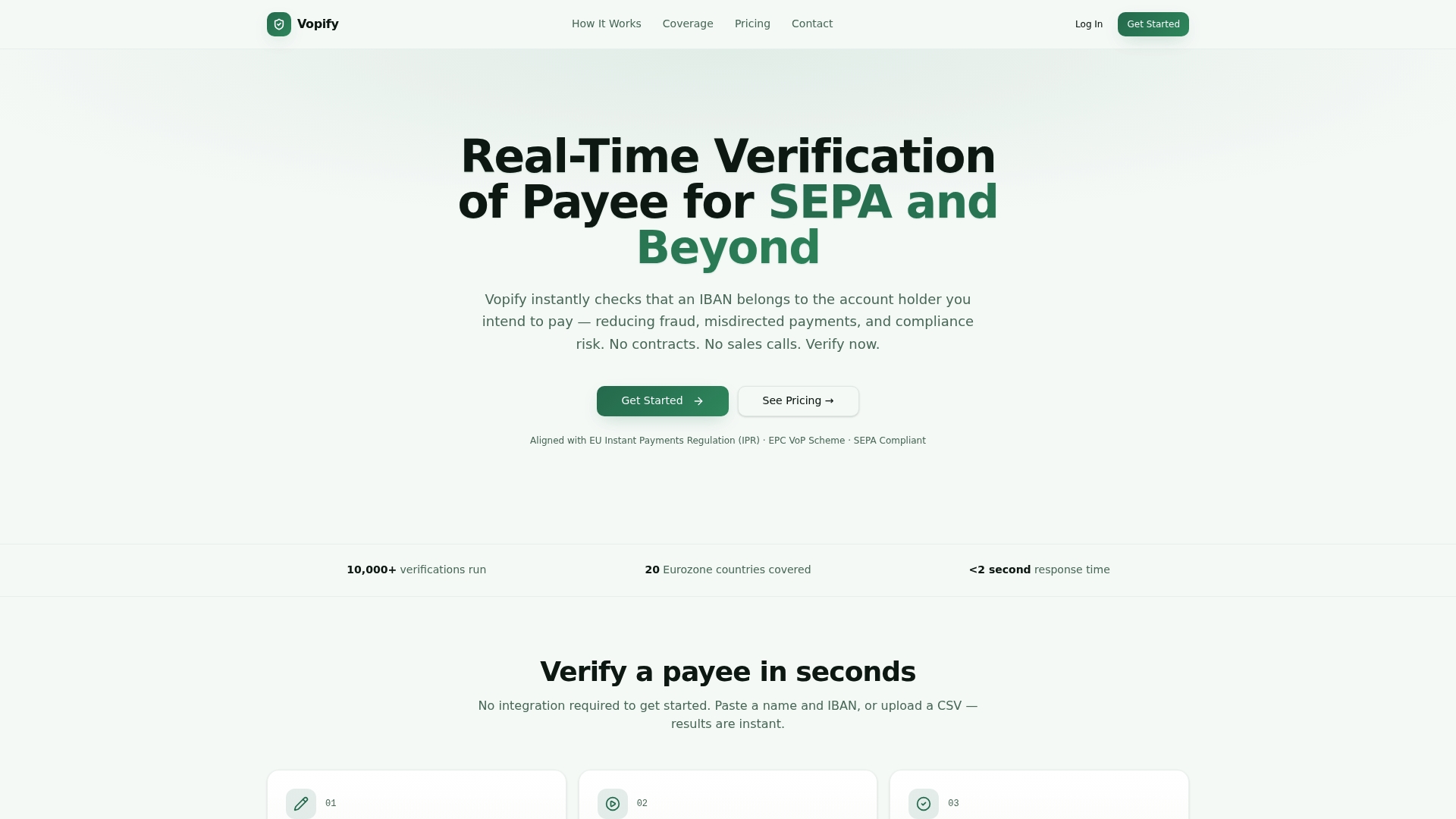
Vopify solves that second problem. It checks a provided IBAN against the account holder's name on live payment networks across 20 Eurozone countries, returning a result in under two seconds. No lengthy contracts, no manual bank calls — just a name and an IBAN, and you get an instant match or mismatch. Finance teams and accounts payable departments can run bulk IBAN verification via CSV upload for supplier onboarding or database audits, and Vopify's SEPA-compliant VoP service keeps you aligned with EU Instant Payments Regulation requirements. Pay-as-you-go credits mean no subscription commitment to get started.
Run your first IBAN verification at vopify.io and see the result in seconds.
Useful sources and further reading
- SWIFT IBAN standard page — the authoritative source for IBAN structure, the ISO 13616 registry, and country-specific format specifications. Start here for standards questions.
- SWIFT IBAN Registry (PDF) — the complete technical specification for every country's national IBAN format; useful for confirming exact lengths and BBAN structures.
- SWIFT BIC standard — explains BIC/SWIFT codes and how they complement IBANs for international routing.
- ISO 13616 standard — the formal ISO standard document for IBAN; reference for compliance and technical implementation.
- Wikipedia: International Bank Account Number — a well-maintained overview of IBAN adoption by country, format details, and the mod-97 validation method; good for a quick country coverage check.
- UK government guidance on sending money abroad — practical guidance on what details to provide for international transfers, including when IBANs are required.