
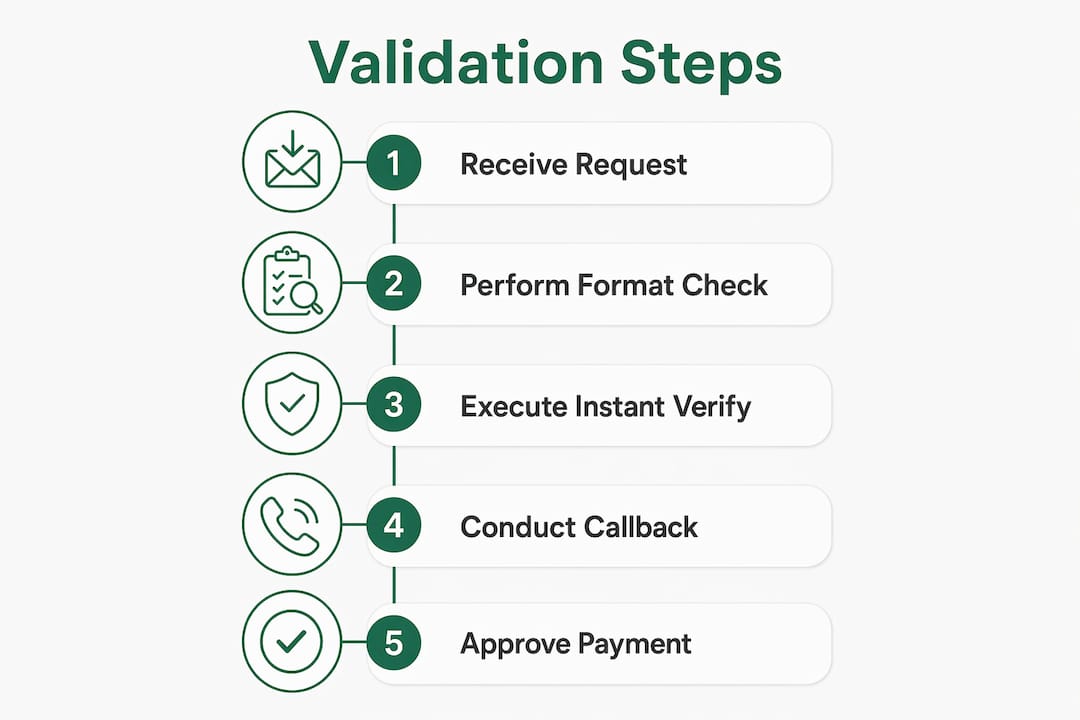
The most reliable way to validate a vendor bank account combines instant automated name-plus-account verification with a mandatory independent callback and two-person approval for any bank-detail change. No single check is enough. A fraudster can submit a legitimate, open account that passes a format check or even a prenote but fails the moment you match the account holder name against the vendor's legal name.
Here is a checklist your AP team can run today:
Immediate validation checklist:
- Verify routing number and account number format using the Federal Reserve's ACH directory or an equivalent lookup
- Run a real-time name-plus-account check to confirm the account holder matches the vendor's legal name
- Require all bank-detail submissions through a secure vendor portal, never by email or phone alone
- Call the vendor at the phone number already on file (not one supplied in the change request) to confirm the update
- Require two-person sign-off before any bank-detail change is saved to the vendor master file
When to run validation:
- New vendor onboarding
- First payment to any vendor
- Any bank-detail change request
- Reactivation after six or more months of inactivity
- All international wire payments, where recovery is significantly harder than domestic ACH
NACHA's rules on ACH account validation require first-use validation for consumer debit WEB entries and list commercially available validation services as acceptable options. For AP teams running high volumes of ACH payments, that regulatory baseline is the floor, not the ceiling.
Table of Contents
- Why validating vendor bank accounts matters more than most teams realize
- What validation methods actually check, and where each one falls short
- How real-time name-plus-account verification works, and what to look for
- A step-by-step AP workflow for onboarding and bank-detail changes
- How to implement bank-account validation: tools, integration, and costs
- What real-world performance looks like, and where automated checks have limits
- Key Takeaways
- Vopify brings real-time IBAN verification to your AP workflow
- Useful sources for policy drafting and further reading
Why validating vendor bank accounts matters more than most teams realize
Payment fraud targeting AP departments has one consistent entry point: a bank-detail change that nobody verified properly. Business Email Compromise (BEC) attacks work precisely because they exploit the gap between receiving a change request and actually confirming it with the real vendor.
The financial stakes differ sharply by payment rail. A misdirected domestic ACH payment can often be recalled within a short window, though recovery is not guaranteed and the process takes time. An international wire sent to a fraudulent account is nearly impossible to recover once it clears. That asymmetry alone justifies tighter controls on international payments.
The risks your validation process needs to address:
- Misdirected payments: Funds sent to the wrong account due to a typo, stale banking data, or a fraudulent change request
- Failed payments: Incorrect routing or account numbers cause returns, triggering reconciliation work and late-payment penalties
- Account existence vs. ownership fraud: An account can be valid and open but owned by a fraudster. Confirming ownership requires matching the account holder name to the vendor's legal name, not just checking that the account number is formatted correctly
- Audit exposure: Without documented verification steps and approval records, AP teams cannot demonstrate due diligence in a fraud investigation or SOX audit
- Reconciliation overhead: Payment failures and disputes consume staff time that scales poorly as vendor counts grow
The ownership gap is the one most teams underestimate. A prenote or format check tells you the account exists. It tells you nothing about who owns it.
What validation methods actually check, and where each one falls short
Not every method verifies the same thing. Choosing the right mix depends on what you need to confirm, how fast you need the answer, and how much volume you are processing.

| Method | What it verifies | Speed | Fraud resistance | Best use case |
|---|---|---|---|---|
| Routing/account format check | Format only, not existence or ownership | Instant | Very low | First-pass filter at data entry |
| Voided check / bank letter | Routing and account format, documentation | 1–3 days | Low (can be forged) | Low-volume onboarding, legacy workflows |
| ACH prenote (zero-dollar) | Account existence (usually not ownership) | 2–3 business days | Low for ownership | Existence confirmation only |
| Micro-deposits | Account access (not ownership) | 2–3 business days | Moderate | Onboarding when speed is not critical |
| Manual callback | Depends on quality of on-file contact data | Hours to days | Moderate when done correctly | Change requests, high-value vendors |
| Real-time name+account API | Existence, ownership, and account status | Seconds | High | Onboarding, change requests, bulk cleanup |
Key limitations to keep in mind:
- Voided checks confirm routing and account numbers but can be forged. Manual controls like bank letters carry the same weakness when used without a secondary check.
- Prenotes often do not return the account holder name. Many banks process them without sending back ownership data, so a prenote that clears tells you the account is open, not that it belongs to your vendor.
- Micro-deposits prove the vendor can access the account (they confirm the deposit amounts), but they do not confirm ownership. A fraudster with access to a compromised account can pass a micro-deposit check.
- Manual callbacks are only as reliable as your on-file contact data. If the fraudster has already changed the contact number in your system, the callback goes to them.
Pro Tip: Use format checks and real-time name+account verification together as a first pass, then layer micro-deposits or callbacks for high-value or high-risk vendors. No single method covers all three dimensions: format, existence, and ownership.
How real-time name-plus-account verification works, and what to look for
Real-time name-plus-account verification is the closest thing AP has to a definitive ownership check. Instead of waiting days for a prenote to clear or a micro-deposit to be confirmed, an API or dashboard service queries live payment network data and returns a match result, typically in under two seconds.
The check works by submitting the vendor's account number (or IBAN for international payments) alongside the account holder name. The service compares those details against bank network data, open banking connections, or consortium records and returns a result: match, close match, no match, or inconclusive. A "close match" result usually means a minor name variation (an abbreviated legal name, for example) and warrants a manual review rather than an automatic rejection.
What a solid real-time verification service should confirm:
- Account exists and is currently active (not closed or frozen)
- Account holder name matches the vendor's legal name
- Routing number or IBAN is valid and corresponds to an active financial institution
- Result is logged with a timestamp and reference ID for audit purposes
Trust signals to require when evaluating a vendor:
- Alignment with NACHA's account validation guidance for ACH-originated payments
- Audit logs that capture every check, result, and user action
- Domestic U.S. ACH coverage plus international rails (SEPA, RTP, and others) for teams with global supplier bases
- Response time under two seconds for high-volume workflows
- Clear data privacy and security controls (SOC 2, encryption at rest and in transit)
- Pricing transparency: per-check credits or subscription tiers, not opaque enterprise contracts
Automated third-party validation services reduce fraud risk and scale better than manual processes, supporting instant verification at onboarding and during change requests. The audit log alone is worth the cost for any team subject to SOX or internal control reviews.
The one thing real-time checks cannot always resolve: joint accounts and some international banks where privacy regulations limit the data returned. In those cases, the service returns "inconclusive" rather than a match or no-match, and a manual fallback is required.

A step-by-step AP workflow for onboarding and bank-detail changes
The workflow below separates new vendor onboarding from bank-detail change requests because the fraud risk profile is different. Change requests are higher risk: the vendor relationship already exists, which makes a fraudulent request easier to disguise.
New vendor onboarding
- Collect bank details through a secure vendor portal. Never accept bank details by email, fax, or phone. The portal creates a timestamped submission record.
- Run an instant name-plus-account check. Submit the account holder name and routing/account number (or IBAN) to your verification service. A match result clears the vendor for the next step; a no-match or inconclusive result triggers manual review.
- Apply a micro-deposit as a fallback for vendors where the real-time check returns inconclusive. Confirm the deposit amounts with the vendor before proceeding.
- Lock verified details in the vendor master file. Only authorized AP staff should be able to modify banking data, and every change should require a new verification cycle.
- Apply first-payment controls. Route the first payment to a new vendor through an additional approval step, regardless of dollar amount.
Bank-detail change requests
- Require portal submission only. Reject any change request that arrives by email or phone, even if it appears to come from a known contact.
- Call the vendor at the phone number already on file. Not the number in the change request. Confirm the request is legitimate before touching the vendor master file.
- Run a new real-time name-plus-account check against the updated details. A validation status of "failed" or "inconclusive" should pause the change, not just flag it.
- Require two-person approval. The person who receives the change request should not be the person who approves it. Segregation of duties is the single most effective social-engineering control.
- Hold payments until verification clears. Do not process any payment to the new account until the full approval chain is complete and documented.
Red flags that require immediate escalation:
- The email domain in the change request differs from the vendor's known domain
- The request creates urgency around payment timing ("please update before end of day")
- New contact details accompany the bank-detail change
- The vendor has been inactive for more than six months
- The request arrives outside normal business hours or from an unfamiliar sender
Pro Tip: Set a calendar-based re-verification trigger for any vendor inactive for six or more months. Stale banking data is a fraud vector that most AP teams discover only after a failed payment.
How to implement bank-account validation: tools, integration, and costs
Getting a validation solution live is a project, not a purchase. The integration path you choose determines how quickly you can validate at scale and how cleanly the results feed into your approval workflow.
Integration options and their trade-offs:
- API integration: Fastest results, fully automated, and the only option that scales to high volumes without manual intervention. Requires developer time to connect to your ERP or payment system. Best for teams processing hundreds of vendor changes per month.
- Dashboard / manual portal: No development work required. An AP staff member submits details and reads results. Works well for low-to-moderate volumes and for teams piloting a new service before committing to a full API build.
- Bulk CSV upload: Upload a file of vendor records and receive results in batch. Ideal for one-time vendor master cleanups or periodic re-verification campaigns. Bulk verification is also the fastest way to audit an existing supplier database for stale or unverified records.
- Native ERP integration: Some platforms surface validation results directly in the supplier registration or profile-change workflow, showing Verified/Failed/Inconclusive status to approvers. ERP-integrated validation reduces the risk of an approver missing a failed check because the result appears inline, not in a separate system.
Vendor selection checklist:
- Coverage: Does it support your payment rails? (Domestic ACH, SEPA, RTP, international wires)
- Speed: Sub-two-second response for real-time use cases
- Audit logs: Timestamped records of every check, result, and user action
- Security: SOC 2 certification, encryption at rest and in transit, data retention policy
- Pricing: Per-check credits vs. subscription tiers, and whether bulk CSV is included
- Support: SLA for API uptime and a support channel for inconclusive results
Typical rollout timeline:
| Phase | Activity | Typical duration |
|---|---|---|
| Pilot | Dashboard testing on 20 high-risk vendors | 1–2 weeks |
| Integration | API or ERP connector build and testing | 2–6 weeks |
| Full rollout | All new onboarding and change requests | Week 6 onward |
| Cleanup | Bulk CSV re-verification of existing vendor master | Parallel or post-rollout |
On cost: per-check pricing suits low-volume teams or those running periodic audits. A subscription model makes more sense once you are running verification on every new vendor and every change request, because the per-unit cost drops and the budget is predictable. Internal staffing costs for manual verification (callbacks, document review, reconciliation of failed payments) often exceed the cost of an automated service once you account for the full time burden.
Data and privacy considerations matter here too. Any service you use will be processing vendor banking data, so confirm how long it retains records, whether it shares data with third parties, and how it handles data subject requests. For SOX purposes, your audit trail needs to show who ran each check, when, what result was returned, and who approved the subsequent action.
What real-world performance looks like, and where automated checks have limits
Real-time name-plus-account verification is fast. Services operating on live bank network data return results in under two seconds for the majority of checks. Vopify processes verifications across multiple Eurozone countries with a sub-two-second response time and has handled thousands of verifications on its platform.
NACHA's guidance does not mandate a specific response time, but its account validation framework treats commercially available validation services as acceptable for first-use validation of ACH debit entries, which implicitly sets an expectation of timely, documented results.
Where automated checks return inconclusive results:
- Joint accounts, where the name on the account may not match either party's legal name exactly
- Some international banks that do not participate in open banking or consortium data networks
- Accounts held under a trading name rather than a legal entity name
- Privacy-limited rails where the bank returns a binary "match/no match" without detail
An inconclusive result is not a failure. It means the automated check could not confirm ownership, and a manual fallback is required. The right response is to escalate to a callback and, for high-value vendors, request a bank letter or official documentation.
How to cover the gaps:
- Pair every automated check with a documented callback policy for inconclusive results
- For international vendors on rails with limited name-matching capability, require a bank letter or official bank confirmation alongside the automated check
- Log every inconclusive result and the manual steps taken to resolve it. That log is your audit trail if a payment is later disputed.
The combination of automated checks for speed and manual controls for edge cases gives AP teams both the efficiency of real-time verification and the defensibility of a documented process.
Key Takeaways
Automated name-plus-account verification combined with mandatory callbacks and two-person approval is the most effective and auditable approach to vendor bank account validation.
| Point | Details |
|---|---|
| Use real-time name+account checks | Instant verification confirms account existence, active status, and owner name match in under two seconds. |
| Require portal-only bank changes | Never accept bank-detail updates by email or phone; portal submissions create a timestamped, auditable record. |
| Enforce two-person approval | Segregation of duties on bank-detail changes is the single most effective control against social engineering. |
| Re-verify after six months of inactivity | Stale banking data is a fraud vector; set a calendar trigger for vendors inactive six or more months. |
| Vopify for instant IBAN verification | Vopify delivers sub-two-second name-plus-IBAN checks across 20 Eurozone countries, with bulk CSV and audit logs for compliance. |
What most AP teams get wrong about vendor bank validation
The conventional wisdom says "add more checks." Run a prenote, get a voided check, do a callback. Layer enough steps and you are covered. That logic sounds right, but it misses the actual attack vector.
Most successful vendor fraud does not beat the verification process. It bypasses it. A fraudster who sends a convincing email from a spoofed domain, creates urgency around a payment deadline, and reaches an AP coordinator who is busy and behind on approvals does not need to defeat your prenote. They need you to skip it.
The single policy change that makes the biggest difference is not a better verification tool. It is making the callback to an on-file number non-negotiable, every time, for every bank-detail change, with no exceptions for urgency or seniority. Automated checks are faster and more accurate than manual methods, but they are most valuable when they are part of a process that cannot be socially engineered around.
When rolling out a new validation tool, the teams that see the fastest adoption pilot on their highest-risk vendor segment first, typically international vendors or those with recent change requests, and build a simple supplier communication plan so vendors know what to expect. Resistance usually comes from the AP team itself, not from vendors. The fix is showing staff the fraud cases the process is designed to prevent, not just the new steps they have to follow.
Instant checks also reduce payment exceptions in practice. When a name-plus-account check catches a mismatch at onboarding rather than after a failed payment, the reconciliation work disappears entirely. That is a quieter benefit than fraud prevention, but it compounds across hundreds of vendor records.
Vopify brings real-time IBAN verification to your AP workflow
Manual verification backlogs and email-based bank-detail changes leave AP teams exposed. Vopify closes that gap with instant name-plus-IBAN verification that returns a match result in under two seconds, covering 20 Eurozone countries and additional rails including India, Indonesia, South Korea, and China (Alipay).
For teams running periodic vendor master audits or onboarding large supplier batches, bulk CSV verification lets you upload thousands of vendor records and receive verified, auditable results without building an API integration first. When you are ready to embed verification directly into your onboarding workflow, API access is available for high-volume programmatic use. Every check produces a logged result with a timestamp, giving your compliance and audit teams the documentation trail they need.
Pricing runs on pay-as-you-go credit bundles or tiered subscriptions, so you pay for what you use rather than committing to an enterprise contract. Start with a sample CSV of your highest-risk vendors and see results in minutes at vopify.io.
Useful sources for policy drafting and further reading
- NACHA Account Validation Resource Center: The authoritative U.S. source for ACH account validation rules, acceptable methods, and first-use validation requirements. Use this when drafting your AP policy and when evaluating whether a validation service meets regulatory expectations.
- Federal Reserve ACH Routing Directory: The primary lookup for U.S. routing number validity. Use it as a first-pass format check before running a full name-plus-account verification.
- The Clearing House ACH: Background on the ACH network and payment system rules; useful for understanding the rails your domestic vendor payments travel on.
- The Clearing House UID Lookup: Routing number lookup tool for confirming financial institution identity.
- SWIFT IBAN Standard: The definitive reference for IBAN structure and country-specific formats; use when onboarding international vendors or validating IBAN format before submitting to a verification service.
- Vopify IBAN Verification: Product page covering global IBAN verification capabilities, supported countries, and technical integration options.
- Vopify Verification of Payee (VoP): Details on SEPA-compliant VoP functionality and EU Instant Payments Regulation alignment; relevant for teams with European supplier bases.