
What is an IBAN and what does it mean for your bank account?
IBAN stands for International Bank Account Number. It is a standardized code that uniquely identifies a bank account across national borders, making it possible for banks worldwide to process cross-border payments accurately and automatically. Think of it as a universal address for your bank account, one that any bank in any participating country can read and route correctly.
The IBAN system was originally developed by the European Committee for Banking Standards and adopted as the international standard ISO 13616 in 1997. Its core job is simple: replace the patchwork of incompatible domestic account formats with a single, globally recognized structure.
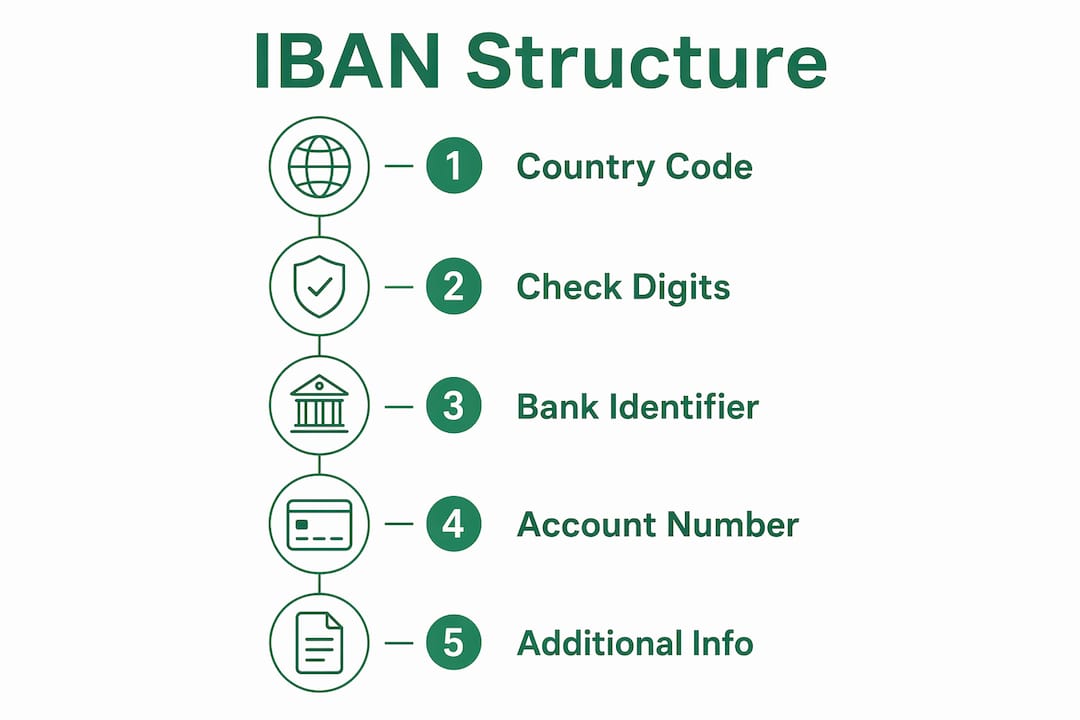
Every IBAN is built from three core components:
- Country code: A two-letter code identifying the account's home country (for example, "GB" for the United Kingdom or "DE" for Germany)
- Check digits: Two numeric digits that allow banks to verify the number's integrity before processing a payment
- BBAN (Basic Bank Account Number): The domestic account details, including bank identifiers, branch codes, and the account number itself
One thing worth knowing upfront: not every country uses IBAN. The United States, for example, does not issue IBANs. If you are a US customer sending money abroad, you will need to understand how IBAN fits into the transaction even when your own account lacks one.
How an IBAN is structured and formatted
An IBAN contains up to 34 alphanumeric characters, though the actual length varies by country. Germany uses 22 characters; the United Kingdom uses 22 as well; France uses 27. No IBAN ever exceeds 34 characters.
The structure always follows the same sequence: country code, then check digits, then the BBAN. What changes from country to country is the BBAN portion, because each nation's central bank or payment authority decides its own domestic format.

| Component | Length | Example (UK IBAN) | Description |
|---|---|---|---|
| Country code | two-letter code | GB | two-letter country code |
| Check digits | two numeric digits | 29 | Validates the full IBAN using modulo-97 |
| Bank identifier | Varies | NWBK | Identifies the specific bank |
| Sort code / branch | Varies | — | Routes to the correct branch |
| Account number | Varies | — | The individual account |
A full UK IBAN looks like this: GB29 NWBK 6001 6131 9268 19. A German IBAN follows a different BBAN pattern: DE89 3704 0044 0532 0130 00. Both obey ISO 13616 rules, but the internal layout of the BBAN differs completely.
The check digits are calculated using the modulo-97 method defined in ISO 7064. When you submit a payment, the receiving bank runs this calculation instantly. If the result does not equal 1, the IBAN is flagged as invalid before any money moves. That single check catches most data entry errors before they become rejected payments.
Pro Tip: When you write or type an IBAN, group the characters in sets of four separated by spaces (e.g., GB29 NWBK 6001 6131 9268 19). This is the standard print format and makes it much easier to spot transcription errors.
Why IBANs matter for international banking
The IBAN's biggest contribution to international banking is automation. Before a shared standard existed, banks had to manually interpret dozens of incompatible domestic account formats, a process that was slow, expensive, and error-prone. SWIFT, which serves as the official registration authority for IBAN formats under ISO 13616, built the standard specifically to let payment systems read and route accounts without human intervention.

By December 2024, 89 countries had adopted the IBAN numbering system, concentrated mainly in Europe and the Middle East. That reach means a payment originating in France can reach a bank in Jordan with the same automated process it would use for a domestic transfer.
The practical benefits are real and measurable:
- Fewer rejected payments: Check digit validation catches errors at the point of entry, not after the wire has been sent
- Faster processing: Automated routing removes the manual review step that delays international transfers
- Global standardization: Every IBAN-compliant account follows ISO 13616, so banks do not need country-specific processing rules for each destination
- Reduced costs: Less manual intervention means lower processing fees for banks and, often, for customers
Banking experts consistently point to the check digit pre-validation as IBAN's most practical feature. A mistyped digit gets caught before the payment leaves your bank, not three days later when a correspondent bank returns the wire.
One important caveat: an IBAN identifies an account, not the person who owns it. IBAN acts as an account address, not a guarantee that the right person receives the money. Verifying the account holder's name alongside the IBAN is a separate step, and one that matters a great deal for fraud prevention.
Does the US use IBAN? What American customers need to know
The United States does not use the IBAN system. US bank accounts have no IBAN, and American banks do not issue them. This creates a specific challenge when US customers send or receive international transfers involving IBAN countries.
Here is what that means in practice:
- Sending money to an IBAN country: You will need to provide the recipient's full IBAN, along with the recipient bank's SWIFT/BIC code. Your US bank uses the SWIFT network to route the payment; the destination bank uses the IBAN to credit the correct account.
- Receiving money from an IBAN country: The sender will ask for your bank's SWIFT/BIC code and your domestic account number and routing number. You cannot give them an IBAN because you do not have one.
- Common confusion: Some international payment forms have a mandatory IBAN field. If you are a US customer, contact the sender and explain that US accounts use routing numbers and account numbers instead. Most international banks and payment platforms are familiar with this.
- What to provide instead: Your nine-digit ABA routing number, your account number, and your bank's SWIFT/BIC code cover everything a foreign bank needs to send you money.
The absence of IBAN in the US is not a gap in the system. The US relies on the Fedwire and ACH networks domestically, and on SWIFT for international transfers, which works fine for cross-border payments. The friction only appears when a foreign sender's system expects an IBAN field and your account simply does not have one.
IBAN vs. SWIFT/BIC codes: what is the difference?
People often confuse IBANs and SWIFT/BIC codes because both appear on international payment forms. They do different jobs.
An IBAN identifies the individual account. It tells the receiving bank exactly which account to credit, down to the branch and account number. A SWIFT/BIC code identifies the bank itself, not any specific account within it. BIC stands for Business Identifier Code, and it is the address of the financial institution in the SWIFT network.
Key differences at a glance:
- What it identifies: IBAN points to a specific account; SWIFT/BIC points to a specific bank
- Format: IBAN is up to 34 alphanumeric characters; SWIFT/BIC is 8 or 11 characters
- Who uses it: IBAN is used in 89 countries, mainly Europe and the Middle East; SWIFT/BIC is used globally, including the US
- Purpose in a transfer: SWIFT routes the payment between banks; IBAN routes it to the correct account within the destination bank
For most international wire transfers, you need both. The SWIFT/BIC gets the payment to the right bank; the IBAN gets it to the right account. Providing only one of the two is a common reason international transfers fail or get delayed. Bank-grade validation processes at the receiving institution check both identifiers before crediting funds.
SWIFT also plays a structural role beyond routing individual payments. As the registration authority for ISO 13616, SWIFT maintains the official IBAN Registry, which documents the exact BBAN format for every participating country. When a bank needs to validate whether a foreign IBAN is correctly formatted, that registry is the reference.
Where to find your IBAN
If your bank account is in an IBAN country, finding your IBAN is straightforward. Banks are required to provide it, and it appears in several standard places.
- Bank statement: Your IBAN is printed on paper and electronic statements, usually near the top alongside your account name and sort code
- Online banking portal: Log in and navigate to account details or account information. Most European and Middle Eastern banks display the IBAN prominently on the account summary page
- Mobile banking app: The same account details section in your bank's app will show the IBAN, often with a copy button for convenience
- Official bank correspondence: Letters confirming account opening or annual account summaries always include the IBAN
- IBAN calculator tools: Some banks and financial websites offer tools where you enter your domestic account number and sort code to generate the corresponding IBAN. Use only your own bank's official tool or a tool from a recognized financial institution
If you bank in the United States and need to receive a payment from abroad, skip the IBAN search entirely. Provide your routing number, account number, and your bank's SWIFT/BIC code instead.
Pro Tip: Never share your IBAN publicly or in unsolicited communications. While an IBAN alone cannot be used to withdraw money from your account, it does reveal your bank and account details, which can be used in social engineering or phishing attempts.
One nuance that catches people off guard: even a correctly formatted IBAN does not confirm the account belongs to the person you intend to pay. The IBAN validation process checks the number's mathematical integrity, not the account holder's identity. For businesses processing supplier payments or payroll, that gap is where fraud and misdirected payments happen. Verifying the payee's name against the IBAN, not just the IBAN itself, is the step that closes it.
Key Takeaways
An IBAN is a standardized international account identifier that automates cross-border payment routing, but it does not verify who owns the account, making name verification an essential companion step.
| Point | Details |
|---|---|
| IBAN definition | International Bank Account Number; uniquely identifies a bank account for cross-border transfers under ISO 13616. |
| Structure | Up to 34 characters: two-letter country code, two check digits, and a country-specific BBAN. |
| Global adoption | 89 countries used IBAN by december 2024, concentrated in Europe and the Middle East. |
| US banking | The US does not issue IBANs; American customers use routing numbers, account numbers, and SWIFT/BIC codes instead. |
| IBAN vs. SWIFT/BIC | IBAN identifies the individual account; SWIFT/BIC identifies the bank. Both are typically required for international wire transfers. |
Why IBAN verification goes beyond the number itself
Knowing what an IBAN means is one thing. Knowing whether the IBAN you have actually belongs to the person you intend to pay is another problem entirely. A valid IBAN format tells you the number is mathematically correct. It does not tell you whether the account holder's name matches your records.
Vopify solves exactly that problem. Enter a name and an IBAN, and Vopify checks live payment networks across 20 Eurozone countries, returning a match result in under two seconds. Finance teams and accounts payable departments use it to catch mismatches before a payment is sent, not after a wire has gone to the wrong account. For high-volume supplier onboarding, the bulk IBAN verification tool handles CSV uploads so teams can screen thousands of payees at once without manual lookups. For businesses operating in the UK, Confirmation of Payee checks run against UK bank accounts directly.
Visit Vopify to run your first verification and see how fast the gap between "valid IBAN" and "correct payee" can be closed.