
A payee match rate is the share of payee checks in which the name you hold for a recipient matches the name on the account you are about to pay. The formula is simple: matched checks divided by total checks. What counts as a "match" depends on who runs the check, so the number only means something once you know the definition behind it and what you do with the misses.
This guide explains how to calculate the rate, why two providers can report different numbers for the same supplier file, what drives mismatches, and how U.S. finance teams can raise the rate and handle the exceptions.
TL;DR
- Payee match rate = matched checks ÷ total checks. Track it by outcome (match, close match, no match, could not check), not as one blended figure.
- There is no universal scoring standard. The European Payments Council lets each responding provider apply its own criteria.
- In the U.S., ACH posting runs on the account number, so name matching works as a fraud and validation control, not a settlement rule.
- Most low match rates come from messy master data: legal versus trading names, abbreviations, transliteration and typos.
- Treat a close match as a prompt to confirm through a second channel, never as an approval.
Table of Contents
- What a payee match rate actually measures
- How to calculate it
- Why the same file can give different match rates
- What pulls the match rate down
- How to raise your match rate
- What to do with a close match or a mismatch
- How U.S. rules differ from the EU's Verification of Payee
- Perspective: why we think the check belongs before the payment run
- Run the check on your own supplier file
- A simple monthly routine
- FAQ
- Sources
What a payee match rate actually measures
Every payee check asks one question: does the person or company I think I am paying own this account? The match rate reports how often the answer is yes.
The term also appears in other settings, which causes confusion. In Treasury payment processing, Federal Reserve Financial Services exception guidance distinguishes outcomes such as Payment Posted-Payee Match from Payee Not Matched, depending on whether the receiving account belongs to the intended payee or a representative payee. That is a post-payment exception category. The rate this article covers is measured before money moves, on your own supplier, vendor or beneficiary data.
In plain terms, the payee is the party meant to receive the transfer. The CFPB uses the word "recipient" for the same role.
How to calculate it

Start with a fixed population of checks, usually one batch or one month. Sort each result into an outcome. The EPC framework uses four: Match, Close Match, No Match and unable to match. Then compute each outcome as a share of the total.
Here is a worked example with made-up numbers, for illustration only. Suppose an accounts payable team checks 1,000 suppliers before a quarterly payment run:
| Outcome | Count | Share of checks |
|---|---|---|
| Match | 870 | 87% |
| Close match | 70 | 7% |
| No match | 40 | 4% |
| Could not check | 20 | 2% |
The headline match rate is 87%. A more useful figure is the "resolved" rate, meaning matches plus close matches you confirmed by a second channel, divided by checks. If you confirm 60 of the 70 close matches, the resolved rate is 93%. The 4% of no matches are the payments you hold.
Track two further numbers alongside it:
- Exception age: how many days a flagged supplier sits unresolved before payment is released or cancelled.
- Repeat offenders: suppliers that flag in every run. They usually point to a master data problem, not a fraud problem.
Why the same file can give different match rates
Blended match rates are not comparable across tools, banks or countries. The EPC's October 2024 recommendations explain that the responding provider stays responsible for the result and may apply its own criteria for Match, Close Match, No Match or inability to match.
The European Banking Authority's 2025 paper on matching checks makes the same point from the industry side. It notes that different provider logic can produce inconsistent results, and that diacritics, transliteration, habitual names, names on formal documents, corporate naming variations and special characters all affect match quality.
What this means in practice:
- Compare match rates only on the same file, with the same tool, over time.
- When you benchmark vendors, run an identical sample through each and look at the split between outcomes, not the single percentage.
- Ask how a close match is defined before you set an approval policy around it.
What pulls the match rate down
Name matching is hard because names vary so much. Nacha's 2023 account validation white paper says individual and company names have endless variations, and that wrong routing or account numbers cause errors too. In its survey, around 90% of respondents wanted to confirm a valid routing number and a valid account number for it. Close to 80% wanted some form of name match and a check that the account could receive ACH debits and credits.
In day-to-day supplier files, the usual culprits are:
- Legal name versus trading name. Your vendor master says "Northwind Supply" while the account is held by "Northwind Supply Holdings LLC". The EPC recommends that matching can accept a reliable commercial name for a legal person, but only when the responding provider holds that information.
- Abbreviations and suffixes. Inc., Incorporated, Ltd, GmbH, S.A., "&" versus "and".
- Transliteration and diacritics. Names written in non-Latin scripts, or with accents, can be stored differently on each side. The EPC notes that systems commonly normalize case, diacritics, punctuation, honorifics and stray spaces before comparing.
- Individuals' names. First and last names are usually compared. Nicknames, middle names, married names and swapped name order cause close matches.
- Typos and stale data. A transposed digit in an account number is a different account entirely, so the name will not match.
- Joint or sole-proprietor accounts. The person you know is not always the account title.
How to raise your match rate
Most of the gain comes before you run a single check.
Clean the vendor master first
Store the exact legal name as it appears on the supplier's registration or bank letter, and keep trading names in a separate field. The EPC recommends that payees give payers their exact and complete official name to reduce unnecessary no-match responses. Put that line in your onboarding form: ask for the legal name and a bank letter or voided check, not just an invoice header.
Verify at onboarding and again at change
Run the check when a supplier is created and whenever bank details change. A bank detail change is the classic trigger for business email compromise, so it deserves a check and a callback to a number you already hold.
Check before you pay, not after
Nacha recommends account validation before ACH transactions. Its paper says validation can reduce returns caused by mistyped account numbers and fraudulent payments that involve deliberately wrong account numbers. The cost of skipping it is also spelled out there: returned transactions, bank fees, delayed payroll, failed supplier payments, late collections, customer service costs and damaged relationships.
Segment your reporting
Report by supplier type, country and onboarding channel. A 95% rate for domestic corporate suppliers and 70% for overseas sole traders tells you where to put your cleanup time.
What to do with a close match or a mismatch
The right response depends on the result.
| Result | What it usually means | What to do |
|---|---|---|
| Match | Name and account agree under the provider's criteria | Pay, and log the check |
| Close match | Minor difference, such as a suffix, abbreviation or spelling | Confirm the exact name with the supplier through a known contact, then update the record |
| No match | Name and account disagree | Hold the payment, contact the supplier on a verified channel, never use contact details from the email that asked for the change |
| Could not check | Account type or country not supported, or the provider could not respond | Use an alternative control, such as a bank letter and a callback |
U.S. guidance supports a measured response. Nacha's 2022 risk guidance advises using name comparison alongside other flags when a payment is escalated for review, and says further research may be needed to decide whether it is fraud or should be posted as received. In the same guidance, Nacha says name matching on every transaction in a high-volume batch ACH environment is generally untenable. Complex spellings, nicknames and middle names would create unmanageable false positives, so it is more useful after other risk signals fire. You can read that in its risk-based controls guidance.
The practical conclusion: use the name result as one signal among several. ACH fraud prevention tools are built on the same layered idea, combining name checks with transaction behavior rather than relying on one rule.
Nacha's July 2024 operations bulletin adds a specific pattern. A mismatch between the name field and the account name, especially when one account suddenly receives credits under many different names, may indicate a credit-push fraud scheme. It should be read together with velocity and anomaly controls.
If money has already gone to the wrong place, speed matters. The CFPB advises contacting the provider immediately to correct the recipient name, account number or institution, and warns that a wrong account or routing number can lead to lost funds. It also recommends checking account numbers and the spelling of the recipient's name before sending.
How U.S. rules differ from the EU's Verification of Payee
In the EU, Verification of Payee is a scheme in which the sender's provider asks the recipient's provider whether the name and IBAN agree, and warns the sender of a mismatch before the payment goes out. Match, close match and no match are formal outcomes.
The U.S. has no equivalent rule across the board. The Nacha bulletin states that ACH rules allow a receiving bank to rely solely on the account number when posting an entry. They do not require receiving banks to do name matching, or let them return an entry only because a name is not in the voluntary format. So for domestic ACH, a payee name match rate is mainly a fraud-monitoring and validation metric, not a condition of settlement.

Things are moving, though. Federal Reserve Financial Services said Payee Name Verification would be the latest addition to FedDetect Notification Services, letting financial institutions verify the beneficiary name tied to an intended payment account. See the 2026 fees and enhancements notice.
For consumer remittances sent abroad, Regulation E's remittance transfer rule matters. Where a sender gives an incorrect account number or institution identifier, a provider's exception depends on conditions including advance notice, reasonable verification measures and reasonable efforts to recover misdirected funds.
If your U.S. company pays suppliers in Europe, you will meet the EU's matching outcomes whether or not your domestic rails use them. That is where a dedicated check on the payee's name and IBAN earns its keep.
Perspective: why we think the check belongs before the payment run
We built Vopify because name-to-account matching should not need a contract, a platform fee or an integration project. A finance team should be able to type a name and an IBAN and get an answer in seconds.
Our view of match rate is simple: the number is only as good as the action it triggers. A dashboard that says 92% is not protecting anyone. A workflow that holds the other 8% until someone confirms the details is.
That is why we focus on instant results for individuals and businesses, single lookups for the urgent invoice and bulk CSV uploads for a whole supplier file. Checking the file before the run, rather than finding errors after the money has moved, is the cheapest control an accounts payable team can add.
We also think the definition problem is real. Because providers score matches differently, we encourage teams to look at outcomes, not one blended percentage, and to track them over time on their own data.
David
Run the check on your own supplier file
Vopify verifies that the name you hold matches the account holder behind an IBAN, for individuals and businesses. Results come back in seconds from live payment networks, and our coverage includes the Eurozone's SEPA countries, India, Indonesia, South Korea and China (Alipay). It fits teams that pay European and Asian suppliers from the U.S. and want a match rate they can measure before the payment run.
Pricing is published: $0.70 to $1.00 per verification on pay-as-you-go, or monthly plans at $240 (Starter), $750 (Growth) and $2,000 (Scale). Use a single lookup for one urgent invoice, or upload a CSV for the whole file.
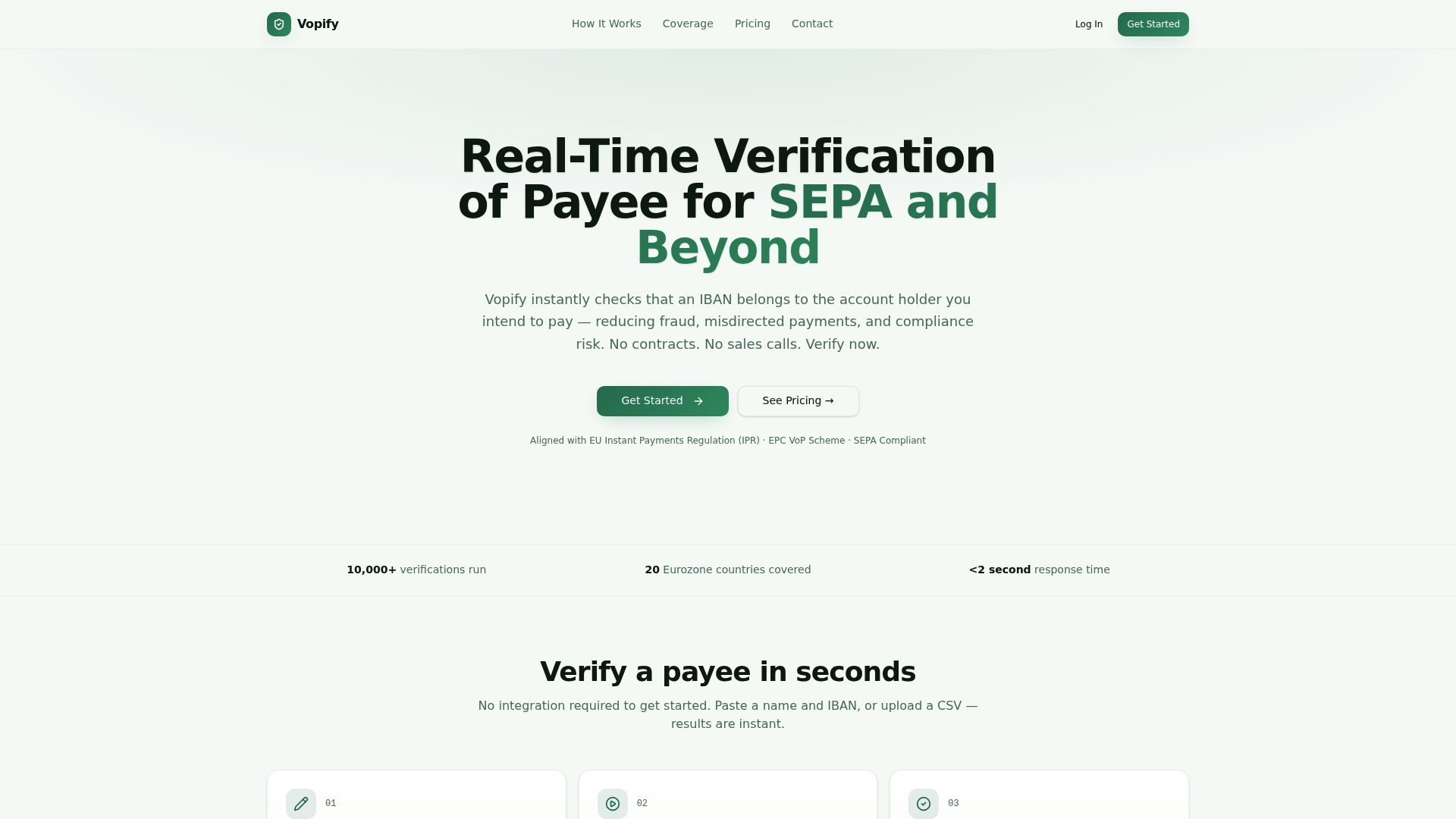
Start on the Vopify site, or go straight to bulk IBAN verification if you have a supplier list to check. If your team works through AI assistants, see the Vopify MCP integration. API access for programmatic, high-volume checks is planned.
A simple monthly routine
- Export active suppliers with their legal names and bank details.
- Verify the file and sort results into match, close match, no match and could not check.
- Resolve close matches by confirming the exact legal name with the supplier through a known contact.
- Hold no matches until the account holder is confirmed by phone or a bank letter.
- Update the vendor master with the corrected legal name so the next run matches cleanly.
- Record the outcome split and the number of days exceptions stayed open.
After two or three cycles, the same few suppliers stop appearing in the exception list, and the rate climbs without any change in tooling.
FAQ
What is a good payee match rate?
No standard benchmark exists, because providers define matches differently. Compare your own rate over time on the same file and tool, and focus on how fast you resolve close matches and no matches. A rising resolved rate and falling exception age are better signs than one headline figure.
Is the payee the one getting the money?
Yes. The payee, also called the recipient, is the party the sender intends to receive the transfer. A payee match check confirms that the account you are paying belongs to that party.
Does a name match guarantee a payment is safe?
No. A match shows the name and account agree under the provider's criteria. It does not prove the supplier's request to change bank details was genuine. Pair it with callbacks to known numbers and monitoring for unusual patterns, in line with Nacha's guidance on using name checks alongside other flags.
Do U.S. banks have to match names on ACH payments?
Not under the ACH rules. Nacha's 2024 bulletin says a receiving bank may post using only the account number and is not required to perform name matching. Name matching is therefore a control you add yourself or buy, rather than something the network does for you.
Sources
- Federal Reserve Financial Services: exception resolution guidance for Treasury reclamations
- CFPB: I sent money and the recipient couldn't get it
- EPC recommendations for matching processes under the VOP scheme rulebook
- EBA Clearing: key challenges for VOP matching checks
- Nacha: account validation white paper
- Nacha: risk-based controls guidance
- Nacha: ACH Operations Bulletin #2-2024
- Federal Reserve Financial Services: 2026 fees and payment system enhancements
- CFPB: Regulation E remittance transfer final rule