
The controls that cut payment fraud and misdirected payments fastest are segregation of duties with approval thresholds, automated invoice-to-payment matching, real-time anomaly monitoring, and out-of-band verification for anything unusual. None of these works alone: policy sets the rules, technology enforces them, and an audit trail proves they held.
TL;DR:
- Separate vendor creation, bank detail changes, approval, and payment release; review access quarterly and require a second approver before paying any new vendor account.
- Use exact matching for fixed, low risk invoices, tolerance matching for routine variances, and fuzzy matching for near duplicates; document every override outside the allowed tolerance.
- Call a known number, independent of the request channel, to verify new or changed bank details before release; never trust the number in a suspicious email.
- Pilot the highest risk payment type first, then track exception rates, review times, and overrides without written reasons before expanding to other teams.
- Use six months of flagged payment history to adjust tolerances and anomaly rules, separating legitimate exceptions from recurring gaps rather than relying on anecdotes.
Table of Contents
- Priority Controls Checklist for Finance and AP Teams
- Step-by-Step Implementation Plan for Verification Controls
- Technical Controls and Methods: What They Do and When to Use Them
- Monitoring, KPIs and Audit Trails to Measure Control Effectiveness
- Common Fraud and Error Scenarios and the Control That Stops Each
- How Real-Time Payee Verification Supports These Controls
- Author Perspective: Three Practical Priorities for AP Teams
- Vopify Payee Verification Options and How to Get Started
- FAQ
- Sources
Priority Controls Checklist for Finance and AP Teams
Most accounts payable teams already have some of these pieces. The gap is usually sequencing: which control to tighten first, and which one catches the fraud the others miss.
Start with the controls that touch every payment, then layer in the ones reserved for exceptions and high-risk changes.
- Segregation of duties and approval workflows. No single person should be able to create a vendor, change bank details, and release payment. Set dollar thresholds that trigger a second approver, and require two- or four-eye sign-off above a defined amount.
- Automated invoice-to-payment matching. Exact matching works for routine, low-risk invoices. Tolerance matching (allowing small variances in quantity or price) speeds up recurring supplier payments. Fuzzy matching catches near-duplicates and formatting mismatches that exact rules miss. Every policy threshold needs a recorded override reason when a payment clears outside the match tolerance.
- Real-time monitoring and anomaly detection. Watch velocity (how many payments to a destination in a short window), destination patterns (new country, new bank), and account-level anomaly markers that flag a payment as unusual before it settles.
- Payee controls. Positive pay confirms that a check or electronic payment matches what was issued. Allow-lists restrict payments to pre-verified accounts; forbid-lists block known-bad destinations. Any change to supplier bank details should trigger a verified-change procedure, not a one-line email update.
- Out-of-band verification for high-value or anomalous payments. Confirm the request through a channel independent of however it arrived, such as a callback to a phone number on file rather than a reply to the same email thread.
- Transaction limits and time-window controls. Cap single-payment and daily aggregate amounts, and restrict high-value releases to business hours when staff is available to respond to alerts.
- Mandatory reconciliation and audit trail logging. Every override, exception, and manual approval needs a timestamp, a user ID, and a documented reason.
The FFIEC's authentication guidance recommends layered security built on multifactor authentication, transaction value and frequency limits, and monitoring that accounts for velocity and behavioral patterns, not a single checkpoint.
Segregation of duties deserves particular attention because it is the control most often eroded over time. A role that starts as "approve invoices under $5,000" quietly expands as staff turn over, until one person can originate, approve, and release a payment without a second set of eyes.
- Define roles explicitly: who can create a vendor, who can edit bank details, who can approve, who can release.
- Review role assignments quarterly, not just at onboarding.
- Require a second approver for any new vendor bank account before the first payment.
Pro Tip: Run a quick access audit this week: pull a list of everyone who can both edit vendor banking details and approve payments. If that list is not empty, you have found your highest-priority fix.
Match thresholds deserve the same scrutiny. A tolerance set too loose lets small, repeated discrepancies slide through unnoticed; set too tight, it buries the AP team in manual review for routine variances. The right threshold depends on vendor risk tier and payment history, not a single company-wide number.
Step-by-Step Implementation Plan for Verification Controls
Rolling out new verification controls without disrupting daily payment runs takes a sequence, not a single policy memo; to ensure smooth change management and efficient scaling, you can learn how to optimize financial services support workflow for efficiency.
- Map payment flows and assess risk. List every payment type (payroll, supplier invoices, wire transfers, international payments) and flag the highest-risk corridors: new vendors, cross-border payments, and any payment type that has seen a bank-detail change in the last 90 days.
- Design policy before buying tools. Set approval thresholds, match tolerances, allow-list rules, and the specific triggers that require out-of-band confirmation. Define what counts as an acceptable override reason in writing, before anyone needs to use one.
- Select tools that fit existing systems. Look at how a verification service integrates with your ERP, treasury management system, and bank portals. A single lookup suits spot checks on individual payments; bulk CSV upload suits onboarding a new supplier list; an API suits teams that want verification embedded directly into the payment approval step.
- Pilot on a limited scope. Choose one payment type or one business unit, track exception rates and false positives, and define a rollback plan before you expand. Get sign-off from AP, treasury, and internal audit before scaling past the pilot.
- Scale with governance built in. Train staff on the new override process, set a service-level target for how fast a flagged payment gets reviewed, and schedule periodic control testing, not just an annual audit.
The OCC's Comptroller's Handbook on payment systems outlines this kind of layered framework for funds transfer activities: verification procedures, sampling and testing, positive pay, and documented segregation of duties, all treated as components of one control environment rather than standalone checkboxes.
Pilots fail most often because teams skip the metrics step and jump straight to a go/no-go gut call. Track exception rate, time-to-resolution for flagged payments, and how many overrides got approved without a documented reason. If overrides without justification are climbing during the pilot, that is a policy gap, not a tooling problem.
Pro Tip: Pilot your highest-risk payment type first, not your easiest one. A control that only gets tested on routine, low-risk payments will not tell you anything about how it performs under pressure.
Technical Controls and Methods: What They Do and When to Use Them
Different verification techniques solve different problems, and picking the wrong one for the risk level either slows down legitimate payments or lets risky ones through unchecked.
- Exact matching confirms invoice, purchase order, and payment amounts align precisely. Best for recurring, low-risk, fixed-price contracts.
- Tolerance matching allows a defined percentage or dollar variance, useful for suppliers with routine small-quantity adjustments.
- Fuzzy matching catches near-duplicate invoices, transposed digits, and formatting inconsistencies that exact rules would miss entirely.
- Rules-based anomaly scoring flags payments based on predefined conditions (new destination, unusual amount, off-hours submission) and can either block the payment pending review or alert a reviewer while letting it proceed.
- Out-of-band verification confirms a request through an independent channel, such as a phone callback to a pre-established number rather than a reply to the originating email or message thread.
Out-of-band verification only works when the second channel is truly independent of the first. The FFIEC notes that out-of-band authentication can be defeated if the confirmation prompt lands on the same compromised device used to initiate the request, which is why a callback to a known number, not a text to the number listed in the suspicious email, is the standard for high-risk payments.
Bank-side services and network-level services solve different pieces of the puzzle. Positive pay and debit blocks operate at the bank account level, catching discrepancies between what was issued and what is presented for payment. SWIFT Payment Controls works at the network level, scanning outgoing FIN and ISO 20022 messages and alerting or blocking payments in real time based on configurable rules and account-level anomaly data drawn from across the SWIFT network. In-house verification services, by contrast, check a specific detail (does this IBAN belong to this named account holder) before a payment is even released.
Deployment timing matters as much as the method. Real-time, pre-release verification belongs in front of any high-value, first-time, or changed-detail payment. Post-payment reconciliation is acceptable for low-risk, recurring, pre-verified payments where the cost of a brief delay outweighs the fraud exposure.
Among occupational fraud cases, a majority involve a weak or overridden internal control, which is why pre-release checks on high-risk payments carry more weight than catching the error after settlement, according to the ACFE Report to the Nations.
Monitoring, KPIs and Audit Trails to Measure Control Effectiveness
Controls that are never measured tend to decay quietly. A handful of metrics tell you whether the rules you set are actually catching problems or just adding friction.
| Metric | What it tells you |
|---|---|
| Exception rate | Share of payments flagged for manual review |
| Override rate | Share of flagged payments approved despite the flag |
| Average time-to-detect | How long between an anomalous payment and its flag |
| Amount blocked or held | Dollar value of payments stopped before release |
| False positive rate | Share of flagged payments that turned out to be legitimate |
Every flagged payment and every override needs a consistent audit trail, not just a note in an email thread.
- User ID of the person who created, approved, or overrode the transaction.
- Timestamp for each stage: creation, flag, review, resolution.
- Original data (invoice amount, payee details) before any correction.
- A documented change reason for every override.
- An evidence attachment where relevant, such as a callback confirmation note.
Tune thresholds using your own transaction history: pull six months of flagged payments, see how many were false positives, and adjust match tolerances or anomaly rules accordingly. Share findings from investigations back into the rule set so the same gap does not reopen. A monthly dashboard review for AP managers and a quarterly deeper pull for internal audit keeps the loop closed without turning monitoring into a daily chore.
Common Fraud and Error Scenarios and the Control That Stops Each
Mapping specific fraud patterns to specific controls makes it easier to prioritize where to invest first.
- Business email compromise and vendor impersonation: stopped by a verified-change process for any bank-detail update, out-of-band confirmation through a known number, and a whitelist that blocks payment to any account not already verified.
- Misdirected payments to the wrong beneficiary: stopped by payee verification that matches the account holder name to the IBAN before release, positive pay, and pre-release anomaly detection on new destinations.
- Duplicate payments: stopped by duplicate-detection rules at the matching stage, a consistent reconciliation cadence, and payment batching controls that catch the same invoice submitted twice.
- Insider overrides of legitimate controls: stopped by segregation of duties, a mandatory written justification for every override, and periodic audit sampling that reviews a random slice of overrides each quarter.
The OCC's bulletin on authentication points to the same pattern: positive pay and restricted recipient lists work well specifically when the business process around adding or changing a recipient requires multi-factor approval, not just a single click.
How Real-Time Payee Verification Supports These Controls
A verification check fits into the AP workflow at three points: when a payment is created, when a bank-account-change request comes in, and as a periodic hygiene pass across the full supplier file.

For payment creation, a single lookup against name and IBAN before release catches a misdirected payment before it leaves the building, which is exactly the gap positive pay and bank-side controls cannot close on their own since those operate on what was already issued. For bank-account changes, running the new IBAN and account holder name through a verification check before updating a supplier record adds a layer that email confirmation alone cannot provide. For supplier file hygiene, a bulk check across the full vendor list on a quarterly basis catches stale or incorrect records before they turn into a payment problem.
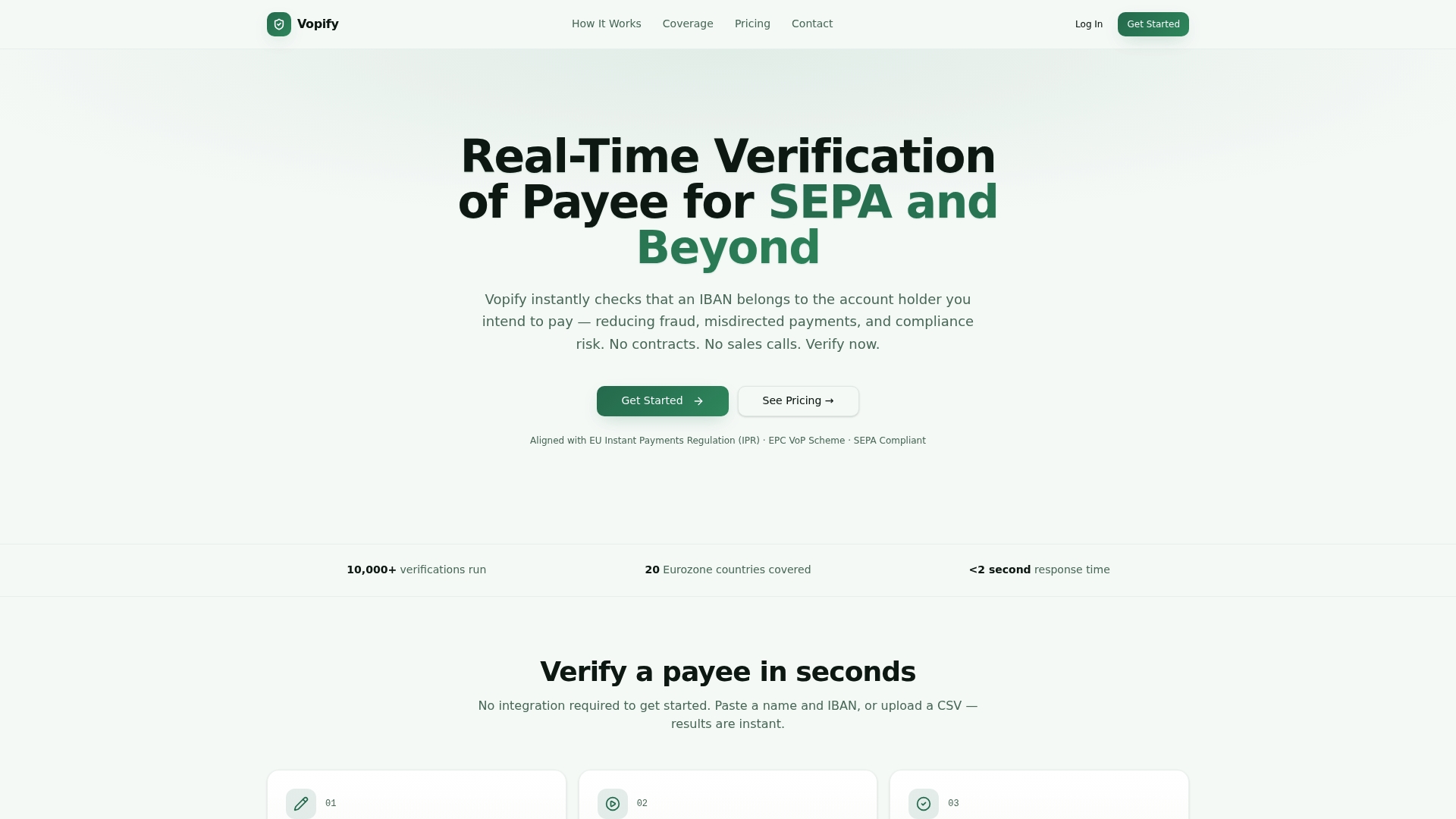
A verification platform can be built to sit at exactly these three points, checking a payee name against an IBAN in under two seconds, across multiple countries, with no contract or integration project required to get a result. Such platforms may process tens of thousands of verifications and run checks against live payment networks rather than a static database, which matters when a supplier changes banks and the old record is still sitting in your file.
- Bulk supplier onboarding: upload a CSV of new vendor bank details and get a full accuracy pass before the first payment goes out.
- Pre-payment spot checks: run a single lookup on any payment above your approval threshold before release.
- Out-of-band confirmation augmentation: pair a callback with a live IBAN check for the highest-risk changes.
- Exception handling: when a payment gets flagged, a quick verification check gives the reviewer a fast, independent data point instead of a guess.
Pro Tip: If your team only has time to add one new control this quarter, make it a verification check on every bank-account-change request. That single point is where most misdirected-payment fraud actually starts.
Author Perspective: Three Practical Priorities for AP Teams
Most AP teams try to fix verification everywhere at once and end up with a policy nobody follows consistently. Start narrower: identify your highest-risk payment types and corridors, usually new vendors and cross-border transfers, and harden the approval and whitelist rules there first. Everything else can wait a quarter.
Make auditability non-negotiable from day one, not something you backfill before an audit. Every override needs a written reason and an approver's name attached, and someone outside the approval chain should sample those overrides periodically.
Treat verification as governance, not as a reviewer's judgment call. Set a service-level target for how fast a flagged payment gets resolved, measure it monthly, and adjust thresholds based on what the data shows rather than on anecdote. The teams that get this right stop treating verification as a one-time project and start treating it as a standing operational discipline.
— David
Vopify Payee Verification Options and How to Get Started
Once the policy and approval workflow are in place, the fastest way to add real-time payee verification is to pick the integration pattern that matches your payment volume.
- Starter plan, $240 per month, fits teams running a steady volume of individual verification checks through the dashboard without a bulk upload need.
- Bulk IBAN Verification fits a full supplier file cleanup or new-vendor-batch onboarding, letting you check an entire CSV of bank details in one pass instead of one lookup at a time.
- Vopify MCP fits teams that want verification embedded directly into an existing workflow or AI-assisted process, with no separate login step for the reviewer.
Single verification checks start at $0.70 to $1.00 per lookup on a pay-as-you-go basis for teams that would rather pay per check than commit to a monthly plan. For teams scaling past Starter volume, Growth and Scale plans are available at $750 and $2,000 per month respectively.
The simplest way to see the fit is to run a bulk check against your current supplier file and see how many records come back unverified. From there, teams typically add a single-lookup step at payment release and, for high-volume operations, move toward the planned API integration for fully automated checks. Start at Vopify to see current plan details and run your first verification.
FAQ
How do I verify my payment information?
Confirm the payee name matches the account holder on the receiving bank account, check that the IBAN or account number has not changed since the last payment, and use a verified-change process for any update to bank details rather than accepting an email request at face value. For high-value payments, add an out-of-band callback to a known contact before releasing funds.
What does "merchant check verification" mean?
Merchant check verification generally refers to confirming that a payment presented for processing matches the authorized details on file, similar to how positive pay confirms a check matches what the issuer originally recorded. Definitions vary by provider and payment type, so the specific check performed depends on the service and payment rail involved.
How do I verify a transaction?
Match the transaction against the original invoice or purchase order using exact, tolerance, or fuzzy matching rules depending on the payment's risk level, then run it through anomaly checks for unusual destination, amount, or timing before release. Any transaction that triggers a flag should go through documented review with a recorded reason before it clears.
What are the steps in payment processing?
Payment processing generally follows invoice or request creation, matching against supporting documents, approval based on defined thresholds, verification of payee details, release, and reconciliation against bank records. Controls like segregation of duties and real-time monitoring, as described in FFIEC guidance, sit across these steps rather than at a single point.
How can payment verification controls reduce business email compromise risk?
A verified-change process for bank-detail updates, combined with out-of-band confirmation through a known channel, closes the gap that business email compromise exploits, since the fraud typically relies on a convincing email rather than a compromised phone call. Real-time payee verification that checks the IBAN against the named account holder before release, such as the checks run through Vopify, adds an independent data point a reviewer can use before approving a changed payment.