
Payment verification is a short check, usually a microcharge, a code, or a document review, used to confirm you own a payment method or account. Legitimate verifications ask for only a few data points: your name, the last four digits of an account or card, a photo ID, or a one-time code. The steps below show you exactly what to share, what to redact, and what standards should back any request before you comply.
TL;DR:
- For bank statements, keep your name, last four account digits, and the relevant transaction visible; redact balances, unrelated transactions, and other identifiers when allowed.
- Never share a verification code with anyone who contacts you first; open the provider’s app or website directly and upload documents only through its official portal.
- Microcharge checks may resolve within minutes or take a few days, while Google allows up to seven days for document review; pending transactions are usually held.
- For payee checks, a real time name and account match can avoid document uploads; reserve ID review for legal or regulatory checks that require it.
- Before sharing data, check the provider’s privacy policy for collection limits, data sharing, security standards, and a clear retention period; keep a record of submission.
Table of Contents
- What payment verification means and why services ask for it
- Which details and documents get requested, and what you can redact
- How firms protect verification data: standards to look for
- Practical privacy steps to minimize exposure during verification
- What happens after you submit and typical timing
- Practitioner view: how real-time payee verification limits document sharing
- Methods and technologies for preserving privacy during payment verification
- Best practices for secure data handling when verifying payee accounts
- How verification services keep pace with privacy laws like GDPR
- Weighing privacy against security during verification
- Comparing verification approaches by their privacy footprint
- Your rights and controls over data shared during verification
- A note on where privacy and verification actually meet
- How Vopify limits document sharing during payee verification
- FAQ
- Sources
- Primary sources and further reading
What payment verification means and why services ask for it
Payment verification confirms that a person or business controls the account or card they claim to control. Services trigger it in a handful of predictable situations: you add a new payment method, your account shows unusual activity, a payout is unusually large, or a regulator requires an identity check before funds move.
The flow usually takes one of three shapes:
- A microcharge or short code sent to your account that you report back to confirm ownership.
- A document upload, such as a bank statement or government ID, reviewed by a human or an automated system.
- An account challenge, where you confirm a login or action through a secondary device or app.
Each flow has a different timeline. A microcharge check often resolves within minutes to a couple of days once you confirm the code, matching how Google's payments verification process works. Document reviews run longer because a person or system has to inspect what you submitted. During either process, expect a temporary hold on the related transaction rather than an outright cancellation. Most legitimate services explain this upfront, and if a request skips that explanation entirely, treat it as a signal to slow down before sharing anything.
Which details and documents get requested, and what you can redact
Verification requests tend to repeat the same short list: a photo of a government ID, proof of address, a bank statement showing the last four digits of an account, an image of a card showing its last four digits, and a billing address. Not every field on those documents needs to stay visible.
- Keep your full name and the last four digits of the relevant account or card visible, since that is what matches the request to your identity.
- Redact full account numbers, routing numbers beyond what's needed, Social Security numbers, and account balances wherever the provider's instructions allow it.
- Black out unrelated transactions on a bank statement; verifiers only need the one line that proves ownership.
- Submit through the provider's official upload portal rather than a form field that strips formatting or metadata.
Pro Tip: Cover everything on a statement except your name, the account's last four digits, and the one transaction being verified, then photograph it in good light before uploading.
Google's own guidance confirms that redacted bank statements are acceptable for this exact reason: the verifier needs a match, not your entire financial history.
How firms protect verification data: standards to look for
A legitimate verification process leans on a specific set of technical and regulatory safeguards rather than asking you to trust a stranger's word. Four show up repeatedly across reputable providers:
- PCI DSS compliance, which governs how card data gets stored, transmitted, and encrypted across the payment chain.
- Tokenization, which replaces a real account number with a substitute value so the original never sits exposed in a merchant's database.
- EMV 3-D Secure, which lets issuers and merchants exchange transaction and device data to authenticate a cardholder during card-not-present purchases, as described in EMVCo's guidance.
- Secure Payment Confirmation and WebAuthn, a web standard that cryptographically ties your consent to the exact transaction details instead of relying on a text message code, per the W3C specification.
Secure Payment Confirmation reduces dependence on SMS-based codes by generating cryptographic evidence of consent tied directly to transaction data, which closes a gap that text message interception has long exploited.
On the regulatory side, the CFPB's Personal Financial Data Rights rule requires authorized third parties handling your financial data to limit what they collect, disclose how they use it, and follow defined retention limits. Before you comply with a request, check whether the provider's privacy policy names these standards or at least describes retention timelines and data-sharing limits in plain language. For deeper background on how encryption and authentication work together, OK Technology's overview of encryption and authentication breaks down the mechanics in accessible terms.
Practical privacy steps to minimize exposure during verification
A few habits cut your exposure without slowing down a legitimate check.
- Confirm the request came from the platform itself by logging in directly rather than clicking a link in an email or text.
- Upload sensitive documents only through the provider's official portal, never as an email attachment.
- Redact every field that isn't required for matching, following the checklist above before you submit anything.
- Avoid public Wi-Fi when uploading identity documents, and keep your browser and device updated to current security patches.
- Keep a record of who you shared documents with and when, along with any stated retention or deletion timeline.
Pro Tip: Screenshot the confirmation page after you submit, including the date and the provider's stated retention policy, in case you need to dispute how your data was handled later.
The FTC's guidance on verification codes is blunt on one point: never share a one-time code with anyone who contacts you first. A legitimate verifier never needs you to read a code back to them over the phone.
What happens after you submit and typical timing
Microcharge and code-based checks tend to resolve fastest, often within minutes once you report the code back, though some platforms take a few days to post and refund the temporary charge. Manual document reviews run longer, with Google's own process allowing up to seven days for review and refunding temporary verification charges within 30 days.
- A pending transaction usually gets held, not canceled outright, while review is underway.
- If verification fails or the merchant cancels, funds typically return to your original payment method within the platform's stated window.
- If a check or deposit clears quickly but turns out fraudulent, you can still be liable for the returned funds weeks later, since check settlement risk differs from fund availability.
- If a review stalls past the stated window, use the platform's support channel first, then its formal dispute or appeals process if support doesn't resolve it.
Practitioner view: how real-time payee verification limits document sharing
One underused lever in this whole process is avoiding document exchange altogether. When a finance team needs to confirm that an IBAN matches its intended account holder, a real-time check on name and IBAN alone answers the question without a single ID photo or bank statement changing hands.
That matters for exposure, not just speed. Every document uploaded sits somewhere, gets reviewed by someone, and carries some retention timeline, even under good governance. A payee check that confirms ownership instantly, rather than requesting a document and waiting on a reviewer, reduces how often personal identifiers travel between parties and cuts down on repeat verification requests when a vendor's details are already confirmed on file.
Methods and technologies for preserving privacy during payment verification
Beyond standard encryption, a handful of newer techniques aim to confirm what's needed without exposing the full underlying data. Data masking replaces sensitive characters with placeholders before a document or field ever reaches a reviewer, so a bank statement shows the match without displaying balances or unrelated transactions.
Zero-knowledge proof techniques go a step further: in concept, they let one party prove a fact, such as "this name matches this account," without revealing the account's full details to the party doing the checking. The approach is still emerging in consumer payment verification, and no major U.S. verification provider has published a production deployment at consumer scale, so treat it as a direction the field is moving toward rather than a feature you should expect today.
More practically available right now, tokenization and SPC/WebAuthn (described above) already remove the need to transmit raw account numbers or SMS codes for many transaction types. Device-level authentication, where your phone or laptop confirms your identity through a biometric or security key rather than passing a code over the network, serves a similar purpose: it moves the proof of identity to your device instead of a shared secret traveling through email or text.
For readers evaluating a provider, the practical question is simple: does the verification method need to see your raw data to work, or can it confirm a match without storing a copy. The second kind of system is strictly less exposed.
Best practices for secure data handling when verifying payee accounts
Verifying that an IBAN or account number belongs to the stated holder involves handling financial identifiers that deserve the same care as a password. A few practices separate careful handling from careless handling.
- Request only the fields needed to make the match: name and account identifier, not a full statement, when a simpler check will do.
- Encrypt data both in transit and at rest, and confirm the provider states this plainly rather than assuming it.
- Limit internal access to verification data to the people who actually need it for the specific transaction.
- Set a defined retention window and delete records once that window passes rather than keeping them indefinitely "just in case."
- Log every access to verification data so a provider can show an audit trail if a dispute arises.
Finance teams running vendor or supplier checks at volume benefit from batching these checks through a single controlled channel rather than letting individual staff request documents ad hoc by email, which multiplies the number of places sensitive data ends up stored.
How verification services keep pace with privacy laws like GDPR
Providers operating verification checks across multiple regions generally structure their data handling around a few consistent principles that satisfy GDPR's core requirements even outside the EU: collect the minimum data needed for the stated purpose, state that purpose clearly, and give individuals a path to request deletion or correction of their records.
In practice this means a provider processing an IBAN and name for a one-time match should not be retaining that data indefinitely for unrelated marketing or analytics use. It also means the provider should be able to tell you, on request, what it stored, for how long, and who had access. The CFPB's Personal Financial Data Rights rule echoes this same logic domestically for financial data shared with authorized third parties: limited collection, clear disclosure, and defined retention. When you're evaluating any verification provider, whether or not GDPR technically applies to you, ask the same three questions GDPR forces providers to answer anyway: what is collected, why, and for how long.
Weighing privacy against security during verification
More verification generally means more friction, and more friction generally means fewer successful fraud attempts getting through. That tradeoff is real, but it isn't a straight line: a provider that demands a full ID photo and a bank statement for every transaction isn't automatically safer than one that confirms a name-and-account match instantly, it's just collecting more data for the same outcome.
The better framing is to ask what each verification step buys you. A microcharge confirms account control. A document review confirms identity against a government record. A real-time account match confirms that a specific name is tied to a specific account right now. Each answers a different question, and stacking all three for every transaction usually means collecting data you don't need to answer the question actually in front of you.

For individuals, the practical balance is redacting anything not required for the match while still cooperating with the parts of the request that genuinely confirm ownership. For businesses verifying suppliers or payees, the balance shifts toward choosing verification methods that answer the specific risk (is this IBAN correct) without defaulting to document collection as the first option every time.
Comparing verification approaches by their privacy footprint
The three dominant verification approaches carry different privacy costs for the same basic goal of confirming ownership.
| Approach | What it collects | Privacy footprint |
|---|---|---|
| Microcharge or code verification | Bank login access to report a code or amount | Low; no document stored, just a confirmed match |
| Document upload and review | Government ID, bank statement, proof of address | Higher; images stored and reviewed, subject to retention policy |
| Real-time name and account matching | Name and account identifier only | Low; confirms a match without storing supporting documents |
| EMV 3-D Secure / SPC authentication | Device and transaction data, cryptographic consent signal | Low to moderate; data tied to one transaction, not stored as a document |
Document-based review remains necessary for identity checks tied to legal or regulatory requirements, where a government record genuinely needs to be inspected. For transaction-level and payee-level checks, the lighter-footprint methods, microcharges, SPC/WebAuthn, and direct account matching, answer the question with less data changing hands and less of it sitting in storage afterward.
Your rights and controls over data shared during verification
You generally have more say over your verification data than most requests make obvious. Under the CFPB's Personal Financial Data Rights rule, authorized third parties handling your financial data must disclose how they'll use it and are bound by limits on collection and retention, which means you can ask directly what a verifier plans to do with your information before you hand it over.
Practically, you can ask any provider for its retention timeline, request deletion once a transaction is complete, and decline to share fields that aren't required for the specific match being requested. You can also report inappropriate requests, especially unsolicited demands for one-time codes, which the FTC flags as a common scam tactic rather than a legitimate verification step. Keeping a short written record of what you shared, with whom, and when gives you something concrete to point to if a dispute comes up later.
A note on where privacy and verification actually meet
The common assumption is that stronger verification always means handing over more personal data, and that's backwards. The strongest verification methods available right now, SPC/WebAuthn and real-time account matching, work precisely because they confirm a fact without needing to store a copy of your life's paperwork to do it. Document review is the blunt instrument, useful when nothing else will do, but it's often reached for by default rather than by necessity.
The practical priority for any team handling verification, whether you're an individual confirming a payment method or a finance department checking a supplier's bank details, is the same: ask what the check actually needs to prove, then share only what proves it. Automate the parts that don't need a human reviewing a document, and set a retention policy you'd be comfortable explaining to the person whose data you're holding.
— David
How Vopify limits document sharing during payee verification
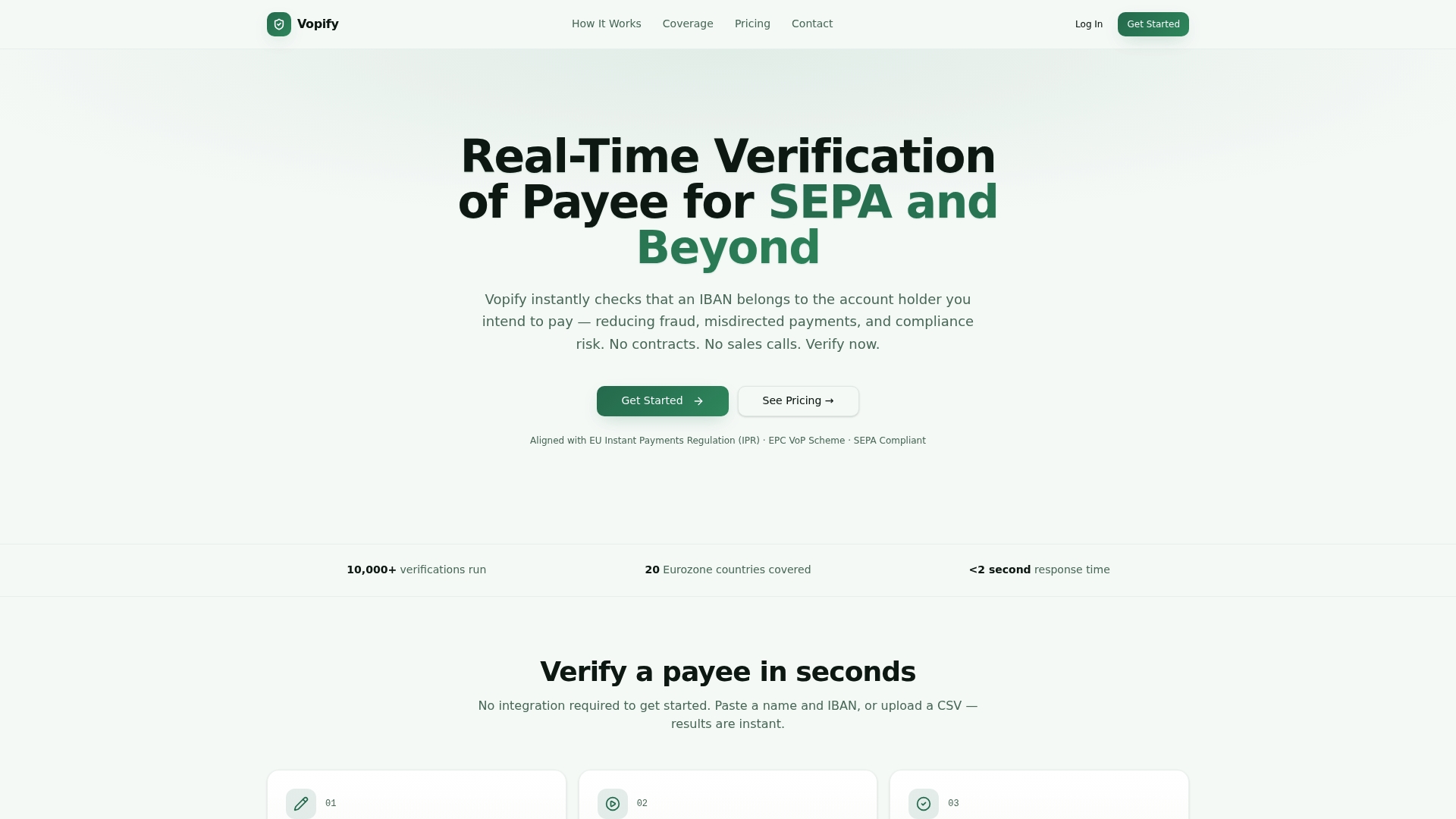
We built our verification process around a simple idea: confirming that a name matches an IBAN shouldn't require either side to exchange a government ID or a bank statement. Our Payee Verification service checks a name against a live IBAN in under two seconds, covering 20 Eurozone countries plus additional networks, so finance teams get a confirmed match without opening a document review process at all.
- Run a single lookup for a one-off payee check before processing a payment.
- Upload a CSV for bulk IBAN verification when you need to clear a full supplier list at once.
- Connect verification into your payout workflow through our MCP integration for programmatic checks.
Pricing details for plans and pay-per-check options are available on our website. Visit Vopify to run your first check.
FAQ
What payment apps are protected?
Major payment platforms generally follow PCI DSS standards for card data and increasingly support strong authentication methods like EMV 3-D Secure or WebAuthn-based confirmation for sensitive transactions. The strongest signal of protection isn't the app's name but whether it discloses its data retention policy and uses recognized authentication standards rather than SMS-only codes.
What does payment verification mean?
Payment verification is a check used to confirm that you control a given payment method or account, typically through a microcharge, a one-time code, or a document review. It exists to prevent fraud and misdirected payments before a transaction completes or a new payment method gets added to an account.
What are the steps in payment processing?
Payment processing generally moves through authorization (confirming funds are available), verification (confirming identity or account ownership when flagged), settlement (funds actually moving between accounts), and reconciliation (matching records on both sides). Verification steps, when triggered, usually happen between authorization and settlement, which is why a transaction can show as pending during review.
How long does it take Google to verify payment information?
Google's payments verification process typically resolves within one to seven days for document-based reviews, while microcharge or code-based checks often confirm faster. Temporary verification charges are refunded within a reasonable timeframe according to Google's own help documentation.
Sources
- Notice of Final Rulemaking - Required Rulemaking on Personal Financial Data Rights
- Verify your identity or payment info - Google payments center help
- Secure Payment Confirmation — W3C
- EMV® 3‑D Secure | EMVCo
- How to spot scams — FTC consumer guidance
Primary sources and further reading
- Notice of Final Rulemaking - Required Rulemaking on Personal Financial Data Rights
- How to spot scams - FTC consumer guidance
- Secure Payment Confirmation - W3C
- Verify your identity or payment info - Google payments center help
- EMV 3-D Secure | EMVCo
- Check fraud liability guidance - HelpWithMyBank
- FTC consumer alert on verification codes
- Encryption & Authentication | OK Technology