
Pre-payment verification confirms that an account, a payment file, or an eligibility status is correct before money leaves the building, and it works best as an automated first layer with human review reserved for exceptions. Done right, it cuts misdirected payments and the costly reversals that follow. The core toolkit covers API-based account checks, instant or micro-deposit bank verification, AVS and card pre-authorization, file validators, and, in healthcare, prior authorization.
TL;DR:
- Instant bank checks confirm ownership in seconds, while micro deposits can take a day or more and suit lower risk, nonurgent onboarding.
- Validate NACHA or ISO 20022 files for record lengths, control totals, and routing checksums, then test bank specific profiles because schema checks alone miss mismatches.
- Keep healthcare payments out of the queue until approval; impacted payers must decide expedited requests within 72 hours and standard requests within seven calendar days.
- Pilot automation with new suppliers, high value recurring payments, or vendors with changed bank details, then expand after reviewing exception rates and reversal costs.
Table of Contents
- Common pre-payment verification methods and when to use each
- Technical checks and tools: validators, prenotes, and API patterns
- Pre-payment verification in regulated flows: prior authorization and timelines
- Step-by-step checklist for operations: build verification into your payment flow
- Vendor proof: how real-time name and IBAN checks reduce payment risk
- Author perspective on when automation is worth the investment
- Vopify: try instant payee verification
- FAQ
- Sources
- Primary sources and tools cited
Common pre-payment verification methods and when to use each
Different payment types call for different checks, and matching the method to the risk saves both time and money.
Bank-to-bank transfers benefit most from instant account verification, which confirms ownership in seconds instead of the day or more that traditional micro-deposits take. Micro-deposits still work where instant checks are unavailable, but they delay onboarding and give fraud a longer window to slip through.

Card transactions rely on a different pair of tools: address verification (AVS) catches billing-address mismatches, while card pre-authorization places a temporary hold to confirm the card is active and funded before the final charge.
For ACH and SEPA transfers, API-based eligibility and account-status checks replace guesswork with a real-time answer on whether an account exists and matches the name on file. Payment file validation adds a second layer, checking that NACHA or ISO 20022 files meet structural rules before a bank ever sees them.
Healthcare payments carry their own gate entirely separate from banking checks: prior authorization, which confirms a payer will cover a service before a claim or payment is processed.
- Instant bank verification suits time-sensitive transfers; micro-deposits suit lower-risk, non-urgent onboarding.
- AVS and card pre-authorization protect card-based payments from stolen or invalid card data.
- API eligibility checks and file validators protect ACH and SEPA transfers from rejected or misdirected funds.
- Prior authorization protects healthcare payments from denied claims after the fact.
Technical checks and tools: validators, prenotes, and API patterns
Before any file reaches a bank, a short sequence of technical checks catches most of the errors that cause rejections or delays.
- Run the payment file through a NACHA or ISO 20022 pain.001 validator to check record lengths, control totals, and routing checksums before submission.
- Send a prenote or zero-amount test transaction where the receiving bank accepts them, since some banks disallow prenotes entirely and only reveal profile rules through a live or test upload.
- Call an instant account verification API with the name and IBAN, then confirm the result through a webhook or a polling endpoint rather than assuming success.
- Apply an IBAN mod-97 checksum calculation on international payments to catch transposed digits before the file leaves your system.
- Confirm bank-specific profile settings, including originator ID, SEC code, and whether the receiving bank expects a balanced or unbalanced file.
Validator tools that run schema and bank-rule checks locally catch structural errors, like flipped IBAN digits or malformed BICs, before a bank rejects the file outright. Schema validation alone is not enough: a file can pass structural checks and still bounce because of a bank-specific profile mismatch that only a live test reveals.
Pro Tip: Run a dry-run file through both a structural validator and a sandbox API call before every new vendor's first live payment.
Pre-payment verification in regulated flows: prior authorization and timelines
Prior authorization works as a pre-payment eligibility gate in healthcare: a payer must approve a service before it gets billed or paid. The CMS final rule requires impacted payers to return standard decisions within seven calendar days and expedited decisions within 72 hours, with a Prior Authorization API mandate taking effect starting in 2027.
That timeline has direct consequences for scheduling payments: a claim held pending authorization should not enter the payment queue until status changes, which means approval status needs to surface inside the accounts-payable system rather than live only in a separate portal.
- Treat prior authorization as a hard gate, not a formality, before scheduling any related payment.
- Build in the 72-hour and seven-day decision windows when forecasting payment timing.
- Use electronic prior authorization (ePA) APIs and document attachments to automate status polling instead of manual follow-up calls.
Step-by-step checklist for operations: build verification into your payment flow
A repeatable sequence keeps verification consistent across every vendor and payment type instead of depending on whoever happens to be reviewing a batch that day.
- Normalize incoming payee data and confirm required fields: legal name, account number or IBAN, bank identifier, and payment currency.
- Run file and format validation, then route new or changed vendor details through a prenote or dry-run process before the first live payment.
- Trigger account verification, whether an instant name-and-IBAN API call or a micro-deposit flow, and confirm the result through a webhook or status endpoint rather than a one-time check.
- Apply business-rule checks: match the payment against the purchase order or invoice, screen for duplicates, and confirm contract pricing, then route anything that fails to a human reviewer.
- Move verified payments into a hold-to-approve flow, reconcile against the original invoice, and keep an audit trail for every verification result.
Operational best practice favors shifting from manual sampling toward rules-based automated controls that validate invoices, pricing, and supplier identity before release, since automation scales in a way manual spot checks cannot — as detailed in this invoice checklist that cuts rejections. Escalating only genuine exceptions to a human reviewer keeps the workload manageable even as transaction volume grows.
Pro Tip: Log every verification result, pass or fail, so disputes and audits have a timestamped record instead of a reconstructed guess.
Vendor proof: how real-time name and IBAN checks reduce payment risk
Vopify runs instant name-and-IBAN verification for single lookups or bulk CSV uploads, with API integration planned for high-volume programmatic checks. It has processed over 10,000 verifications across 20 Eurozone countries, India, Indonesia, South Korea, and China (Alipay), with responses typically under two seconds.
A payment that gets verified before it leaves the building never needs a reversal, a dispute, or an awkward call to the vendor.
The check fits step three of the checklist above: call the lookup after data normalization and before the file goes to the bank, then let the pass or fail result drive the hold-to-approve decision automatically.
Author perspective on when automation is worth the investment
Automation earns its cost once exception rates or value-at-risk justify the setup. We would pilot it on the highest-risk vendor cohort first, new suppliers, high-dollar recurring payments, or any vendor with a history of banking-detail changes, before expanding coverage. Scaling from there tends to compress reversal costs and free accounts-payable staff from repetitive checks faster than a full rollout attempted on day one.
— David
Vopify: try instant payee verification
We built Vopify so finance and accounts-payable teams get an instant name-and-IBAN match instead of waiting on contracts or integration work. 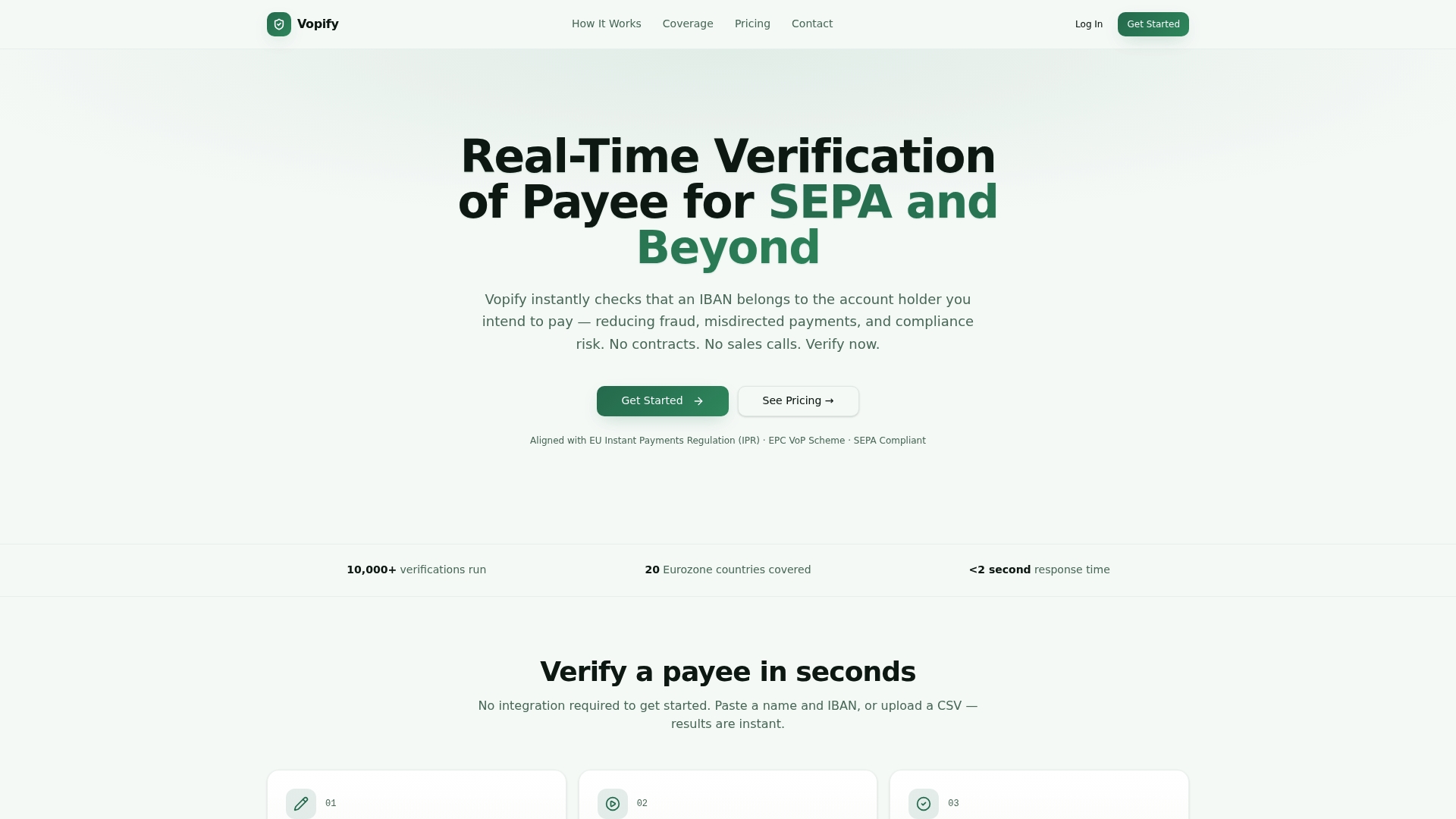
Run a single lookup or bulk CSV check now, or review the Vopify MCP integration if your team wants programmatic checks built into an existing workflow.
FAQ
What would be considered a pre-authorized payment?
A pre-authorized payment is a recurring electronic fund transfer a consumer has approved in advance, such as a mortgage or utility bill paid automatically from a bank account. Under Regulation E, this authorization must be in writing or a similarly authenticated record, and consumers can stop a scheduled transfer by notifying their bank at least three business days ahead.
How can I verify my payment information with Google?
Google does not independently verify bank or card payment details for third-party transactions; that verification runs through the payment processor or bank involved. For business payments, instant account verification services that match a name against an IBAN or account number offer a faster, more reliable confirmation than relying on a general search or account-settings check.
What are the steps in payment processing?
Payment processing generally moves through authorization, batching, clearing, and settlement, with pre-payment verification steps like account checks and file validation layered in before authorization completes. Adding verification earlier in that sequence catches errors before funds move rather than after a payment has already settled.
What are the four types of payment methods?
The four broad categories are cash, card payments (credit and debit), electronic funds transfers (ACH, wire, and SEPA), and digital or mobile wallets. Each carries different pre-payment verification needs: AVS and pre-authorization for cards, account verification APIs for electronic transfers, and issuer-side checks for most digital wallets.
How does pre-payment verification differ from post-payment reconciliation?
Pre-payment verification confirms account and eligibility details before funds move, while post-payment reconciliation checks that completed transactions match invoices and records after the fact. The former prevents errors from reaching settlement; the latter catches whatever slipped through.
Sources
- CMS finalizes rule to expand access to health information, improve prior authorization process
- CFPB — Regulation E (12 CFR part 1005) — Consumer protections for electronic fund transfers
- CFPB Compliance Bulletin 2015-06: Requirements for consumer authorizations for preauthorized EFTs