
Real time bank account verification gives accounts payable teams instant confirmation of three things before a payment leaves the building: whether the account is open, whether the name on the account matches the payee on file, and whether the routing and account numbers are valid. That confirmation arrives in under five seconds. Micro-deposits take one to three business days and still leave you guessing about name ownership. For any AP team running ACH or cross-border payouts at volume, the difference is not marginal.
The three core checks every verification returns:
- Account status: open, closed, or not found
- Ownership/name match: first name, last name, or business name against the account record
- Routing and account number validity: confirmed against live bank networks or a national shared database
Speed contrast: Real-time verification returns results in under 1–5 seconds. Traditional micro-deposits take 1–3 business days and carry return risk.
Table of Contents
- What the verification signals actually tell you
- Why AP teams should treat this as a compliance tool, not just a fraud screen
- How the technical flows work across API, bulk, and dashboard modes
- Designing a hybrid verification policy that actually works
- Implementation checklist before go-live
- What to expect on pricing, SLAs, and ROI
- How Vopify supports real-time payee verification
- Key Takeaways
- A practitioner's note on rollout pitfalls
- Start a Vopify pilot with your supplier list
- Useful sources and further reading
What the verification signals actually tell you
A live bank account status check returns more than a pass/fail. The response structure matters because it drives your downstream decision logic.
| Signal | Field | What it tells you |
|---|---|---|
| Account status | primaryStatusCode | Open, closed, or not found |
| Condition | conditionCode | Whether the account can be fully or partially validated |
| Name match | firstNameMatch / lastNameMatch / businessNameMatch | Y, N, C, or U per field |
| Overall confidence | overallMatchScore | numeric score across all matched data points |
| Routing validity | routingNumber check | Confirmed against national database |
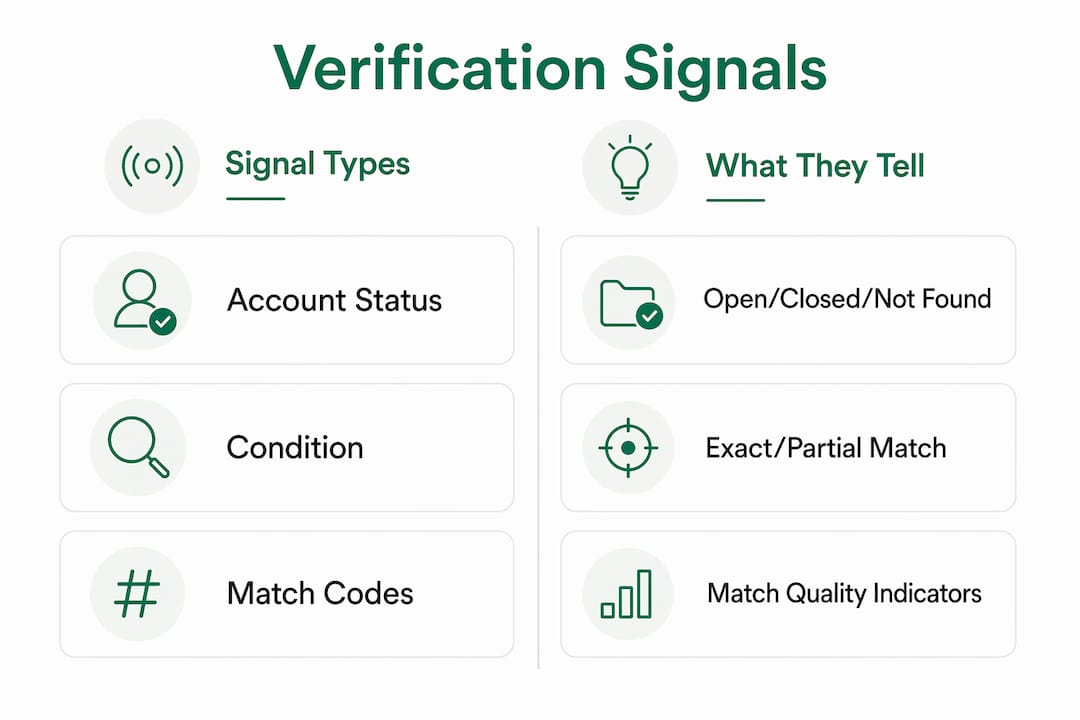
The Y/N/C/U codes deserve attention. Y means a close or exact match. N is a clear mismatch. C (conditional) means partial data matched, often triggered by address or phone discrepancies. U means no identifying data was available for that field. KeyBank's Account Validation API recommends treating an overallMatchScore of 81 or above as a confident acceptance threshold. Scores below that warrant a second look, not an automatic reject.
Minor spelling differences, punctuation, and spacing are typically ignored during matching. What does move the needle is a wrong address, a transposed digit in a phone number, or a business name filed under a DBA that differs from the legal entity name on the account.
Pro Tip: Submit as many data points as your system holds. Fields left blank are not checked, which lowers your match score and reduces confidence. A full submission, including address and phone, consistently outperforms a name-only check.
Why AP teams should treat this as a compliance tool, not just a fraud screen
Real-time verification is frequently framed as a fraud prevention measure. That framing undersells it. The bigger daily value for most AP teams is operational: fewer ACH returns, less manual remediation, and a cleaner audit trail.
Direct cost and efficiency benefits:
- Fewer ACH return fees, which typically run $2–$5 per return from the originating bank, plus any fees charged by the receiving institution
- Less FTE time spent tracking down returned payments, contacting suppliers, and re-initiating transactions
- Faster supplier onboarding because account confirmation happens at setup, not after the first failed payment
- Automated accept/route-to-review rules replace manual judgment calls on every new vendor
Compliance benefits:
- Nacha's web-debit rules require account validation before initiating consumer ACH debits; real-time verification creates a timestamped proof of that check
- Stored verification responses, including match codes and scores, serve as audit evidence if a payment is disputed
- AP teams that surface match-reason codes and confidence levels can build automated thresholds instead of relying on a binary valid/invalid flag
The audit trail point matters more than most teams realize until they face a dispute. A log entry showing the account was verified, the match score was 87, and all name fields returned Y is a much stronger defense than "we checked it manually."
How the technical flows work across API, bulk, and dashboard modes
Two verification modes underpin most real-time systems: passive and active.
Passive (database/network) checks run silently against large bank record networks, sometimes covering hundreds of millions of accounts, without requiring the account holder's interaction. No consent is needed from the payee. Results come back in under a second in most implementations.

Active (open-banking) checks connect directly to the account holder's bank with their permission, returning live ownership and balance signals. They require a consent step, which adds friction, but they provide the highest confidence, especially for new or high-value payees.
| Integration mode | Best for | Typical latency | Consent required |
|---|---|---|---|
| Real-time API | Payment flow verification, new vendor onboarding | Sub-1s to ~5s | Depends on mode |
| Bulk CSV upload | Supplier list audits, periodic re-verification | Minutes for batch | No (passive) |
| Dashboard (ad hoc) | One-off checks, exception handling | Sub-5s per check | No (passive) |
For engineering teams, the request/response pattern is straightforward: send routing number, account number, and owner details; receive status codes, match flags, and a confidence score. Store every response locally, including error codes and timestamps, for troubleshooting and audit requirements. A 000 error code means the request was well-formed and processed. Anything else needs a retry or fallback path.
Designing a hybrid verification policy that actually works
The most practical approach is passive by default, active for exceptions. Running active open-banking checks on every transaction adds friction and cost that most recurring supplier payments do not justify.
| Scenario | Recommended check | Rationale |
|---|---|---|
| Low-value recurring supplier, previously verified | Passive only | Low risk, no new data to confirm |
| New supplier, first payment | Passive + escalate to active if score below threshold | Higher uncertainty warrants live confirmation |
| High-value or one-off payment | Active check required | Cost of a return or misdirected payment outweighs friction |
| Match code returns C or U on name fields | Route to manual review | Conditional or unknown codes need human judgment |
| Match score below 81 | Hold for review or request active verification | Below the recommended threshold for confident acceptance |
A hybrid policy also protects against over-reliance on passive checks for vendors whose account details have changed. Periodic re-verification of your full supplier list, even passively via bulk CSV, catches stale records before they cause returns.
Implementation checklist before go-live
Technical tasks:
- Obtain API credentials and run sample calls against a sandbox environment
- Confirm your retry logic handles timeouts and non-200 responses gracefully
- Set up local logging for every response, including
primaryStatusCode,conditionCode, match codes, andoverallMatchScore - Test bulk CSV ingestion with a representative sample of your supplier data
- Define fallback paths: micro-deposit or manual validation for accounts that return "not found" or fail active checks
Operational tasks:
- Update supplier onboarding forms to collect the data fields your verification API checks (legal name, address, phone)
- Train AP staff on what each match code means and which codes trigger manual review
- Set automated acceptance thresholds in your payment workflow (e.g., score 81+, all name fields Y = auto-approve)
- Assign ownership for the manual review queue and define SLA for resolving held payments
Exception handling roles:
| Situation | Owner | Action |
|---|---|---|
| Score below threshold | AP analyst | Request additional supplier documentation |
| Active check fails | AP manager | Escalate to manual bank confirmation |
| Account returned "closed" | AP team | Contact supplier for updated details |
| Unresolved after several hours | Finance controller | Hold payment pending resolution |
What to expect on pricing, SLAs, and ROI
Most verification platforms price on one of three models: per-check credits, tiered monthly subscriptions, or a hybrid of both. Credit-based models suit lower-volume or irregular use. Subscriptions make more sense once you are running hundreds of checks per month.
| Pricing model | Best fit | Throughput behavior |
|---|---|---|
| Per-check credits | Ad hoc or low-volume teams | Pay only for what you use |
| Tiered subscription | High-volume AP departments | Predictable monthly cost |
| Credits + monthly fee | Mixed use (bulk + real-time) | Flexibility for spikes |
On performance, real-time active checks can return ownership confirmation in under a second. Passive checks against large national databases typically land within 1–5 seconds. Bulk CSV jobs process asynchronously, so latency is measured in minutes for large files, not seconds.
For ROI, the math is simple. Take your current monthly ACH return volume, multiply by the average cost per return (bank fee plus FTE remediation time), and compare that against the per-check cost of verification. Most AP teams find the break-even point well below their actual return rate.
Example: If your team processes 500 supplier payments per month and 2% return, that is 10 returns. At $15 in combined fees and labor per return, you are spending $150/month on avoidable failures. Verification at even $0.50 per check costs $250 for the full batch, but eliminates most of those returns and the downstream delays they cause.
How Vopify supports real-time payee verification
Vopify delivers instant IBAN and account holder name matching for both individual and business payees, with results typically returned in under two seconds. The platform has processed over 10,000 verifications across 20 Eurozone countries, supports single checks and bulk CSV uploads, and provides audit-ready logs for every verification run.
For U.S. AP teams with international supplier bases, that coverage matters. Vopify's IBAN verification covers the full SEPA zone plus select Asia rails including India, Indonesia, South Korea, and China (Alipay). It also supports the EU Instant Payments Regulation and Verification of Payee compliance requirements for European payments.
Pricing runs on credit bundles or tiered subscriptions, with no long-term contract required for credit-based use. API access for high-volume programmatic integration is on the roadmap for enterprise customers. For teams that need it now, the dashboard handles ad hoc checks and the bulk CSV path covers supplier list audits at scale.
One practical limit to flag: Vopify's coverage is strongest on SEPA/IBAN rails. For domestic U.S. ACH-only verification, teams should confirm coverage with the Vopify team before piloting.
Key Takeaways
Real time bank account verification reduces ACH returns, satisfies Nacha compliance requirements, and gives AP teams a timestamped audit trail, but only when match-reason codes drive your acceptance logic rather than a binary pass/fail flag.
| Point | Details |
|---|---|
| Run passive checks by default | Silent database checks cover most recurring suppliers without adding supplier friction. |
| Escalate to active for high-risk payments | New vendors, high-value transactions, or conditional match codes warrant live open-banking confirmation. |
| Use match codes, not just status | Granular Y/N/C/U codes and a numeric confidence score let you automate approvals and route exceptions. |
| Log every response | Stored match codes and scores are your audit evidence if a payment is disputed later. |
| Vopify for cross-border payees | Vopify covers 20 Eurozone countries with sub-2s responses and bulk CSV support for supplier list audits. |
A practitioner's note on rollout pitfalls
The most common mistake AP teams make when deploying account verification is treating passive checks as sufficient for all scenarios and never building the escalation path. The passive check tells you the account exists and the name roughly matches. It does not tell you whether the account holder changed banks last month or whether the business was acquired and the account is now under a different legal entity. Those gaps surface as returns, and by then the payment delay has already damaged a supplier relationship.
The second pitfall is not storing match codes. Teams that only log a pass/fail result lose the ability to tune their thresholds over time. If you track the distribution of match scores across your supplier base for 60 days, you will almost always find a cluster of borderline scores that deserve a policy decision, not a default approval.
My recommendation: automate approvals for scores above your threshold and name fields returning Y, and keep a manual review queue for anything conditional. Review that queue weekly for the first 90 days, then use the patterns you find to tighten your rules.
Start a Vopify pilot with your supplier list
The fastest way to see what real-time payee verification does for your AP operation is to run it against data you already have. Export a subset of 50–200 suppliers from your ERP, upload the CSV to Vopify, and review the match-code distribution before your next payment run. Pay attention to how many accounts return conditional codes or scores below 81. That number tells you exactly how much exposure your current process is carrying.
Run the pilot in parallel with your existing payment workflow for 30 days. Track response times, match-code distribution, and any returns that occur on accounts that cleared verification. At the end of 30 days, you have a real return-rate delta and a concrete ROI figure to bring to your finance leadership.
To get started, request a demo or upload a sample CSV directly at Vopify's bulk verification page. Credit bundles require no contract, so the pilot cost is bounded from day one.
Useful sources and further reading
| Source | Best for | Audience |
|---|---|---|
| KeyBank Account Validation User Guide | Match-code tables, response field definitions, score thresholds | Engineering, AP analysts |
| U.S. Bank Account Validation API | Nacha compliance context, audit logging requirements | Compliance, engineering |
| Socure Bank Account Verification Use Cases | Business case for verification, efficiency framing | Finance leadership, procurement |
| Vopify IBAN Verification | SEPA/Eurozone coverage, bulk CSV flows, SLA details | AP teams with international suppliers |
| Moov Bank Account Verification Docs | Instant micro-deposit fallback flows, RTP/FedNow rails | Engineering teams building fallback logic |