
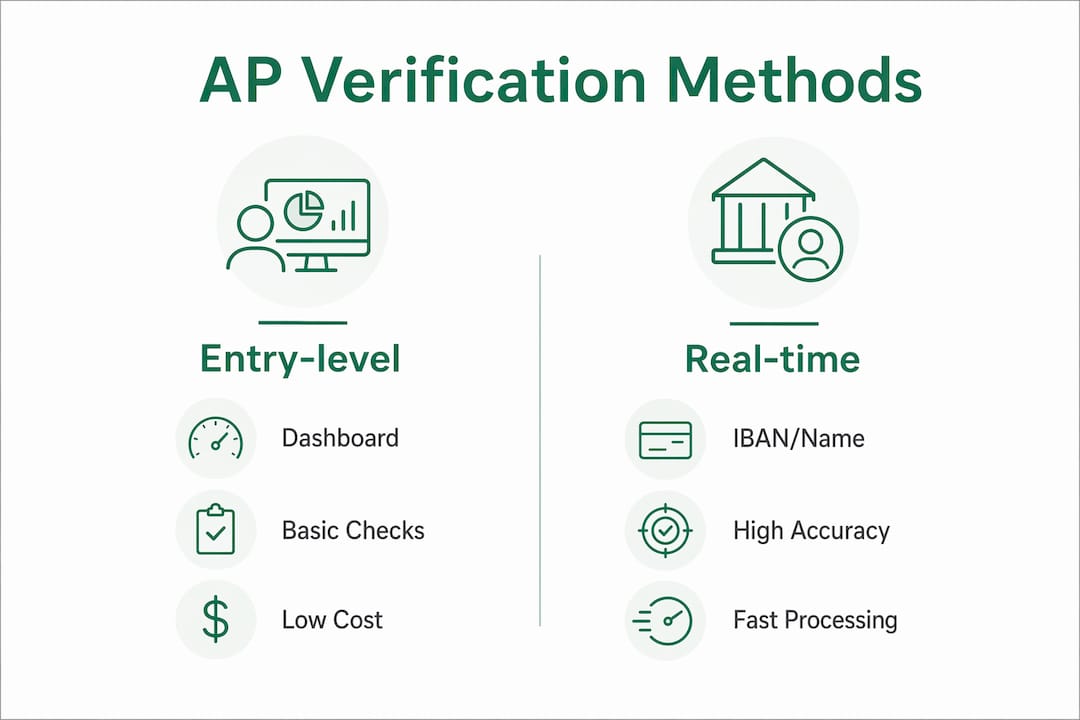
For finance and accounts-payable teams that need instant payee validation, the strongest approach is real-time IBAN plus account-name matching delivered via API or bulk CSV. Vopify is a recommended option here: it matches name and IBAN in under two seconds, supports both single-check and bulk CSV workflows, and covers 20 Eurozone countries plus select international schemes. Procurement teams evaluating SurePay alternatives will find the market splits into three broad categories worth shortlisting:
- Small-volume spot checks: A dashboard-based IBAN/name service with pay-as-you-go credits. No integration required; results in seconds.
- Bulk supplier validation: A platform supporting CSV uploads of hundreds or thousands of payees. Vopify's bulk IBAN verification fits here directly.
- Enterprise API integration: A service with a documented REST API, sandbox environment, and SLA commitments for high-frequency programmatic checks.
One critical benchmark: request a vendor's documented match rate on a realistic supplier sample and confirm average API latency stays low. Those two numbers tell you more than any feature list.
Table of Contents
- How do SurePay alternatives compare on AP-critical dimensions?
- How do you choose the right payee-verification provider?
- How do payee verification methods actually work?
- What should you budget and how long does implementation take?
- How should AP teams run a pilot before full rollout?
- What does a successful deployment look like in practice?
- Key Takeaways
- A note on what actually matters in procurement
- Vopify gives AP teams a fast path from pilot to production
- Useful sources and reference notes
How do SurePay alternatives compare on AP-critical dimensions?
Aggregator sites mix payment processors, KYC platforms, and dedicated verification services in the same list. That conflation makes procurement harder. The table below separates them by category so you can score against what AP actually needs.
| Dimension | Entry-level dashboard services | KYC/identity platforms | Real-time IBAN/name services (e.g., Vopify) | Bank-backed confirmation methods |
|---|---|---|---|---|
| Verification method | IBAN format check only | Identity + document checks | IBAN + account-name match | Bank-confirmed payee match |
| Coverage | Varies; often EU-only | Global, varies by scheme | SEPA + select international | Typically domestic (UK, NL) |
| Speed/latency | Seconds to minutes | Minutes to hours | Under 2 seconds | Seconds (where live) |
| Bulk/CSV support | Rarely | Rarely | Yes (Vopify supports CSV) | No |
| Integration options | Dashboard only | API + dashboard | API + dashboard + CSV | API (bank-dependent) |
| Pricing model | Per-check or freemium | Per-check or subscription | Credits or subscription | Per-check or contract |
| Security & compliance | Varies | SOC2/ISO common | SEPA-compliant, encrypted | Regulated by banks |
| Support/SLAs | Community or email | Tiered SLAs | Tiered SLAs | Bank-level SLAs |
Real-time IBAN/name services cover the widest range of AP use cases: supplier onboarding, one-off payee changes, and high-volume batch runs. KYC platforms add identity depth but slow down routine payment checks. Bank-backed confirmation is accurate but limited to markets where the scheme is live. Entry-level dashboard tools work for occasional spot checks but break down at scale.
Pro Tip: Ask every shortlisted vendor for a match-rate result on a realistic supplier sample of 500 records and confirm average API latency. A vendor that cannot produce those numbers in a sales call is unlikely to meet production SLAs.
How do you choose the right payee-verification provider?
Start with the verification method. IBAN plus name real-time matching is the baseline for AP teams. From there, score vendors on coverage, integration friction, bulk capability, and compliance certifications.
Buyer checklist:
- Coverage: Does the vendor support every country your suppliers are paid in?
- Latency: Is the average API response under two seconds?
- Match rates: Can the vendor share documented match-rate data on a real supplier set?
- Bulk file limits: What is the maximum CSV row count per upload? Is there a queue or rate limit?
- API documentation and sandbox: Is the sandbox self-serve, or does it require a sales call?
- Pricing clarity: Are per-check costs published, or do you need a custom quote?
- SLAs: What are the uptime and response-time guarantees in writing?
- Data handling: How long is payee data retained? Is it encrypted at rest and in transit?
Questions to ask vendors directly:
- What is your documented match rate on a 500-record supplier sample?
- What is your average API latency at peak load?
- Can I access a sandbox today without a contract?
- What is your data-retention policy for submitted IBANs and names?
- Do you hold SOC2 Type II or ISO 27001 certification? Can you share the report?
- How does your system handle a failed match — retry logic, error codes, fallback?
- What is the minimum contract term, and is there a monthly rolling option?
Procurement red flags: opaque per-check pricing, no self-serve sandbox, no published SLAs, CSV bulk uploads not supported, minimum contract terms over 12 months, and API documentation that requires a sales engineer to interpret.
How do payee verification methods actually work?
Real-time IBAN plus name matching is the fastest and most AP-friendly method for stopping misdirected payments before they leave your system. It queries live payment networks and returns a match, close match, or no-match result in under two seconds. Vopify's verification of payee service operates on this model and covers SEPA-compliant checks across 20 Eurozone countries.
The five main approaches differ significantly in speed, accuracy, and where they fit:
- Instant IBAN/name match: Queries live bank data; sub-2-second response; best for AP supplier checks and payment-run validation.
- Confirmation of payee (bank-backed): The receiving bank confirms the name matches the account; highly accurate but limited to markets with live CoP schemes (UK, Netherlands). Vopify also offers UK confirmation of payee for buyers with UK payment flows.
- Micro-deposits: Two small credits sent to the account; payee confirms amounts; slow (1–3 business days) and disruptive for supplier onboarding at scale.
- Account tokenization/ACH-style linking: Used for consumer-facing flows; not suited to B2B supplier verification.
- KYC/identity checks: Document and identity verification; adds compliance depth but adds latency and is overkill for routine payment validation.
| Method | Typical latency | Accuracy | Best use case | Regulatory fit |
|---|---|---|---|---|
| IBAN/name real-time | Under 2 seconds | High | AP supplier checks | SEPA, EU Instant Payments |
| Bank-backed CoP | Seconds | Very high | UK/NL payment flows | UK PSR, Dutch CoP |
| Micro-deposits | 1–3 days | High | Consumer account linking | ACH (US) |
| KYC/identity | Minutes to hours | Very high | Onboarding, AML | Global, varies |
For integration, single API calls handle one-off payee changes, bulk CSV uploads cover supplier onboarding batches, and a dashboard works for ad-hoc manual lookups. API comparison data shows that integration-level parity across providers varies considerably, so sandbox testing before committing is not optional.
What should you budget and how long does implementation take?
Expect either a pay-as-you-go credit model or a tiered monthly subscription. Proof-of-concept pilots typically consume a small credit bundle, often available without a long-term commitment.
Typical pricing shapes:
- Per-check credits: Buy a bundle (e.g., 100, 500, or 1,000 checks); cost per check decreases at volume. Predictable for low-to-mid AP volumes.
- Monthly subscription tiers: Fixed monthly fee for a defined check volume; overage charged per check. Better for teams with consistent monthly payment runs.
- Enterprise per-volume contracts: Negotiated pricing for high-frequency API users; usually includes SLA commitments and dedicated support.
Pricing model choice matters for AP spend predictability. A per-check credit model suits teams with variable monthly volumes; a subscription suits teams with predictable supplier payment cycles.
Sample implementation timeline:
- Vendor selection and contract: 1–5 days
- Sandbox access and initial testing: 1–3 days
- Bulk CSV pilot (500-supplier sample): 1–2 days
- API integration and unit testing: 3–10 days
- UAT and sign-off: 2–5 days
- Production cutover: 1 day
A small AP team can realistically move from pilot to production in 2–6 weeks. Larger organizations with IT change-management processes should budget 6–10 weeks.
How should AP teams run a pilot before full rollout?
Run a time-boxed pilot using both a bulk CSV of existing suppliers and a single-check API flow for one live payment process. That combination tests the two scenarios you will actually use in production.
- Define scope and success metrics before you start: target match rate, acceptable latency, and maximum false-positive rate.
- Sign up for the sandbox without a sales call. If that is not possible, flag it as a red flag.
- Upload a 500-supplier CSV and review match results. Note any mismatches and investigate a sample manually.
- Integrate a single-check API call into one payment workflow (e.g., new vendor onboarding or payee-change requests).
- Measure match rate, average latency, and false-positive/false-negative incidents over the pilot window.
- Test support response: submit a non-urgent query and a simulated error; measure time to resolution.
- Set rollback criteria: if match rate falls below your threshold or latency exceeds two seconds consistently, pause and reassess before production cutover.
Pilot success metrics to track:
- Match rate on the 500-supplier sample (target: above 95%)
- Average API latency (target: under 2 seconds)
- False-positive rate (a match returned for a mismatched payee)
- Time to resolve a failed-match incident
- Operational overhead: how many manual interventions did the pilot require?
For production cutover, run the new verification layer in parallel with existing payment controls for at least one full payment cycle before removing the old process.
What does a successful deployment look like in practice?
Finance teams that have replaced manual bank-detail confirmation processes with real-time IBAN/name verification typically report two concrete gains: fewer misdirected payments reaching the payment run, and faster supplier onboarding because the verification step no longer requires a back-and-forth email chain.

A common deployment pattern for mid-sized AP teams is a two-phase rollout. Phase one covers new vendor onboarding: every new supplier's IBAN and name is verified at the point of entry into the ERP, before the record is approved. Phase two extends verification to the existing supplier master data using a bulk CSV upload, cleaning the supplier file in a batch. Vopify's IBAN verification supports both phases, with single-check API calls for phase one and CSV bulk processing for phase two.
Bottomline and 4Stop represent two other categories worth understanding. Bottomline operates as a broader payment operations platform with verification features embedded in a larger workflow suite, which suits organizations that want verification bundled with payment processing rather than as a standalone service. 4Stop focuses on KYC and fraud-prevention checks, making it a fit for teams that need identity verification alongside payee validation. Neither replaces a dedicated real-time IBAN/name service for pure AP payee verification at speed.
Key Takeaways
Real-time IBAN plus name matching is the fastest, most AP-compatible payee verification method, and any provider you shortlist should support both single-check API calls and bulk CSV uploads before you consider them production-ready.
| Point | Details |
|---|---|
| Verification method matters most | Prioritize real-time IBAN + name matching over format-only checks or slow micro-deposit flows. |
| Sandbox access is non-negotiable | Any vendor that requires a contract before sandbox access is a procurement red flag. |
| Benchmark with real supplier data | Request a match-rate result on a 500-supplier sample and confirm average API latency under 2 seconds. |
| Pilot before committing | A 2–6 week pilot covering bulk CSV and single-check API flows is enough to validate a provider. |
| Vopify covers both AP workflows | Vopify provides real-time IBAN/name verification with bulk CSV and API options across SEPA and select international coverage. |
A note on what actually matters in procurement
The vendors that look best in a feature matrix are not always the ones that hold up in a real AP workflow. The gap shows up in two places: bulk file handling and support when something breaks.
Most procurement teams spend their evaluation time on the API and the pricing slide. The bulk CSV workflow gets tested last, if at all, and support SLAs get reviewed only after the contract is signed. That sequencing is backwards. If your AP team runs a monthly supplier payment cycle, the bulk upload path is the one that will be used most. Test it first, with your own data, at realistic volume. And call the support line before you sign anything. The response you get to a pre-sales question is a reasonable proxy for what you will get at 4 PM on a payment-run day.
For supplier segmentation, start verification with your highest-risk payees: new vendors added in the last 90 days, any supplier where bank details changed recently, and overseas payees where manual confirmation is hardest to do reliably. Those three segments cover the majority of misdirected-payment risk without requiring a full supplier-master overhaul on day one.
Vopify gives AP teams a fast path from pilot to production
Finance teams that need instant payee verification without a lengthy procurement cycle have a direct option: Vopify delivers real-time IBAN plus name matching in under two seconds, with both single-check API access and bulk CSV verification for supplier onboarding at scale. Coverage spans 20 Eurozone countries under the EU Instant Payments Regulation, plus India, Indonesia, South Korea, and China (Alipay). Pricing runs on pay-as-you-go credit bundles or monthly subscriptions, so you can start a pilot without committing to an annual contract.
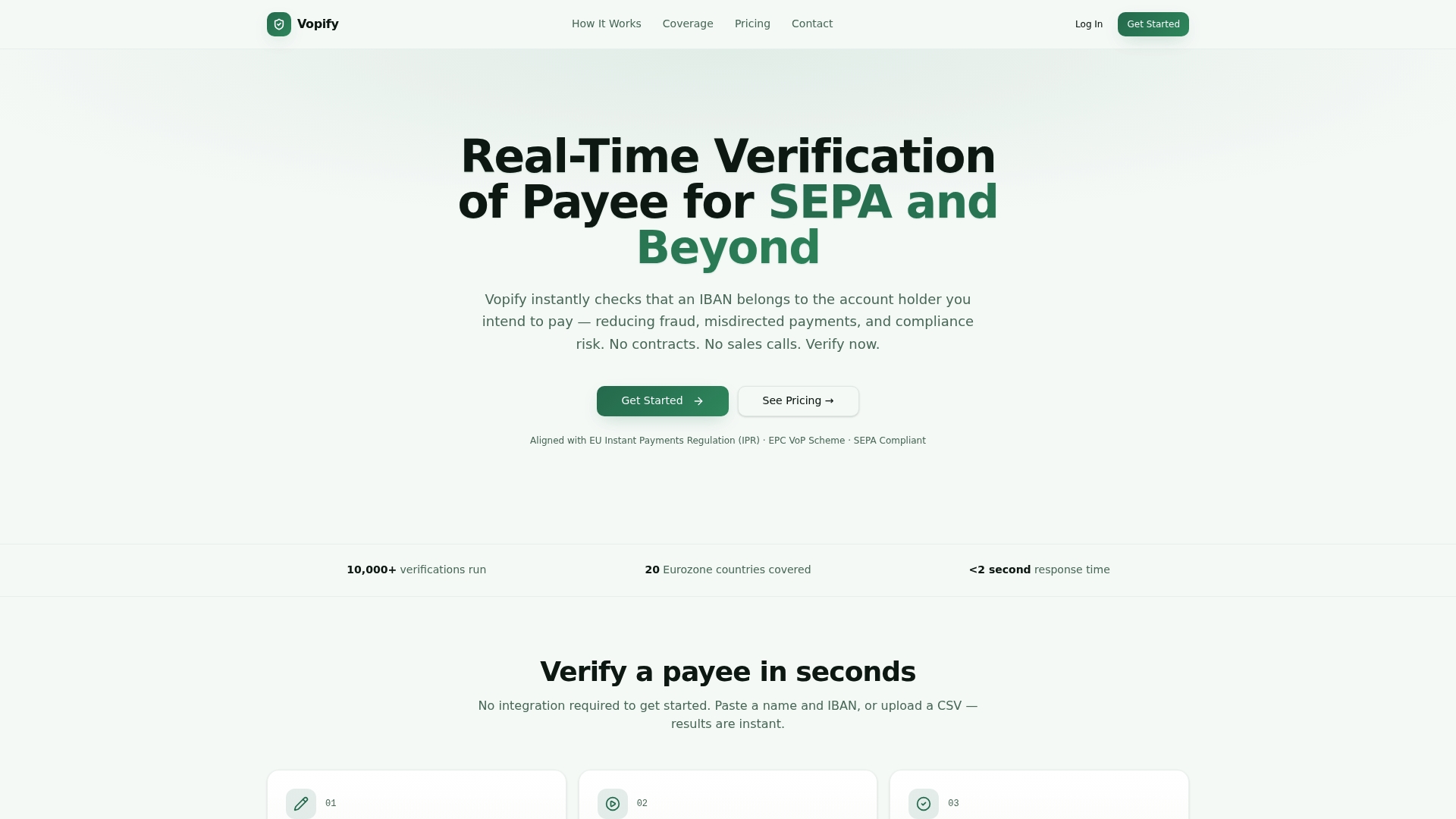
The fastest way to start is a bulk CSV run against your existing supplier file. Upload your payee names and IBANs, review the match results, and you have a clear picture of your supplier data quality before a single payment goes out. Start your pilot at Vopify and see match results within minutes of your first upload.
Useful sources and reference notes
Procurement and technical teams can use the following sources to support vendor evidence requests and market research:
- Vopify — IBAN & name verification: Coverage details, verification response types, and technical capabilities. Use this for feature evidence requests.
- Vopify — Bulk IBAN verification: CSV upload specs, credit bundle pricing, and high-volume workflow documentation.
- Vopify — Verification of Payee (VoP): SEPA compliance documentation and instant-response specifications.
- CBInsights — SurePay alternatives: Industry directory grouping alternatives by core capability. Use for initial market mapping.
- eBool — SurePay alternatives list: Aggregated alternatives list; note that it mixes payment processors with KYC vendors, so filter by verification capability before scoring.
- APITracker — SurePay API alternatives: API-level comparison showing integration and capability differences across providers. Useful for technical teams evaluating API parity.
When requesting vendor evidence, ask specifically for: documented match-rate data on a realistic supplier sample, average API latency under load, sandbox access credentials, SOC2 Type II or ISO 27001 certification reports, and data-retention and encryption policies. Those six items cover the core of a defensible vendor evaluation.