
A SWIFT/BIC code is a globally standardized bank identifier governed by ISO 9362, used to route international wire transfers to the correct institution and branch. Getting it right matters: a single wrong character can send your payment to the wrong bank, trigger a rejection, or generate costly manual intervention fees.
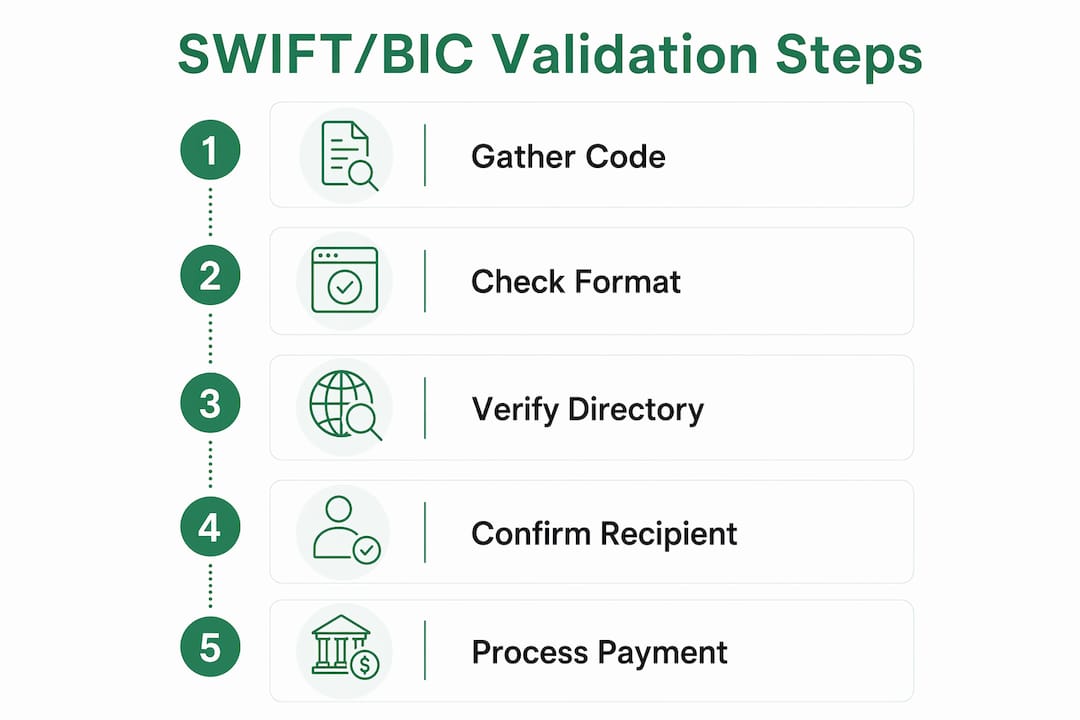
Swift validation, in the banking context, means verifying that a SWIFT/BIC code is not just correctly formatted but also active and matched to the intended recipient. Here is what a complete check covers:
- Format check: Confirms the code is 8 or 11 characters and follows the correct alphanumeric structure.
- Directory cross-reference: Confirms the code exists in an official registry such as SwiftRef, not just that it looks right.
- Branch specificity: Verifies the last three characters point to the correct branch, not just the head office.
- Active status: Confirms the bank or branch is currently operational, since directories update regularly.
Format validation alone is not enough. A code can pass every structural check and still fail to route a payment correctly.
How a SWIFT/BIC code is structured
Every SWIFT/BIC code follows a fixed four-part structure defined under ISO 9362. Understanding each segment makes it far easier to spot errors before they cause problems.
- Bank code (4 letters): Identifies the financial institution. Example: "CHAS" for JPMorgan Chase.
- Country code (2 letters): The bank's country per ISO 3166-1 alpha-2. "US" for the United States, "GB" for the United Kingdom.
- Location code (2 alphanumeric characters): Identifies the city or region of the bank's primary office.
- Branch code (3 alphanumeric characters, optional): Specifies a particular branch. "XXX" conventionally denotes the head office, though not universally.
An 8-character code (bank + country + location) identifies the institution's head office. An 11-character code adds the branch identifier and routes to a specific location. When you receive an 8-character code, most systems treat it as equivalent to the same code with "XXX" appended, but confirming this with the recipient's bank is always the safer move.
When do you actually need a SWIFT/BIC code?

Any cross-border payment that moves through the international banking network requires one. That covers international wire transfers, foreign currency payments, and most transactions between banks in different countries, including many within the SEPA zone when the receiving bank requires it.
The code tells the correspondent banking network exactly which institution and branch should receive the funds. Without it, or with an incorrect one, the payment either stalls in a correspondent bank's queue or gets returned, often with a fee attached. Regulatory compliance adds another layer: anti-money-laundering and anti-fraud frameworks require accurate beneficiary bank identification, so a missing or wrong code can trigger compliance holds beyond just a routing failure.
Domestic transfers within the US typically use routing numbers instead, so SWIFT/BIC codes are specifically a cross-border requirement. If you are paying a supplier in Germany, a contractor in South Korea, or a vendor in the UK, you need the correct code before initiating the transfer.
Where to find the right SWIFT/BIC code
The safest sources are always official ones. Third-party lookup websites can carry outdated or incorrect data, and using a wrong code from an unofficial source is one of the more common causes of failed international payments.
- Bank statement: Most international account statements print the SWIFT/BIC code directly on the document.
- Bank's official website: Nearly every major bank publishes its SWIFT/BIC code in the international payments or wire transfer section.
- Online banking portal: Log in and check the account details or international payments section.
- SwiftRef BIC Directory: The authoritative registry maintained by SWIFT itself, available at swiftref.com.
- Customer service: Call or message the recipient's bank directly. This is the most reliable method when you have any doubt.
Pro Tip: Always ask the recipient to confirm their SWIFT/BIC code directly from their bank statement or online banking portal, not from memory. A single transposed character in an 11-character code is easy to miss and expensive to fix.
How to properly validate a SWIFT/BIC code
Format checking is the starting point, not the finish line. A regex pattern can confirm that a code is 8 or 11 characters and uses only permitted alphanumeric characters, but format validation alone cannot confirm that the bank exists, that the code is currently active, or that the branch identifier is correct.
- Regex format check: Useful as a first pass to catch obvious typos. Most client-side libraries stop here, which is insufficient for live payment systems.
- Directory lookup via SwiftRef: Cross-referencing against the official BIC directory confirms the code is real and active, not just structurally valid.
- Branch code verification: Incorrect branch codes are the most frequent cause of rejected international payments. Always verify the last three digits separately.
- Server-side validation: For high-volume systems, server-side checks against updated official databases reduce risk significantly compared to client-side-only validation.
- Payee name matching: Confirming that the code corresponds to the intended recipient's bank adds a layer of fraud protection that format checks cannot provide.
One pitfall catches even experienced finance teams: the assumption that "XXX" always means head office. Some banks assign non-XXX branch codes to their head offices, so relying on that convention without a directory check can misdirect a payment. A validly formatted SWIFT code does not guarantee a successful transfer; the code must also be authorized for the specific transaction type and currency.
Enhanced verification for international payments
Static code validation has a ceiling. It tells you the code is real and active, but it does not tell you whether the account behind it belongs to the person or business you intend to pay. That gap is where fraud and misdirected payments actually happen.
Real-time payee verification closes that gap by matching the IBAN and account holder name against live payment network data at the moment of the transaction. Vopify does exactly this, processing over 10,000 verifications across 20 Eurozone countries with a response time under two seconds. The service covers both individual and business accounts, supports single checks and bulk CSV uploads for supplier lists, and operates in compliance with the EU Instant Payments Regulation and the UK Confirmation of Payee scheme.
Key figure: Vopify returns a payee match result in under two seconds, covering SEPA countries, India, Indonesia, South Korea, and China (Alipay).
For finance teams running high volumes of international payments, the bulk IBAN verification feature is particularly useful. Uploading a supplier CSV and getting back match results in one pass is far faster than checking codes one at a time, and it catches discrepancies before a payment batch goes out. For businesses that need to meet SEPA compliance requirements, Vopify's Verification of Payee service is built specifically to satisfy those obligations.
The broader point is that SWIFT/BIC validation and payee verification are complementary, not interchangeable. Validating the code confirms the routing address is real. Verifying the payee confirms the money will reach the right person. Both checks together are what a secure international payment process actually requires. For a practical overview of how to build that kind of secure payment process, combining code validation with payee verification is the standard recommended approach.
Key Takeaways
A SWIFT/BIC code must pass both format validation and an official directory check to reliably route an international payment to the correct bank and branch.
| Point | Details |
|---|---|
| Format check is not enough | A structurally valid code can still be inactive or misrouted; always cross-reference with SwiftRef. |
| Branch code errors are costly | Incorrect last three digits are the most frequent cause of rejected international payments. |
| "XXX" is not universal | Some banks use non-XXX branch codes for head offices; directory verification is the only reliable check. |
| Server-side validation matters | High-volume payment systems need live database checks, not just client-side format validation. |
| Payee verification adds fraud protection | Matching IBAN and account holder name, as Vopify does across 20 Eurozone countries, catches errors format checks miss. |