
Payment fraud covers every deceptive method criminals use to steal funds or redirect payments during a financial transaction. For finance professionals and risk management teams, the threat is not abstract: BEC alone caused $3.4 billion in losses in 2023, and APP fraud losses were substantial in 2024. The main types of payment fraud your organization faces today include:
- Phishing and social engineering — deceptive emails, texts, or calls that trick employees into revealing credentials or authorizing payments
- Card skimming — physical devices that capture card data at point-of-sale terminals or ATMs
- Identity theft and account takeover — stolen credentials used to access accounts and initiate unauthorized transactions
- Chargeback fraud (friendly fraud) — consumers disputing legitimate purchases to reclaim funds
- Business email compromise (BEC) — impersonation of executives or vendors to redirect wire transfers
- Card-not-present (CNP) fraud — stolen card data used in online or phone transactions without a physical card
- Authorized push payment (APP) fraud — victims manipulated into sending money directly to fraudsters
- Refund and return policy abuse — exploiting merchant return processes to extract cash or goods fraudulently
- Check washing — chemically altering legitimate checks to redirect payments
- Advance-payment fraud — upfront fees collected for goods, services, or prizes that never materialize
Each of these schemes exploits a different weakness, whether technical, procedural, or human. The rest of this guide breaks down how they work, how attacks unfold, and what your team can do about them.
What are the main types of payment frauds?
Understanding each fraud type at the mechanism level is what separates teams that catch attacks early from those that discover losses weeks later.

Phishing and social engineering

Phishing scams use emails, texts, phone calls, and social media messages to trick employees into revealing payment credentials or downloading malware. The message typically impersonates a bank, a vendor, or an internal executive. What makes phishing effective is not technical sophistication but psychological pressure: urgency, authority, and fear. A finance team member who receives an email appearing to come from the CFO, demanding an urgent wire transfer before end of business, is operating under conditions that suppress normal skepticism. Social engineering tactics like these are the entry point for a large share of payment fraud across every industry.
Card skimming
Skimming devices attach to card readers at ATMs, gas pumps, or retail terminals and silently copy the magnetic stripe data from every card swiped. A small camera or overlay keypad captures the PIN. The stolen data is then encoded onto blank cards and used for fraudulent purchases. Skimming is a physical attack, but its financial consequences land in the digital transaction record. Chip-and-PIN technology has reduced skimming at chip-enabled terminals, though older infrastructure and fuel pump readers remain common targets in the United States.
Identity theft and account takeover
Account takeover fraud involves criminals using stolen credentials to log into existing accounts and initiate unauthorized transactions. Detection signals include logins from new devices or unfamiliar IP addresses, sudden address changes, and rapid fund transfers following login. According to research, 26% of online merchants experience account takeover fraud, making it one of the most widespread forms of e-commerce payment fraud. Synthetic identity fraud, a related and growing threat, combines real and fabricated personal data to create entirely new identities that pass standard verification checks.
Chargeback fraud and friendly fraud
Chargeback fraud, often called friendly fraud, occurs when a consumer makes a legitimate purchase and then disputes the charge with their card issuer, claiming the goods were never received or the transaction was unauthorized. The merchant loses the product, the revenue, and often pays a chargeback fee on top. This type of fraud is particularly damaging for e-commerce businesses because the transaction appeared valid at every stage. Distinguishing genuine disputes from deliberate abuse requires detailed transaction records, delivery confirmation, and behavioral analytics.
Business email compromise
BEC exploits AP department workflows by impersonating vendors or executives to redirect payments. The attack typically involves a spoofed or compromised email account, a plausible pretext (a vendor banking change, an urgent executive request), and a target under time pressure. AP teams process high volumes of invoices with external parties, which makes impersonation attempts convincing. BEC was the most frequently reported fraud type to INTERPOL globally, with the Asia-Pacific and European regions bearing the heaviest impact. A 23% increase in reported BEC attacks occurred in 2023 over the prior year, and a large portion of AP teams identify email fraud as their top concern.
Card-not-present fraud
CNP fraud happens when stolen card details are used for transactions where the physical card is never presented, primarily in online retail and phone orders. Because the merchant cannot verify the card physically, CNP fraud relies entirely on data theft: credentials obtained through phishing, data breaches, or dark web purchases. CNP fraud has grown in proportion to e-commerce volume, and it tends to spike after large-scale data breaches expose card numbers in bulk.
Authorized push payment fraud
APP fraud is distinct from most other payment fraud types because the victim authorizes the transaction themselves. Fraudsters manipulate victims through impersonation, fake invoices, romance scams, or investment schemes, convincing them to send funds directly to a fraudster-controlled account. Once the money moves, recovery is difficult. As INTERPOL notes, authorized transactions are harder to reverse than unauthorized ones, which is what makes APP fraud particularly damaging for businesses and individuals alike. APP fraud losses were substantial in 2024, driven by social engineering that bypasses traditional security controls.
Refund and return policy abuse
Merchants face a specific form of first-party fraud when customers exploit return policies to obtain refunds for items they kept, never purchased, or intentionally damaged. This includes returning counterfeit goods in place of genuine products, claiming non-delivery on items that arrived, or abusing "no questions asked" return windows. Refund policy abuse affects a significant portion of merchants globally, making it the most prevalent form of first-party fraud.
Check washing
Check washing involves chemically erasing the ink on a legitimate check and rewriting the payee name or amount. It is a low-tech attack, but it evades most digital fraud detection systems because the check itself is genuine. The fraud exploits the multi-day clearing window that paper checks require, giving criminals time to withdraw funds before the alteration is discovered.
Advance-payment fraud
Advance-payment fraud covers any scheme where a victim pays upfront for something that does not exist or never arrives. Employment fraud, lottery scams, and inheritance fraud all follow this model. According to INTERPOL, the African region is a primary target for advance-payment fraud, though these schemes operate globally through online marketplaces and social media. The common thread is urgency and an offer that appears too good to pass up.
| Fraud Type | Primary Target | Key Mechanism | Recovery Difficulty |
|---|---|---|---|
| Phishing | Employees, consumers | Social engineering, credential theft | Moderate |
| Card skimming | Cardholders | Physical device, data capture | Moderate |
| Account takeover | Online accounts | Stolen credentials | Moderate |
| Chargeback fraud | Merchants | Disputed legitimate transactions | High |
| BEC | AP departments | Email impersonation, invoice redirect | High |
| CNP fraud | E-commerce merchants | Stolen card data | Moderate |
| APP fraud | Businesses, individuals | Victim-authorized transfer | Very high |
| Refund abuse | Retailers | Policy exploitation (impacts ~47% of merchants) | High |
| Check washing | Businesses, individuals | Chemical alteration | High |
| Advance-payment fraud | Consumers, businesses | Upfront fee collection | Very high |
How a payment fraud attack actually unfolds
Most payment fraud follows a recognizable lifecycle. Recognizing each stage is where early intervention becomes possible.
-
Targeting. The fraudster identifies a victim based on publicly available information, data breach records, or social media research. For BEC, this means mapping the AP team's email structure, vendor relationships, and payment approval workflows. For phishing, it means harvesting email addresses and identifying which employees handle financial transactions.
-
Infiltration. The attacker gains access or establishes contact. This could be a compromised email account, a spoofed domain that looks nearly identical to a vendor's real address, a skimming device installed overnight, or a phishing email that delivers credential-stealing malware.
-
Manipulation. The fraudster builds credibility or applies pressure. In BEC, this stage can last weeks: the attacker monitors email traffic, learns the tone and cadence of communications, and waits for the right moment. In APP fraud, manipulation may involve weeks of relationship-building before any financial request appears.
-
Execution. The fraudulent transaction is initiated. A wire transfer is approved, a card is charged, a check is altered and deposited, or a refund is claimed. Speed matters here: fraudsters move funds quickly to avoid detection and reversal.
-
Concealment. Funds are layered through multiple accounts, converted to cryptocurrency, or withdrawn as cash. The INTERPOL Global Financial Fraud Threat Assessment notes that defrauded funds are frequently laundered through cryptocurrencies across multiple regions, making recovery nearly impossible once this stage is complete.
"Victims of investment fraud are often doubly victimized: after losing money through a fake investment, offenders often re-contact victims — posing as international law firms, recovery agents, or law enforcement agencies — with false promises of retrieving their stolen funds." — INTERPOL Global Financial Fraud Threat Assessment 2026
The manipulation and execution stages are where most organizations have the best chance to intervene. Controls that slow down or add friction to payment approvals, especially for new payees or changed banking details, disrupt the execution window before funds leave.
How to prevent payment fraud in your organization
No single control stops every fraud type. Effective prevention layers technology, process, and people.
Verify payees before every payment. Real-time payee verification, confirming that an IBAN or account number actually belongs to the named recipient, stops misdirected payments and BEC-driven account changes before they execute. Vopify's IBAN verification service checks live payment networks across 20 Eurozone countries and returns a result in under two seconds, covering both individual and business accounts. For AP teams managing large supplier lists, bulk IBAN verification via CSV upload lets you audit your entire payee database at once.
Implement multi-factor authentication (MFA) on all financial systems. MFA blocks account takeover attempts even when credentials are compromised. Apply it to email, banking portals, ERP systems, and any platform that can initiate or approve payments.
Establish a strict callback verification policy for payment changes. Any request to update banking details, whether by email, phone, or portal, should trigger an out-of-band confirmation call to a verified number on file. This single control stops the majority of BEC invoice-redirect attacks.
Train finance teams on fraud recognition regularly. Phishing simulations, BEC scenario walkthroughs, and fraud awareness sessions keep teams alert to the manipulation tactics fraudsters use. Training should be updated as attack methods evolve, not delivered once at onboarding.
Tighten refund and return policies with behavioral analytics. Flag accounts with repeated return activity, mismatched return patterns, or high-value claims on recently opened accounts. Automated rules can hold suspicious refund requests for manual review without disrupting legitimate customers.
Monitor transactions for anomalies in real time. Fraud detection tools that flag unusual transaction volumes, new payee additions, off-hours approvals, and geographic anomalies catch attacks during the execution stage, before funds clear.
Limit payment authorization to dual-approval workflows. Requiring two independent approvers for wire transfers above a defined threshold removes the single point of failure that BEC and APP fraud rely on.
Audit your vendor master file regularly. Dormant vendors, recently changed banking details, and duplicate entries are common vectors for payment diversion. A quarterly review against verified payee data catches manipulation before it costs you.
Pro Tip: Balance security friction with operational speed by applying enhanced verification selectively: new payees, changed banking details, and transactions above your threshold get the full callback-plus-verification treatment, while established, verified payees with stable details move through standard workflows without delay.
Emerging fraud trends reshaping the threat in 2024 and beyond
The fraud types described above are not static. Fraudsters adapt their methods faster than most organizations update their defenses.
APP fraud is the clearest example. Because the victim authorizes the transaction, traditional fraud controls built around detecting unauthorized activity often miss it entirely. APP fraud losses were substantial in 2024, driven by social engineering that bypasses security technology by targeting human judgment instead. The EU's Instant Payments Regulation now mandates Verification of Payee checks for SEPA transactions precisely because APP fraud exploits the speed of instant payments.
First-party fraud is growing alongside APP fraud. Refund policy abuse, as noted earlier, affects approximately 47% of merchants globally. What makes it harder to fight than external fraud is that the perpetrator is a known customer with a legitimate account history. Behavioral signals, not just transaction data, are needed to distinguish abuse from genuine disputes.
BEC has become more technically sophisticated. Fraudsters in the Asia-Pacific region now use deepfake audio to mimic the voices of CEOs and CFOs during live phone calls, bypassing verbal confirmation protocols that finance teams rely on. "Fraud-as-a-Service" platforms powered by generative AI let low-skill actors launch professional-grade BEC campaigns with ready-made phishing kits, fake payment gateways, and automated impersonation tools. The INTERPOL Global Financial Fraud Threat Assessment 2026 identifies BEC as the most frequently reported fraud type globally, with AP departments particularly exposed due to their high invoice volume and constant external communications.
"BEC fraud across the Asia and Pacific region has become increasingly sophisticated, exploiting advanced technologies to target regional businesses with precision. Fraudsters use email spoofing, phishing kits, and AI-generated, hyper-personalized messages to impersonate executives or trusted partners." — INTERPOL Global Financial Fraud Threat Assessment 2026
Recovery scams add a second layer of harm. After victims lose money to investment fraud or APP scams, fraudsters re-contact them posing as law firms or recovery agents, charging fees to retrieve funds that were never recoverable. These double-victimization tactics are documented across multiple regions and represent a growing share of total fraud losses.
The common thread across all these trends is that technical controls alone are not enough. Fraudsters route around technology by targeting people, processes, and trust relationships. Organizations that combine real-time verification, behavioral monitoring, and trained human judgment are the ones that hold the line.
How payment fraud plays out across industries
Payment fraud does not hit every sector the same way. The attack type tends to follow the transaction volume, the process vulnerabilities, and the data available to exploit.
Retail and e-commerce bear the heaviest CNP fraud and chargeback fraud exposure. High transaction volumes, anonymous buyers, and digital-only interactions give fraudsters cover. Return policy abuse is also concentrated here, particularly among merchants with generous no-questions-asked policies.
Healthcare faces a specific identity theft problem. Medical identity theft, where stolen personal data is used to bill insurers for services never rendered, costs the U.S. healthcare system hundreds of millions annually. The data stolen in healthcare breaches (Social Security numbers, insurance IDs, dates of birth) is also used to build synthetic identities for financial fraud elsewhere.
Financial services and banking deal with account takeover, APP fraud, and check fraud simultaneously. Paper check fraud remains a real risk for banks because check clearing periods of multiple business days give criminals time to withdraw funds before the alteration is detected. Digital channels face APP fraud and phishing at scale.
Manufacturing and B2B supply chains are prime BEC targets. Long-standing vendor relationships, large invoice values, and AP teams managing hundreds of suppliers create exactly the conditions BEC exploits. A single redirected wire transfer in a manufacturing context can represent months of profit margin.
Government and nonprofits face advance-payment fraud and grant fraud, where fraudsters submit false applications or impersonate agencies to collect disbursements. Unemployment insurance fraud surged during the pandemic and remains elevated, with the U.S. Department of Labor tracking ongoing losses from fraudulent claims.
Legal and regulatory frameworks addressing payment fraud
Finance teams operate within a growing body of law and regulation designed to reduce payment fraud and assign liability when it occurs.
In the United States, the primary federal framework includes the Electronic Fund Transfer Act (EFTA), which governs consumer protections for unauthorized electronic transactions, and the Bank Secrecy Act (BSA), which requires financial institutions to maintain anti-money laundering programs. The FTC enforces fraud-related consumer protection laws and reported $12.5 billion in consumer fraud losses in 2024. The Computer Fraud and Abuse Act (CFAA) covers unauthorized computer access used to facilitate payment fraud.
For businesses, the Uniform Commercial Code (UCC) Article 4A governs wire transfers and allocates liability between banks and customers when fraud occurs. Under UCC 4A, a business that fails to implement commercially reasonable security procedures may bear liability for fraudulent wire transfers even when the bank processed the transaction in good faith.
In the European Union, the EU Instant Payments Regulation, which took effect in 2024, mandates Verification of Payee (VoP) checks for all SEPA instant credit transfers. This directly targets APP fraud by requiring payment service providers to confirm that the payee name matches the account before funds are released. Vopify's Verification of Payee service is built to meet this requirement, covering SEPA transactions across 20 Eurozone countries.
In the United Kingdom, the Payment Systems Regulator (PSR) introduced mandatory reimbursement rules for APP fraud victims in 2024, requiring banks and payment service providers to reimburse victims up to £85,000 per claim. This shifts significant financial liability onto payment service providers and creates a strong commercial incentive to implement pre-payment verification.
PCI DSS (Payment Card Industry Data Security Standard) applies globally to any organization that stores, processes, or transmits cardholder data. Compliance with PCI DSS version 4.0, the current standard, is required for merchants and service providers handling card payments and covers controls relevant to CNP fraud, phishing, and account takeover.
Understanding which frameworks apply to your organization determines both your compliance obligations and your liability exposure when fraud occurs. The regulatory direction globally is toward mandatory verification before payment, not just detection after the fact.
Key Takeaways
Payment fraud causes the most damage when organizations rely on detection after the fact rather than verification before the transaction executes.
| Point | Details |
|---|---|
| BEC is the top reported fraud globally | BEC caused significant losses in 2023, with a significant increase in reported attacks over the prior year. |
| APP fraud is hardest to reverse | Authorized transactions are harder to recover than unauthorized ones, making pre-payment verification the most effective control. |
| Refund abuse is widespread | Approximately 47% of merchants globally are affected by refund and return policy abuse, the most common form of first-party fraud. |
| Regulatory mandates are tightening | The EU Instant Payments Regulation now requires Verification of Payee checks for SEPA transactions, and the UK PSR mandates APP fraud reimbursement up to £85,000. |
| Layered controls outperform single solutions | Combining real-time payee verification, MFA, dual-approval workflows, and staff training addresses fraud at multiple stages of the attack lifecycle. |
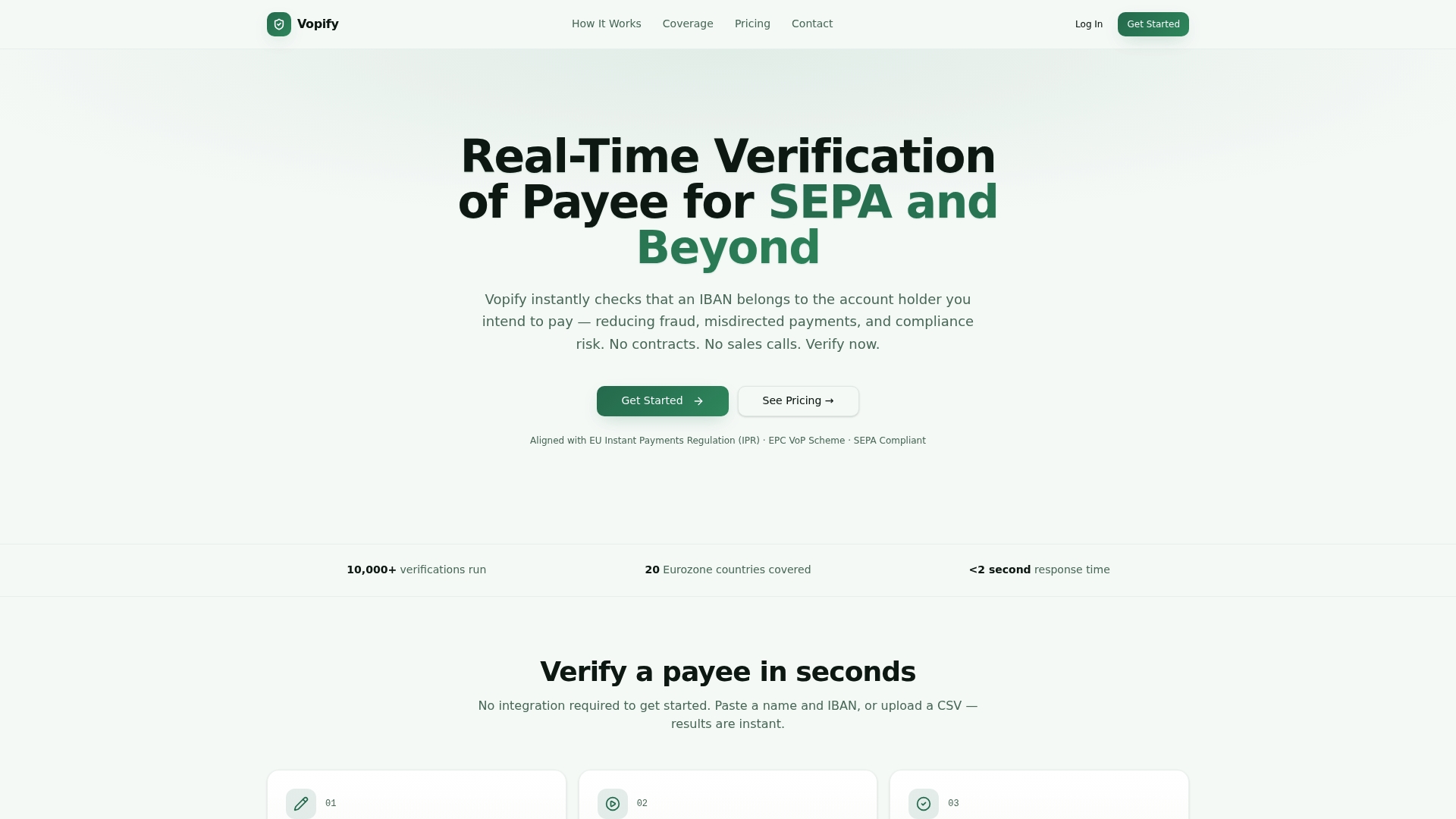
Finance teams that verify payees before every payment close the gap that BEC, APP fraud, and misdirected payments exploit. Vopify delivers real-time payee verification against live payment networks, confirming that the IBAN and account holder name match before funds move. With results in under two seconds, coverage across 20 Eurozone countries, and support for both single checks and bulk CSV uploads, Vopify fits into AP workflows without adding friction. Start verifying payees before the next wire goes out.