
What is a payee ID and why does it matter?
A Payee ID is a unique identifier assigned by a payment system or organization to a specific individual or entity that receives funds. Think of it as a permanent label the system attaches to you as a payee, so every transaction routes to the right place without ambiguity. Under CMS guidelines, for example, the Payee ID specifies the party receiving payment or subject to recoupment in Medicaid and CHIP financial transactions. The identifier is mandatory in those systems, not optional.
Key facts about what a payee identification number does:
- Uniquely links each payment to the correct recipient, whether an individual, vendor, or service provider
- Prevents duplicate payments and misrouted funds by giving the system a single, unambiguous reference
- Supports audit trails by tying every transaction record to one verified payee
- Distinguishes payees with identical names in payment records, which is a common problem in large vendor databases
- Enables automated payment processing since payment requests require a valid Payee ID before the system will execute a transfer
How to find your Payee ID in US state payment systems
The process varies by state, but the general path is consistent: log in, navigate to your profile, and locate the identifier there.
- Ohio (OhioPays). Go to ohiopays.ohio.gov, log in with your OH|ID credentials, click "Manage My Profile," then select "Self Service." Your Payee ID appears under the selected profile name. If you have multiple businesses registered, use the dropdown to select the right one first.
- Texas (TexPayment). Texas assigns a unique Texas Identification Number to every payee before any payment can be issued. New payees must complete a registration with the Texas Comptroller's office and submit identifying documents before a number is assigned.
- Other state portals. Most state financial systems follow a similar pattern: register through the official vendor or payee portal, provide your Tax ID or Social Security Number for identity verification, and receive your Payee ID once the account is approved.
- Mass payout platforms. For private-sector platforms, your Payee ID is typically visible in your account's payment information or profile section after registration.
Common documents required during registration include a federal Tax Identification Number (EIN or SSN), business name or legal name, banking information, and a completed W-9 form for US-based payees.
Pro Tip: Save your Payee ID in a secure internal record the moment you receive it. Re-registering an existing payee in most systems generates an error rather than a new ID, so losing track of it creates delays.
Common Payee ID formats across US states
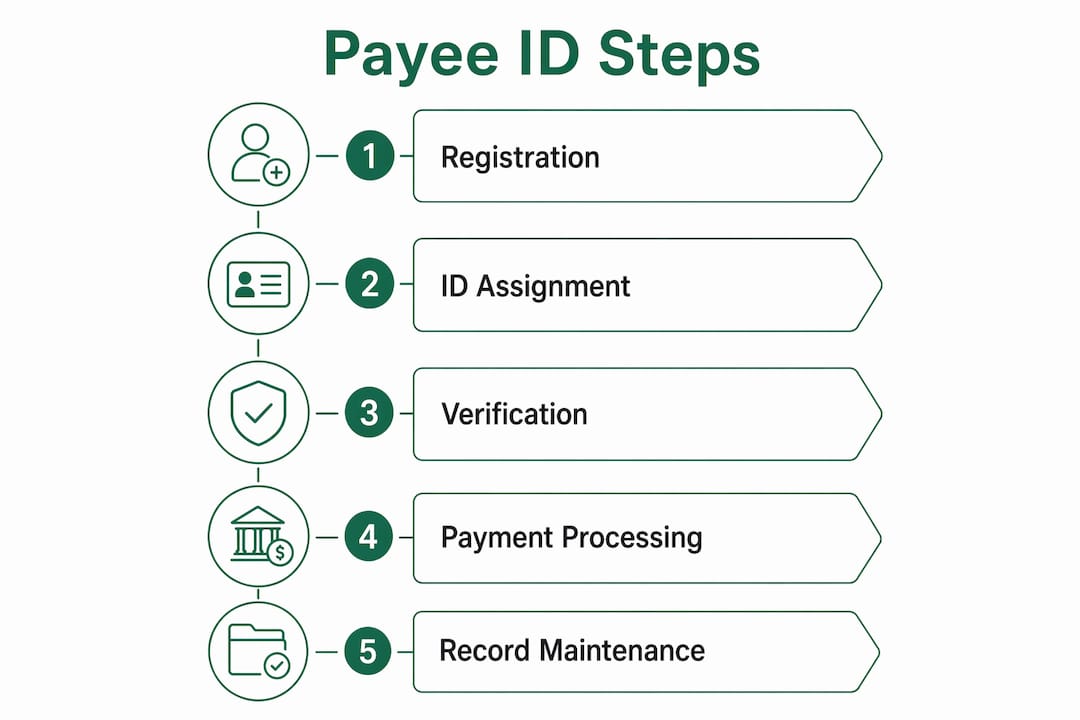
Formats differ widely depending on the agency or platform issuing them.

| State / System | Format | Length | Notes |
|---|---|---|---|
| Texas (TexPayment) | Numeric | 11 digits | Assigned by Texas Comptroller; required before payment |
| Ohio (OhioPays) | Alphanumeric | Varies | Tied to OH |
| CMS (Medicaid/CHIP) | Alphanumeric | Up to 30 characters | Mandatory field; defined in federal data element specs |
| Mass payout platforms | Username or serial | Flexible | Can be a nickname, username, or custom serial number |
A few format rules that apply broadly:
- Payee IDs are case-sensitive in many systems, so "Vendor001" and "vendor001" may be treated as different records
- Most government systems prohibit reuse of a retired Payee ID, even after a payee is deactivated
- Standardized formats are critical for API integrations, where a mismatched field length breaks automated payment runs
How does a Payee ID differ from a Tax ID, IBAN, or bank account number?
These identifiers serve completely different purposes, and mixing them up causes real problems.
- Payee ID: Assigned internally by the payment system or organization. Used for routing and recordkeeping within that specific platform. Not recognized outside it.
- Tax Identification Number (EIN/SSN): Issued by the IRS. Used for tax reporting, regulatory compliance, and identity verification across all government and financial systems.
- IBAN: A standardized international bank account number used for cross-border transfers, particularly in SEPA countries. Vopify's IBAN verification service confirms that an IBAN matches the intended account holder before a payment is sent.
- Bank account number: Identifies a specific account at a specific financial institution. Used by banks to process transfers but not tied to any payment platform's internal records.
A Payee ID is internally defined and maps to the organization's own system. Conflating it with a Tax ID or IBAN leads to audit failures and misdirected payments.
Where Payee IDs get used in practice
State agencies use Payee IDs to process vendor payments, grant disbursements, and employee reimbursements. Ohio's OhioPays system, for instance, covers everyone from DODD providers to state fair entertainers under a single payee registration framework. At the federal level, CMS requires a Payee ID on every Medicaid financial transaction to identify who receives or repays funds.
Private-sector platforms use them differently. In payment API integrations, the standard approach is to look up an existing Payee ID before initiating a transfer and create one only if none exists. Mass payout systems let businesses assign a custom identifier, such as a username or internal serial number, that maps to their own reconciliation logic. That flexibility is useful when you're paying thousands of vendors and need the ID to match your internal accounting codes.
Common Payee ID errors and how to fix them
Duplicate registration attempts are the most frequent issue. Trying to create a new Payee ID for an entity that already has one typically returns an error. The fix is a lookup first: search the system by Tax ID or legal name before submitting a new registration.
Mismatched name or ID fields cause payment rejections. If the name on file with the payment system doesn't match the name on the bank account or Tax ID record, the transaction fails. Verify the exact legal name before submitting.
Deactivated Payee IDs appear in older vendor databases. When a payee's account is closed or a vendor relationship ends, the ID is often retired. Reactivating it usually requires contacting the issuing agency directly rather than creating a new record.
Format errors in API submissions happen when a developer passes the wrong field length or character type. Always validate the Payee ID format against the system's published specification before pushing to production. For payment integration work, this is a standard pre-launch checklist item.
How Payee ID requirements vary across US states and agencies
No two states handle this identically. Texas runs one of the more structured systems: every payee must have an 11-digit Texas Identification Number on file with the Comptroller before a single payment can be issued, and the registration process is handled centrally. Ohio uses a federated model where payees register through OhioPays using their personal OH|ID, then associate that account with one or more business entities.
Federal agencies add another layer. CMS specifies a 30-character alphanumeric field for Payee IDs in Medicaid transactions, a format that state Medicaid agencies must accommodate in their own systems. Private platforms like mass payout services operate outside these government frameworks entirely and set their own rules, which is why a Payee ID from one platform carries no meaning in another.
For organizations processing payments across multiple states or agencies, the practical answer is to maintain a separate record of each system's Payee ID for every payee. A single vendor may have a Texas Identification Number, an OhioPays Payee ID, and a platform-specific identifier, all pointing to the same entity but living in completely separate systems.
How Vopify helps you verify payees before payment
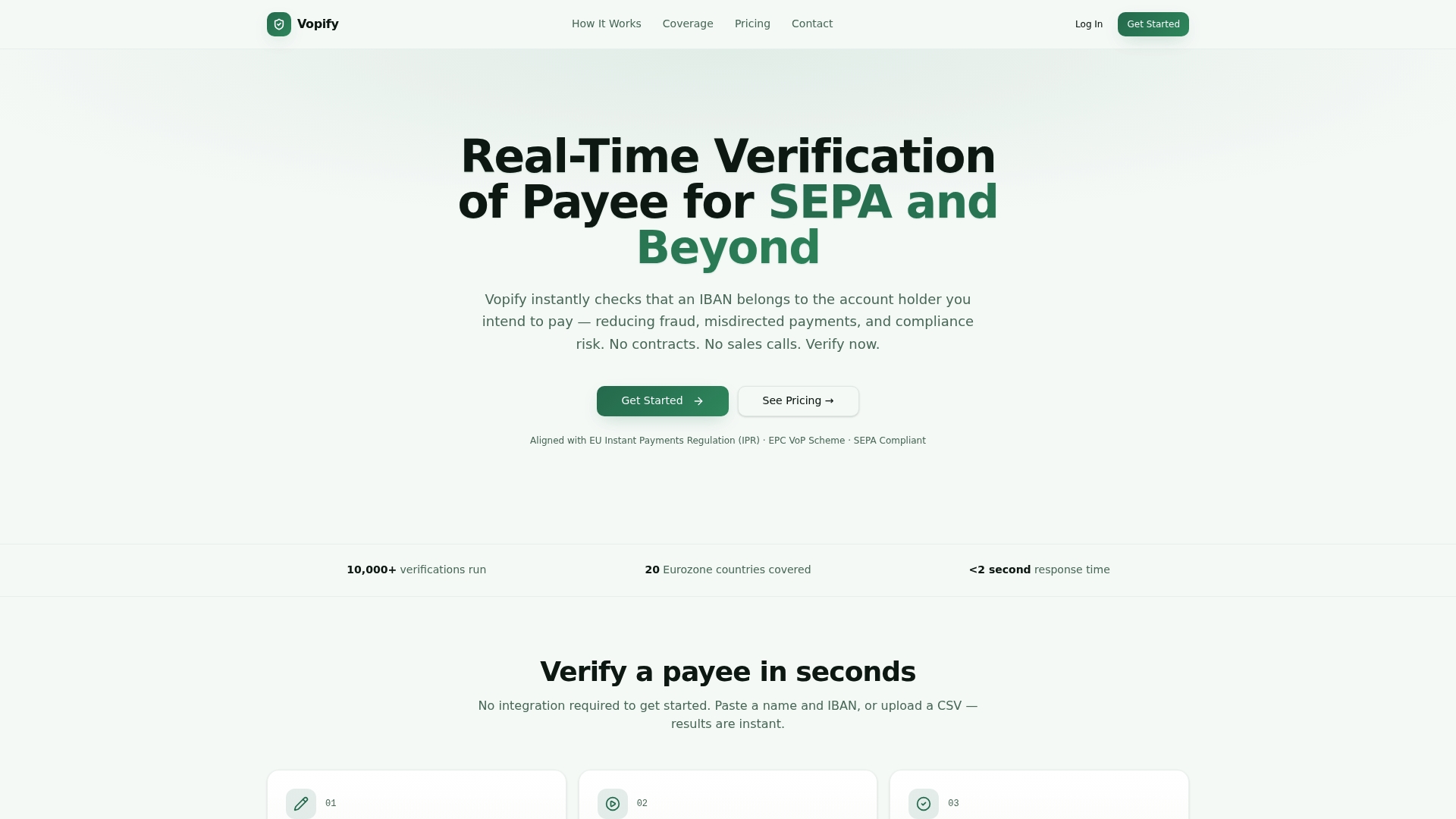
Knowing a payee's ID is only part of the picture. Before sending funds, you also need to confirm that the bank account details on file actually belong to that payee. Vopify does exactly that: it checks a name and IBAN against live payment networks in real time, returning a match result in under two seconds. The platform covers 20 Eurozone countries and supports both individual and business accounts, with options for single checks or bulk CSV verification for large supplier lists. For finance teams managing hundreds of payees across multiple systems, Vopify's verification service adds a concrete layer of protection between a Payee ID lookup and an actual payment going out the door.
Key Takeaways
A Payee ID is a system-assigned unique identifier that routes payments to the correct recipient and is not interchangeable with a Tax ID, IBAN, or bank account number.
| Point | Details |
|---|---|
| Payee ID definition | A unique code assigned by a payment system to identify a specific payment recipient. |
| Format varies by state | Texas uses an 11-digit numeric ID; CMS allows up to 30 alphanumeric characters; Ohio ties IDs to OH |
| Not the same as a Tax ID | A Payee ID is internal to the issuing system; a Tax ID is government-issued and used across all regulatory contexts. |
| How to find yours | Log into the relevant state portal or platform, navigate to your profile, and look under payment or profile settings. |
| Errors to avoid | Always look up an existing Payee ID before creating a new one; duplicate registrations generate errors, not new IDs. |