
Bank account verification confirms that a bank account exists, is active, and is owned or controlled by the person or business claiming it. For finance and accounts payable teams, that confirmation is the difference between a payment landing where it should and a wire disappearing into a fraudulent account. Verification goes well beyond checking whether an account number looks right. It queries live financial systems to confirm real ownership and account status.
What is bank account verification and why does it matter?
Bank account verification is a live, consented query to a financial institution or payment network that confirms three things: the account exists, it is active, and it belongs to the claimed holder. That last point is where most payment fraud actually happens. A fraudster can supply a perfectly formatted account number that passes every format check but routes funds to an account they control.
The stakes are real for accounts payable teams. Vendor payment fraud, payroll misdirection, and business email compromise all exploit the gap between "this number looks valid" and "this account belongs to who they say it does."
Key benefits of account verification include:
- Fraud prevention: Catches mismatched ownership before funds leave your system
- Regulatory compliance: Satisfies KYC and AML obligations built into payment regulations
- Fewer payment errors: Reduces returned payments and reconciliation work
- Vendor and payee trust: Gives counterparties confidence that your payment processes are controlled
- Faster onboarding: Automates a check that would otherwise require manual review
Common use cases include vendor onboarding, payroll setup, ACH payment authorization, and any supplier data refresh where account details may have changed.
Key methods used for bank account verification
Four main methods cover most of what finance teams encounter. Each has a different speed, security profile, and friction level.
Instant authorization (instant auth)
Instant auth uses tokenized customer consent to connect directly to a bank account via API. The account holder logs in through a secure interface, grants permission, and the system returns ownership and status confirmation in seconds. No credentials are exposed. This method is fast and reliable, but it requires the account holder to actively participate, which can be a friction point in B2B supplier onboarding.
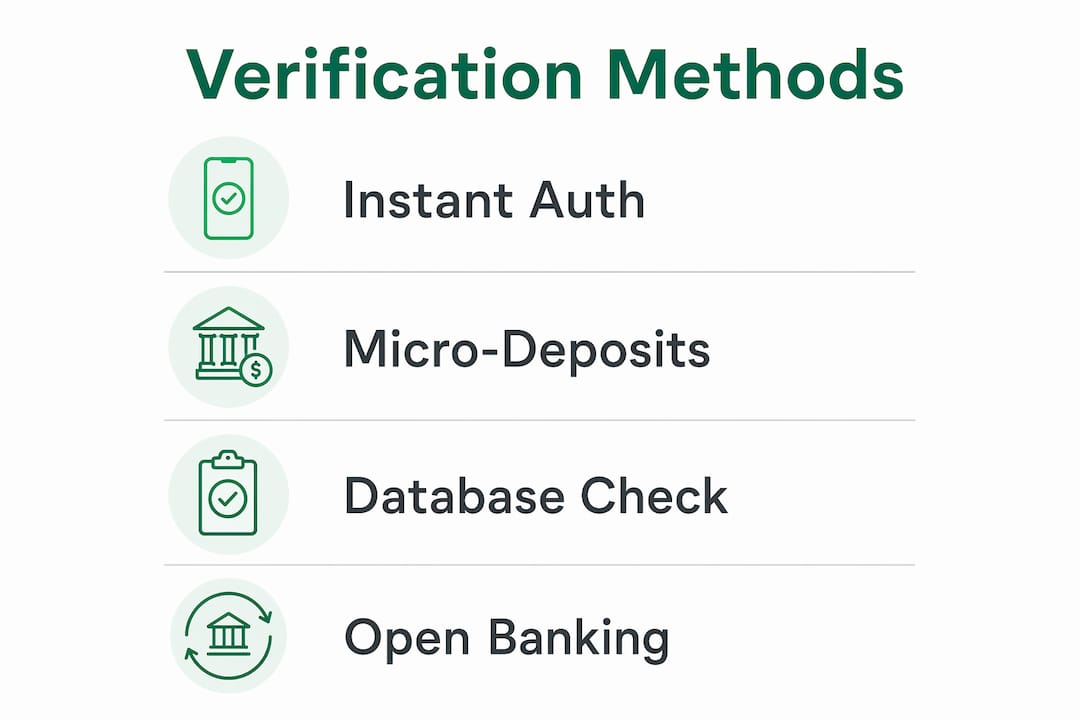
Micro-deposits
Micro-deposit verification sends one or two small amounts to the target account. The account holder then confirms the exact amounts, proving they can access the account. It is a well-established method, but it typically takes one to three business days and is susceptible to certain fraud types where an attacker has temporary access to an account they do not own.

Database validation
Database validation checks account details against a reference database of known bank accounts, routing numbers, or IBANs. It is fast and requires no action from the account holder. The limitation is that static databases go stale. An account that closed six months ago may still appear valid in an outdated reference file, which is exactly the kind of gap that leads to returned payments.
Open banking verification
Open banking leverages regulatory frameworks that require banks to share account data with authorized third parties, with the account holder's consent. It combines the speed of instant auth with richer data, including balance and transaction history when needed. Adoption is strongest in the EU and UK, where regulatory mandates have pushed banks to build compliant APIs.
| Method | Speed | Requires user action | Ownership confirmed | Key limitation |
|---|---|---|---|---|
| Instant auth | Seconds | Yes | Yes | Requires account holder participation |
| Micro-deposits | 1–3 days | Yes | Yes | Slow; some fraud exposure |
| Database validation | Seconds | No | No | Static data may be outdated |
| Open banking | Seconds | Yes | Yes | Regulatory availability varies by region |
How the bank account verification process works in practice
A thorough verification workflow follows a consistent sequence regardless of which method you use.
-
Collect account details. Gather the account holder's name, account number or IBAN, and routing number or BIC. For payee verification, this typically comes from a vendor onboarding form or supplier data file.
-
Submit details to the verification service. Pass the collected data to your verification platform, whether that is a direct bank API, a third-party service, or a bulk upload process for large payee lists.
-
Execute the verification. The service queries the relevant financial institution or payment network in real time. For methods requiring user consent, the account holder completes their step here.
-
Receive and interpret results. Verification results typically include three indicators: whether the account is valid, whether it is active, and whether the name matches the account holder on record. A mismatch on any one of these should trigger a hold.
-
Act on the outcome. Approve the payment or onboarding if all indicators pass. Reject or escalate if there is a mismatch or inconclusive result. Some workflows route partial matches to a manual review queue rather than an outright rejection.
-
Document the result. Record the verification outcome against the payee record. This creates an audit trail for compliance purposes and supports any dispute resolution later.
Timeframes vary from instantaneous with instant auth and open banking methods to several days with micro-deposits. For high-volume accounts payable operations, that difference in speed has a direct impact on payment cycle times.
Pro Tip: Run verification at onboarding and again whenever a supplier submits updated banking details. Account changes are a common vector for vendor fraud, and a one-time check at setup is not enough.
Validation vs. verification: a distinction that prevents fraud
Validation and verification are not the same thing, and confusing them is one of the most common causes of payment fraud in accounts payable.
Validation is a format check. It confirms that an account number or IBAN follows the correct structure, has the right number of digits, and passes a checksum algorithm. It runs offline, against no live system. A fraudulent account with a correctly formatted number passes validation every time.
Verification is a live query. It asks the financial institution whether the account exists, whether it is open, and whether the name provided matches the account holder. Relying solely on validation leaves organizations exposed to authorized push payment fraud, where funds are sent to a real but fraudulent account that simply had a valid format.
Best practices for combining both:
- Always run format validation first to catch obvious errors before hitting live systems
- Follow with live verification for any new payee or any payee who has submitted updated account details
- Treat a validation pass as a necessary but not sufficient condition for payment approval
- Flag any account that passes validation but fails verification for immediate manual review
Verification requires live, consented queries to the financial institution or secure APIs. Static references and offline checks cannot reliably confirm ownership or account activity status.
Security and privacy considerations in bank account verification
Verification processes handle sensitive financial data, which means security and privacy controls are not optional. Any platform you use should encrypt data in transit and at rest, and it should operate under a clear data retention policy that limits how long account details are stored.

Consent is the other critical factor. Open banking and instant auth methods require explicit account holder consent before any data is accessed. That consent must be documented, time-limited, and revocable. Collecting more data than the verification requires, or retaining it longer than necessary, creates both a privacy liability and a security risk.
For accounts payable teams running bulk verification across large supplier lists, access controls matter as much as encryption. Limit who within your organization can initiate verifications or view results, and log every query for audit purposes.
Regulatory and compliance requirements impacting bank account verification
Bank account verification sits at the intersection of several regulatory frameworks that finance teams need to understand.
In the United States, NACHA's rules for the ACH network require originators to verify account ownership before initiating certain transaction types. FinCEN's Customer Due Diligence rule requires financial institutions to identify and verify the identity of beneficial owners, which includes confirming the bank accounts they control.
In the EU, the Instant Payments Regulation mandates Verification of Payee checks for SEPA credit transfers, requiring payment service providers to confirm that the payee name matches the account before processing. SEPA-compliant verification is now a legal requirement for EU payment service providers, not a best practice.
KYC and AML obligations apply broadly. Whether you are onboarding a new vendor or processing a high-value payment, regulators expect documented evidence that you confirmed who you were paying. Verification records serve as that evidence.
Technological platforms and tools that support bank account verification
The verification technology market has matured considerably. Finance teams now have access to platforms that handle everything from single-account checks to bulk verification of thousands of payees via CSV upload.
API-based verification services connect directly to payment networks and bank systems, returning results in under two seconds for supported account types. These are the right choice for high-volume, real-time payment workflows. Platforms like Vopify, which has processed over 10,000 verifications across 20 Eurozone countries, deliver results in under two seconds by querying live payment networks directly.
For teams managing large supplier databases, global IBAN verification tools that accept bulk CSV uploads let you verify an entire vendor list in one pass rather than checking accounts one by one. That matters when you are refreshing supplier data ahead of a payment run or onboarding a new batch of vendors.
In the UK, Confirmation of Payee (CoP) is the specific scheme that checks whether a payee name matches the account. Vopify's CoP service covers UK bank accounts within the broader framework of global payee verification.
For finance teams also managing accounting workflows, AI-driven bookkeeping tools increasingly integrate verification steps into their reconciliation processes, reducing the manual effort of cross-checking payment details.
Best practices for implementing bank account verification
Getting verification right is as much about process design as it is about technology.
Verify at every account change, not just at onboarding. Fraudsters know that most organizations verify once and then trust the record indefinitely. Submitting a fake account change request to an established vendor record is a well-documented attack pattern.
Automate reconciliation between verification outcomes and payment authorization. Manual handoffs between a verification result and a payment approval create gaps where errors and fraud can slip through. Effective verification processes integrate verification outcomes directly into the payment authorization workflow.
Use multiple methods for high-value payments. A single verification method can fail or return inconclusive results. For payments above a defined threshold, running a secondary check, whether a database cross-reference or a manual callback to the payee, adds a meaningful layer of protection.
Set clear escalation rules for mismatches. Define in advance what happens when a name matches partially, when an account is flagged as inactive, or when a verification service returns an error. Teams without documented escalation paths tend to approve payments anyway under time pressure.
Maintain an audit trail. Every verification query, result, and subsequent action should be logged against the payee record. Regulators and auditors expect this documentation, and it is your primary defense if a fraudulent payment is later disputed.
Key Takeaways
Bank account verification requires live queries to financial institutions to confirm account existence, active status, and ownership, making it the only reliable defense against payment fraud that format checks alone cannot catch.
| Point | Details |
|---|---|
| Verification vs. validation | Validation checks format only; verification confirms live ownership and account status. |
| Four core methods | Instant auth, micro-deposits, database validation, and open banking each offer different speed and security trade-offs. |
| Regulatory requirements | NACHA, FinCEN CDD rules, and the EU Instant Payments Regulation all mandate or strongly imply payee verification. |
| Verify at every account change | One-time onboarding checks are not enough; account change requests are a primary fraud vector. |
| Automate the workflow | Integrating verification outcomes directly into payment authorization reduces manual errors and closes fraud gaps. |