
Payment fraud is the intentional theft of funds through deceptive or unauthorized payment transactions. For finance and accounts payable teams, that definition carries real weight: fraudsters don't just target banks or consumers. They target the people who process vendor invoices, approve wire transfers, and update supplier bank details. The core forms your team needs to recognize include:
- Authorized Push Payment (APP) fraud: The victim is manipulated into authorizing a transfer to a fraudulent account. Recovery is nearly impossible once funds settle.
- Business Email Compromise (BEC): A spoofed or hacked email impersonates an executive or vendor to redirect payments.
- Invoice redirection: Fraudsters intercept or forge invoices, swapping legitimate bank details for their own.
- Account takeover: Stolen credentials give fraudsters control of a vendor or employee account.
- Check fraud: Physical checks are intercepted, washed, or forged before clearing.
Real-time payment systems eliminate the cooling-off period that once gave finance teams a chance to catch errors. When a payment settles in seconds, the fraud window closes before anyone can act.
Table of Contents
- What are the most common types of payment fraud hitting U.S. businesses?
- How payment fraud tactics have evolved and what that means for your team
- Best practices for preventing payment fraud, including zero-trust verification
- How real-time verification technology secures payments before they leave your account
- What technologies are used to detect payment fraud?
- Legal and regulatory considerations around payment fraud
- Key Takeaways
What are the most common types of payment fraud hitting U.S. businesses?
Finance teams face a specific and well-documented threat landscape. Juniper Research projects $362 billion in global business losses from online payment fraud between 2023 and 2028. The threats driving that number are not abstract.
| Fraud Type | How It Works | Typical Consequence |
|---|---|---|
| Business Email Compromise | Spoofed email redirects vendor payment | Wire transfer lost, often unrecoverable |
| Invoice Redirection | Fraudster swaps bank details on a legitimate invoice | Payment lands in fraudster's account |
| APP Fraud | Victim authorizes transfer under false pretenses | Instant, irreversible fund loss |
| Account Takeover | Stolen credentials used to alter payment instructions | Unauthorized transactions, data breach |
| Check Fraud | Check washing or forgery exploits processing delays | Funds drained before check clears |
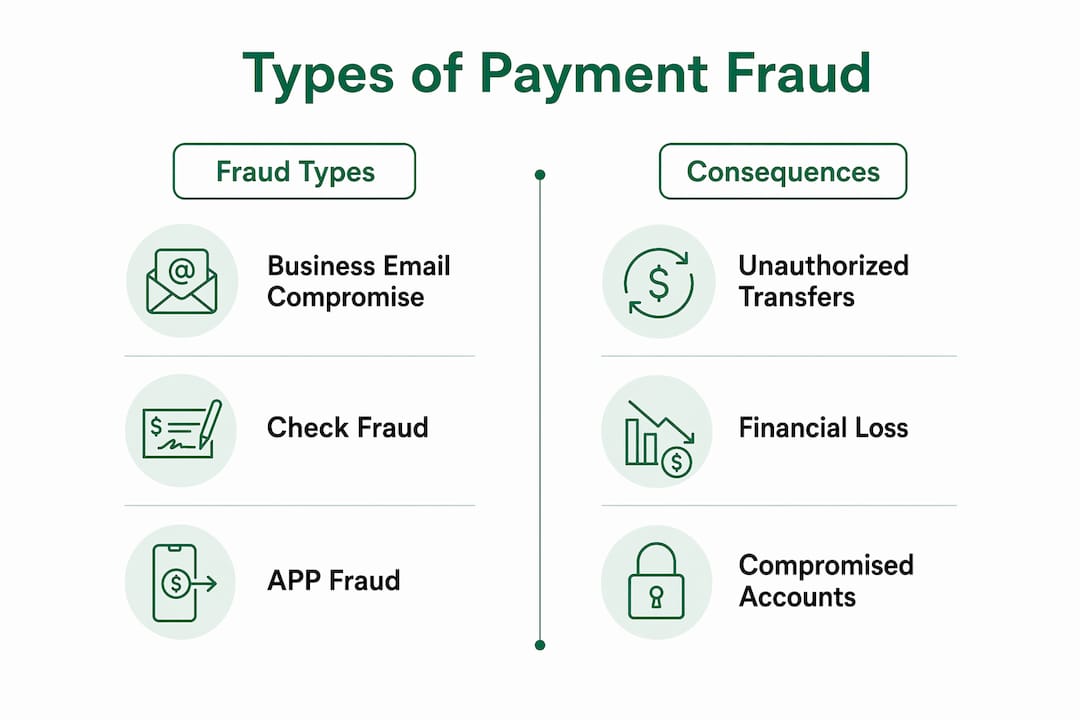
AP departments are frequent BEC targets because they handle high volumes of vendor bank detail updates, often without robust verification protocols. A single email claiming a supplier changed its banking information can be enough.
Check fraud remains serious despite the shift to digital payments. Techniques like check washing exploit the time lag in physical check processing, giving fraudsters a window to intercept and alter checks before funds clear.
APP fraud is particularly damaging because the victim authorizes the payment themselves. That authorization complicates any dispute or reversal claim, especially when the transfer has already settled.
How payment fraud tactics have evolved and what that means for your team
The threat has shifted. Fraud used to center on stealing credentials and initiating unauthorized transactions. Now, according to Visa's payment fraud research, the dominant vector is authorized fraud: manipulating legitimate users into making the payment themselves.
That shift matters because traditional defenses, such as spam filters and visual invoice checks, were built to catch unauthorized intrusions. They are not designed to stop a well-crafted impersonation that never touches your firewall.
Evolving tactics your team should watch for:
- AI-generated phishing emails that replicate a vendor's exact writing style and formatting
- Deepfake voice calls impersonating executives to authorize urgent wire transfers
- Synthetic identity fraud using fabricated credentials to establish fake vendor relationships
- Mandate fraud targeting direct debit setups by submitting false authorization forms
- Payroll fraud redirecting employee direct deposits through compromised HR portals
The CISA cybersecurity advisory on payment fraud frames AP teams as the "soft underbelly" of corporate finance, precisely because behavioral vulnerabilities are harder to patch than software ones. An employee who trusts an urgent email from what looks like the CFO is not making a technical error. They are being socially engineered.
Best practices for preventing payment fraud, including zero-trust verification
The most effective prevention posture treats every change to payment data as suspect until independently confirmed. CISA's advisory calls this a zero-trust approach: verify any payment data change out-of-band, regardless of how legitimate or urgent the request appears.
Practical steps for accounts payable teams:
- Never update vendor bank details based on email alone. Call the vendor at a number from your existing records, not the one in the email.
- Require dual authorization for any payment above a defined threshold.
- Implement Positive Pay for check disbursements to catch unauthorized alterations before they clear.
- Set up ACH debit alerts to flag unauthorized or anomalous transactions in real time.
- Train staff on the "stop, call, confirm" method before processing any unusual payment request.
- Restrict use of personal or free email accounts for business payment communications.
Consider a wire fraud case documented by Regions Bank: a manager received an email appearing to come from the company CFO, requesting an urgent wire transfer. The manager complied. The email was fraudulent. A simple out-of-band call to the CFO's known number would have stopped it.
Pro Tip: Build a verified vendor contact directory that is stored separately from your email system. When a bank detail change request arrives, your team should reach for that directory first, not the reply button.
How real-time verification technology secures payments before they leave your account
Pre-transaction verification is the only reliable defense in a real-time payments environment. Once funds move, recovery options are effectively zero.
Vopify addresses this directly. The platform matches a payee's name against their IBAN in under two seconds, confirming that the account holder is who the payment instruction claims. That check happens before the transaction is created, not after. Vopify covers 20 Eurozone countries under the EU Instant Payments Regulation, plus India, Indonesia, South Korea, and China via Alipay. For teams managing cross-border supplier payments, global payee verification across those markets in a single workflow removes a significant manual burden.
Key capabilities and their business impact:
- Instant name-to-IBAN matching catches mismatches caused by invoice redirection or BEC before payment executes
- Bulk CSV upload lets AP teams verify thousands of payees during supplier onboarding or periodic audits
- SEPA compliance aligns with the EU Instant Payments Regulation, reducing regulatory exposure
- Sub-two-second response time fits naturally into existing payment approval workflows without adding friction
- Pay-as-you-go credits or subscriptions scale with transaction volume, from small teams to enterprise AP operations
Statistic: Vopify has processed over 10,000 verifications across 20 Eurozone countries, with results returned in under two seconds per check.
What technologies are used to detect payment fraud?
Detection technology has moved well beyond rule-based filters. Modern fraud detection layers several approaches:
Machine learning and behavioral analytics establish a baseline of normal payment behavior for each vendor and flag deviations, such as a supplier suddenly requesting payment to a new account in a different country. These systems improve with volume; the more transactions they process, the sharper their anomaly detection becomes.
AI-powered transaction monitoring runs in real time, scoring each payment against hundreds of risk signals simultaneously. J.P. Morgan's fraud prevention specialists note that understanding fraud types and tactics is foundational to deploying these tools effectively, because the model needs to know what it is looking for.

Payee verification services like Vopify operate at the point of payment setup, confirming account ownership before a transaction ever enters the payment rail. This is distinct from monitoring, which catches fraud during or after execution. Verification stops it at the source.
Multifactor authentication (MFA) protects the accounts that initiate payments. Around 70–80% of online data breaches involve password theft, according to J.P. Morgan, making MFA a baseline control rather than an optional upgrade.
Positive Pay systems for check disbursements automatically compare issued checks against those presented for payment, blocking alterations before they clear.
No single tool covers every vector. Effective detection combines pre-transaction verification, real-time monitoring, and strong access controls.
Legal and regulatory considerations around payment fraud
Finance teams in the United States operate under a layered regulatory framework that shapes both liability and reporting obligations.
The Bank Secrecy Act (BSA) requires financial institutions to file Suspicious Activity Reports (SARs) when fraud is detected or suspected. Businesses that discover fraud may need to coordinate with their bank on SAR filings, particularly for BEC and wire fraud cases.
FinCEN actively monitors payment fraud trends and issues alerts, including specific guidance on mail theft-related check fraud, which has risen sharply. Businesses that rely on paper checks should treat FinCEN alerts as operational intelligence, not just compliance reading.
The FBI's Internet Crime Complaint Center (IC3) is the primary federal reporting channel for BEC and wire fraud. Reporting quickly matters: the FBI's Recovery Asset Team has had success clawing back funds when businesses report within hours of a fraudulent transfer, but that window closes fast.
For businesses with international payment flows, the EU Instant Payments Regulation now mandates payee verification for SEPA credit transfers, making services like Vopify's SEPA-compliant verification a regulatory requirement, not just a best practice, for payments into the Eurozone.
Internally, finance teams should document their fraud prevention controls. In the event of a loss, demonstrating that reasonable controls were in place can affect insurance claims and limit legal exposure.
Key Takeaways
Payment fraud is irreversible once funds settle in real-time payment systems, making pre-transaction payee verification the single most effective control available to finance teams.
| Point | Details |
|---|---|
| Zero-trust is the baseline | Verify every payment data change out-of-band, regardless of how legitimate the request appears. |
| BEC and invoice redirection dominate | AP teams are the primary target; a single unverified bank detail update can redirect an entire payment run. |
| Real-time payments remove recovery options | Once funds settle instantly, reversal is effectively impossible — verify before, not after. |
| Technology must layer | Combine pre-transaction verification, behavioral monitoring, MFA, and Positive Pay for full coverage. |
| Regulatory exposure is real | U.S. businesses face BSA reporting obligations and, for Eurozone payments, EU Instant Payments Regulation compliance requirements. |