
Verify bank account ownership with one of three methods: accepted documents (bank statement, voided check, or bank verification letter), micro-deposits, or a real-time account-validation API. Use documents and micro-deposits during vendor onboarding when speed doesn't matter as much as building a paper trail. Use real-time API checks right before any payment run, especially for new payees or high-dollar transfers, where a deterministic match can be returned in under five seconds.
- Documents: statement, voided check, or bank letter current within 30 to 90 days
- Micro-deposits/prenotes: slower but useful when API coverage is thin
- Real-time API: deterministic or probabilistic match against live bank data, seconds not days
Pro Tip: If you're only verifying once, at onboarding, you're leaving a gap. Vendors change banks, get compromised, or hand you a routing number that was never theirs to begin with. Re-verify before any payment above your internal risk threshold, not just the first one.
Key Takeaways
Real-time API verification catches account-switch fraud that document checks alone miss, because ownership can change between onboarding and the next payment run.
| Point | Details |
|---|---|
| Layer your methods | Combine document review at onboarding with real-time API checks before every payment run. |
| Match freshness matters | Reject bank statements or letters older than 90 days, and never accept screenshots. |
| Tier your risk | Reserve deterministic API matches or bank-signed letters for high-dollar or new-payee transactions. |
| Log every response | Store match scores and per-field codes so disputes can be resolved without re-running checks. |
| Vopify handles the real-time layer | Vopify verifies name-to-IBAN ownership in under two seconds across 20 Eurozone countries, with bulk CSV checks for high-volume onboarding. |
Table of Contents
- What Bank Account Ownership Verification Actually Solves
- Documents, Micro-Deposits, and Real-Time APIs Compared
- Building Verification Into the Payables Workflow
- Developer Guide to Interpreting Match Responses
- Why Verification Checks Fail (and How to Fix Them)
- How Vopify Runs Real-Time Payee Verification
- Editorial Take: What the Industry Gets Wrong About Verification
- Skip the Contracts, Check Every Payee in Seconds
- Sources
What Bank Account Ownership Verification Actually Solves
Bank account ownership verification confirms that the name attached to a routing and account number matches the person or business you intend to pay. That's the whole job. It sounds simple until you realize most payment fraud doesn't come from hackers breaking into systems. It comes from someone convincing an AP clerk that a legitimate vendor changed their banking details.
This is the mechanism behind Business Email Compromise (BEC), and shifting from manual document review to real-time verification meaningfully cuts BEC exposure and reduces payment returns, according to KeyBank's developer guidance.
Timing determines how much protection you actually get:
- Verify at onboarding to catch bad data before a vendor record exists in your system
- Verify again before payment, especially for new payees, changed bank details, or amounts above your risk threshold
- Skipping the pre-payment check is where most losses happen. Onboarding fraud is rare. Mid-relationship account-switch fraud is not.
A vendor verified once in January and never checked again is a vendor you're trusting blindly by June.
Documents, Micro-Deposits, and Real-Time APIs Compared
Three methods dominate practice, and each fits a different moment in the payables lifecycle.
Manual documents remain the baseline for onboarding files. A bank statement, a voided check, or a signed bank verification letter typically qualifies, provided it shows the account holder's name, account number, and routing number with visible bank branding. Freshness matters: many organizations require statements dated within the last 30 to 90 days, and some lender programs require fresher statements. A six-month-old statement or a cropped screenshot should trigger a request for something current, not a rubber stamp
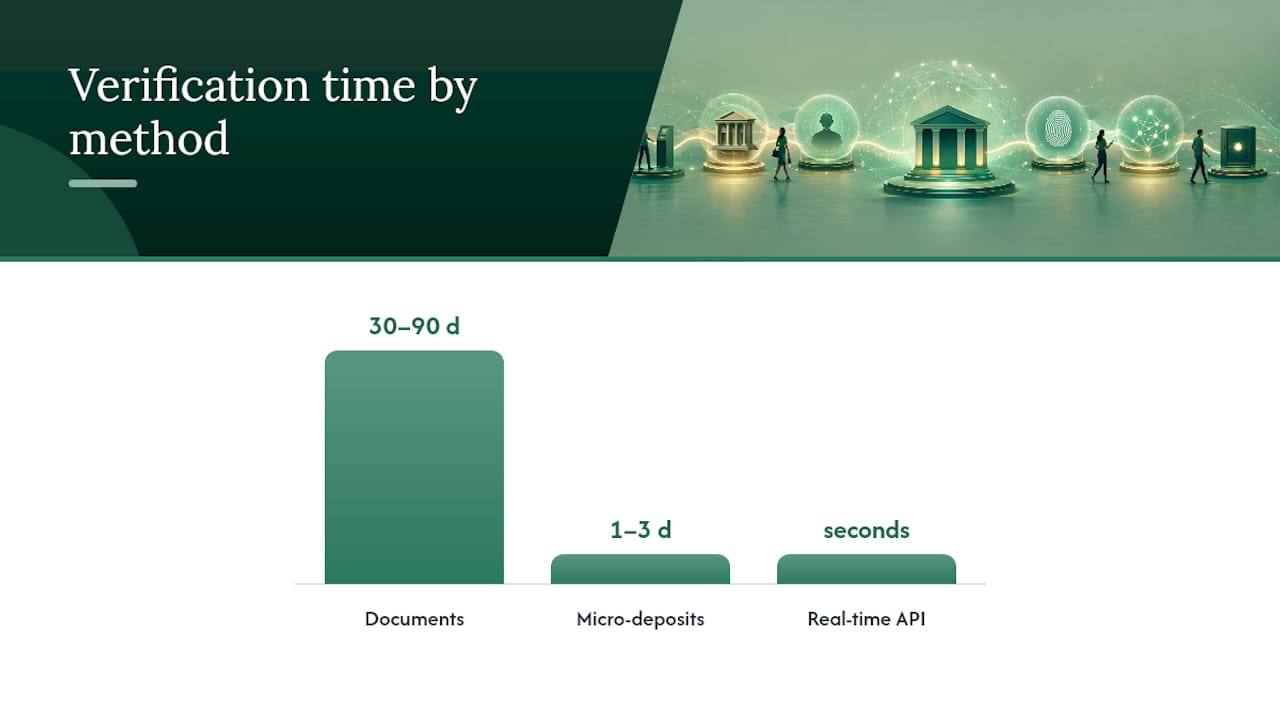
Micro-deposits and prenotes send one or two small test transactions and ask the account holder to confirm the amounts, or route a $0.00 prenote through the ACH network to test that an account exists. This takes one to three business days. It's slow for a payment deadline but still useful when a payee's institution isn't covered by your API provider, or as a secondary check layered on top of document review. Some providers also accept third-party electronic connections, similar to how Plaid links accounts, as a paperless alternative when the underlying data is current.
Real-time API verification matches a name and account against live bank records and returns a result in seconds. Results come back either deterministic (a direct, confirmed ownership match from the bank) or probabilistic (a confidence score based on partial matches across name, address, and account fields).
- Documents: strong evidence trail, zero cost beyond staff time, but slow and easy to falsify.
- Micro-deposits: low cost, moderate friction, but adds days to onboarding.
- Real-time API: fastest and hardest to spoof, but requires integration work and, for probabilistic scores, a defensible internal threshold for what counts as a pass.
Building Verification Into the Payables Workflow
Treat verification as tiered, not binary. A $200 recurring utility payment doesn't need the same scrutiny as a $200,000 wire to a new supplier.
- Low risk (small, recurring, established payee): document on file, no re-check needed unless bank details change.
- Medium risk (new vendor, moderate dollar amount): statement or voided check plus one real-time API check before the first payment.
- High risk (new payee, large amount, or any changed banking detail on an existing vendor): require a deterministic API match or a bank-signed verification letter before releasing funds, and hold the payment if the match fails.
A workable onboarding flow: collect the document, run the API check, and only mark the vendor "approved to pay" once both align. For payment runs, auto-verify payees above a dollar threshold you set, and route anything with a probabilistic score below your cutoff to manual review rather than letting it process automatically.
Log everything. Every verification attempt should record the match result, the confidence score, the timestamp, and the supporting document reference. That's not just good hygiene, it's what an auditor or a bank's fraud investigator will ask for when a disputed payment gets escalated.

Pro Tip: Set your acceptance threshold in writing before you go live, not after the first ambiguous score shows up in production. Deciding case by case is how inconsistent enforcement creeps in.
Developer Guide to Interpreting Match Responses
Sending more identifying data improves match reliability. Beyond the account and routing number, include the full legal name, address components, and, when available, partial identifiers like date of birth. J.P. Morgan's account validation documentation recommends this because a bare name-and-number pair often isn't enough to resolve a confident match against common names.
Responses typically break into per-field match codes and an overall score:
| Response element | What it means | Typical action |
|---|---|---|
| Deterministic match | Bank confirms exact ownership | Auto-approve |
| High probabilistic score | Strong partial match across fields | Auto-approve or light review |
| Low probabilistic score | Weak or partial field alignment | Manual review |
| Explicit mismatch/decline | Name and account don't align | Decline, request new documentation |
Per-field codes (often expressed as Y, N, C, or U for yes, no, conditional, and unavailable) tell you which field failed, which matters more than the overall score alone. A name mismatch paired with a matched address is a different problem than a matched name with an unavailable address field.
Design for latency under five seconds, build retry logic with backoff for timeout responses rather than treating a timeout as a decline, and if you're checking vendors in batches, use bulk verification rather than looping single calls, which strains rate limits fast. Store the raw response alongside the match breakdown for every check. That log is what turns a disputed payment into a five-minute investigation instead of a week-long one.
Why Verification Checks Fail (and How to Fix Them)
Most failed verifications aren't fraud. They're data problems.
- Name mismatches: A vendor operating under a DBA, a recent legal name change, or inconsistent punctuation between your records and the bank's will throw a mismatch. Resolve with a supporting document or a cross-check against your KYC file.
- Stale or altered documents: Enforce your freshness window strictly and reject screenshots outright. A PDF you can trace to a bank portal beats a photo every time.
- Joint and corporate accounts: These carry extra complexity. Corporate accounts may need Ultimate Beneficial Owner verification, and each UBO can require separate KYC review before you're confident in who actually controls the funds.
- When to escalate: If document review and API checks disagree, or the payment is large enough to justify it, request a bank-signed verification letter, which carries more weight than a statement because a bank officer is personally attesting to it.
Pro Tip: A mismatch is not automatically a red flag. It's a prompt to ask one more question before the money moves.
How Vopify Runs Real-Time Payee Verification
Vopify checks whether an IBAN actually belongs to the name you've been given, in real time, for both individual and business accounts. You submit a name and an IBAN; the response comes back without a contract, a sales call, or a multi-day onboarding process.
That matters because the riskiest moment in AP isn't the big obvious fraud attempt. It's the routine vendor update that nobody double-checks. Vopify's coverage spans live payment networks across multiple countries, built to keep pace with current payment regulations rather than lag behind them.
- Single checks for one-off payee verification before a wire goes out
- Bulk CSV uploads for verifying supplier lists at onboarding scale
- Dashboard-based results with credit bundles or subscription access, no API contract required to start
The platform has run over 10,000 verifications across 20 Eurozone countries, with responses returned in under two seconds, which is the kind of speed that makes pre-payment verification a habit rather than a bottleneck.
Editorial Take: What the Industry Gets Wrong About Verification
Most guidance on this topic treats verification as a one-time gate: check the vendor once at onboarding, file the document, move on. That advice is outdated the moment a vendor's bank details change, and they change more often than most AP teams assume, whether from a legitimate bank switch or a fraudster intercepting an email thread.
The bigger miss is treating documents and APIs as competing methods instead of complementary layers. A statement on file proves something happened once. A real-time check proves something is true right now. You need both, at different points in the relationship, not one or the other.
Where I'd push back hardest: probabilistic scoring gets used as a set-it-and-forget-it filter far too often. A confidence score is only as good as the threshold you set behind it, and too many teams borrow a default threshold instead of deciding, deliberately, what risk they're willing to accept at each payment tier. That's a policy decision, not a technical one, and it deserves the same scrutiny as your approval limits.
Prioritize the pre-payment check before you perfect anything else. Onboarding fraud is rare. The account-switch mid-relationship is where the money actually walks out the door.
— David
Skip the Contracts, Check Every Payee in Seconds
Vopify gives you what most verification setups make you wait days or sign contracts for: an instant answer on whether a name matches an IBAN, with no onboarding process standing between you and your next payment run.
That's the practical gap this article keeps circling back to. Document checks and micro-deposits work, but they're slow by design, and slow is exactly what a fraud window needs. Vopify closes that window with a name-and-IBAN check that returns a result in under two seconds, covering live payment networks across 20 Eurozone countries plus India, Indonesia, South Korea, and Alipay accounts in China. If you're running vendor onboarding at volume, the bulk CSV upload checks your whole supplier list in one pass instead of one payee at a time. Run a single check on your next new payee before the payment clears, and see the result land before your coffee does.
Sources
- Mastercard — Account owner verification (insights)
- LegalClarity — How to show proof of a bank account: accepted documents
- J.P. Morgan developer docs — Verify a U.S. bank account and ownership