
An IBAN validation API in the sense that matters for payments doesn't just check whether an IBAN is formatted correctly. It queries live bank and payment-network records to confirm the account holder's name actually matches the IBAN you have on file, and returns one of four standardized outcomes: Match, Close match, No match, or Verification not possible. This is Verification of Payee (VoP), and it's designed to run right before you execute a payment, not after.
Finance teams, accounts payable staff, treasury and compliance specialists, and the developers who build payment workflows all benefit from this check for the same reason: it catches a mismatched name and account before money leaves the building. Vopify offers verifications across multiple Eurozone countries with response times under two seconds, which gives a sense of how fast this check can run inside a normal payment cycle.
- Match: the name and IBAN correspond exactly.
- Close match: minor discrepancies (middle names, abbreviations, punctuation).
- No match: the name does not correspond to the IBAN's registered holder.
- Verification not possible: the receiving bank can't confirm either way.
The operational recommendation is simple: run this check pre-execution, on every payment above your risk threshold, not as a one-time onboarding formality.
Key Takeaways
Real-time IBAN validation confirms that a payee's name matches their bank account before a payment executes, and it works best as a pre-execution gate paired with strong vendor master governance rather than a standalone fraud control.
| Point | Details |
|---|---|
| Four response statuses | Match, Close match, No match, and Verification not possible each require a distinct workflow response. |
| Run checks pre-execution | Gating payments before release catches fraud introduced after onboarding, unlike a one-time check. |
| VoP has real limits | It confirms names, not invoice legitimacy, sanctions status, or insider-altered vendor records. |
| Clean vendor data first | Inconsistent name formats and outdated IBANs drive false No match results more than actual fraud does. |
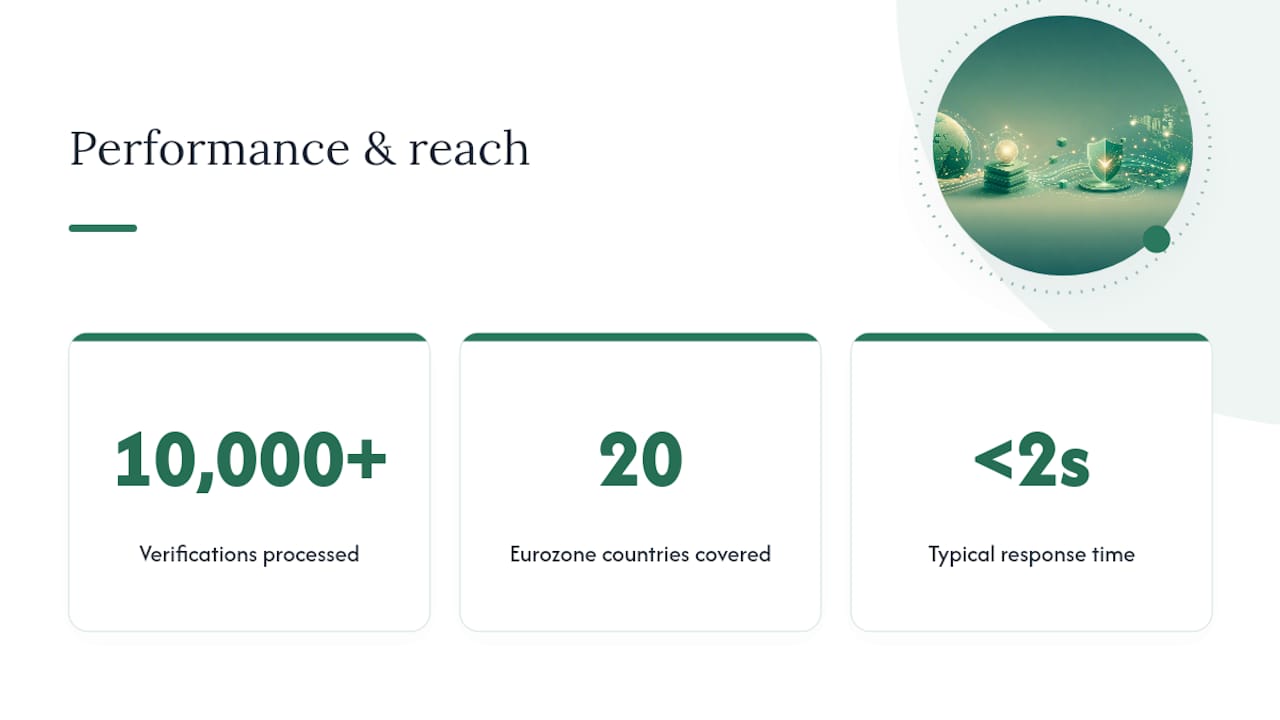
| Vopify delivers sub two second checks | Vopify has processed over 10,000 verifications across 20 Eurozone countries with results in under two seconds, via single or bulk CSV lookups. |
Table of Contents
- How Does an IBAN Validation API Actually Work?
- What Payee Verification Actually Prevents (and What It Doesn't)
- Setting Up Payee Verification Without Breaking Your Payment Runs
- Where Verification Fits Inside ERP and Payment-Factory Workflows
- What Does It Cost to Verify Every Payee?
- Why Finance Teams Choose Vopify for Payee Verification
- Get Instant Payee Verification With Vopify
- Sources
How Does an IBAN Validation API Actually Work?
A request to a real-time verification service typically includes the beneficiary's full legal name, the IBAN, and sometimes an account type flag (individual or business). The API sanitizes and normalizes these inputs, stripping extra whitespace, standardizing diacritics, and validating the IBAN's country code and check digits before it ever leaves your system.
From there, the flow follows a consistent pattern:
- Your system submits a name-plus-IBAN pair, either as a single lookup or as part of a bulk CSV batch.
- The API routes the request to the relevant payment network or bank, which holds the actual account holder record.
- The bank compares the submitted name against its registered holder name using fuzzy matching logic.
- The service returns a standardized response status plus metadata: timestamp, a confidence indicator for close matches, and often a reason code when verification isn't possible.
Under the EU's Instant Payments Regulation, euro-area providers have had to offer this kind of verification since October 2025, and the check is built to return an answer fast enough to sit inside a normal payment authorization step rather than delay it, according to Serrala. Vopify's own coverage runs across multiple countries with sub two second responses, which is the kind of latency that lets you gate a payment without anyone noticing a delay.
"Verification not possible" deserves attention in your logging strategy. It doesn't mean fraud. It usually means the receiving bank doesn't participate in the scheme, or the account is a type the network can't check. Surface that status distinctly in your UI so an AP clerk doesn't mistake it for a red flag.
What Payee Verification Actually Prevents (and What It Doesn't)
The check earns its place by catching the errors that cause the most expensive payment mistakes: a transposed digit in an IBAN, a supplier's name typed slightly wrong during onboarding, or a fraudster who swaps in a lookalike account after intercepting an invoice. Any of those trigger a Close match or No match response instead of sailing through unnoticed.
But verification of payee has a defined job, and it stops there. It confirms a name corresponds to an account. That's it.
- It does not validate that the invoice behind the payment is legitimate.
- It does not screen for sanctions, AML flags, or politically exposed persons.
- It does not catch a well-prepared synthetic account opened under a name that matches your vendor's legal name exactly.
- It won't flag an insider who alters a real vendor's bank details in your own vendor master file, since the new IBAN and name will still match at the bank.
Treasury Intelligence Solutions makes this point bluntly: VoP is one control in a layered defense, not a substitute for vendor master governance or fraud screening. A No match response should trigger a hold and a human review, never an automatic override, and someone in your organization needs clear authority to make that call.
Pro Tip: Treat every "Close match" the same way you'd treat a yellow traffic light: proceed with a documented reason, not a shrug. Auditors will eventually ask why it was approved.
Setting Up Payee Verification Without Breaking Your Payment Runs
Rolling this out well takes more planning than flipping on an API key. The teams that do it smoothly follow a fairly predictable sequence.
- Inventory your vendor data first. Pull every supplier record and check for inconsistent name formats, abbreviated legal names, and missing IBAN country codes. This is usually messier than anyone expects.
- Decide where the check fires. You can run it at vendor onboarding, whenever bank details change, or immediately before payment execution. Pre-execution is the strongest single control point because it catches changes made after onboarding, including fraudulent ones.
- Pick your integration pattern. A single-lookup API call suits one-off or urgent payments. A bulk CSV upload suits monthly supplier runs where you're checking hundreds of accounts at once.
- Test in a sandbox before going live, using idempotent retry logic so a network hiccup doesn't duplicate a check or a payment.
- Define your exception workflow before you need it: who owns triage, what counts as an acceptable override reason, and how every decision gets logged for audit.
Practical rollout guidance is worth following closely here: Pecunia Treasury & Finance notes that cleanup and cross-team alignment across AP, procurement, and IT can take months for organizations with complex supplier structures, so budget the time.
A sensible pilot: test 500 historic payments against the API to measure your baseline match rate, refine your name-normalization rules based on what fails, then gate one supplier cohort live before expanding. Track exceptions reduced and time-to-resolution as your success metrics, not just checks completed. And build your onboarding forms to capture exact account-holder names the way the bank has them, not however your sales team happened to write the vendor's name on the original contract.
Where Verification Fits Inside ERP and Payment-Factory Workflows
The cleanest way to add this to an existing AP or treasury system (ERP, TMS, or payment factory) is as a gate, not a bolt-on report. Structure it around the response status itself:
- Match auto-approves and moves straight to payment execution.
- Close match routes to a human review queue with the discrepancy flagged for a quick eyes-on decision.
- No match blocks the payment automatically and forces manual escalation.
- Verification not possible logs the exception but doesn't hard-block, since the bank simply couldn't answer.
For bulk runs, validate the full CSV before the batch enters your payment file, not after. That way your exception queue is sized and staffed before the deadline, not discovered at the worst possible moment.
Log everything: response code, timestamp, which operator made the override decision, and a reconciliation note. This is the audit trail that protects you when someone eventually asks why a payment went through.
What Does It Cost to Verify Every Payee?
Pricing for this category usually takes one of three shapes: pay-per-check credits, a flat subscription with a check allowance, or bulk credit bundles priced for CSV runs. Which one fits depends almost entirely on your volume.
- Low-volume AP teams (a few dozen new suppliers a month) tend to do better on pay-as-you-go credits.
- High-volume treasury operations running frequent supplier batches usually save money on a subscription tier.
- One-time vendor master cleanups are a natural fit for a bulk credit bundle purchased once.
Estimate your monthly check volume from two numbers: new vendor onboarding events plus payment runs where you want pre-execution gating. Include uptime and response-time expectations in any procurement conversation. A vendor promising sub two second response is a fair benchmark, since that's fast enough to sit inside a real-time authorization step without adding friction to your payment schedule.
Why Finance Teams Choose Vopify for Payee Verification
Vopify's core capability is exactly what this article has walked through: instant name-plus-IBAN checks that query live payment networks rather than just validating format. It runs in two modes, a single-lookup check for one-off payments and a bulk CSV upload for vendor master cleanups or monthly supplier runs, with results delivered through a dashboard.
The performance numbers back the pitch: over 10,000 verifications processed across 20 Eurozone countries, with responses landing in under two seconds. Coverage extends beyond SEPA into India, Indonesia, South Korea, and Alipay accounts in China, which matters if your supplier base isn't purely European.
Commercially, you choose between pay-as-you-go credits and a subscription, depending on your monthly check volume.
Pro Tip: Start with your highest-value suppliers, not your full vendor file. A pilot on your top 50 by payment volume tells you more about real-world match rates than a blanket rollout ever will.
A rollout that skips the boring part usually fails
The pitfall I see most often isn't technical. It's teams skipping vendor master cleanup because it's tedious, then wondering why their No match rate looks alarmingly high in week one. It's not the API failing. It's dirty data meeting a system that finally checks it.
The fix is unglamorous: phase your rollout, name a specific owner for triage before you go live, and set a measurable target (exceptions per hundred payments, average resolution time) instead of just "turn it on and see." Tie verification results into your vendor-change approval process too, so a supplier updating their bank details triggers a fresh check automatically, not six months later when someone notices.
— David
Get Instant Payee Verification With Vopify
Vopify gives you the same real-time name-to-IBAN check this whole article has described, without a long procurement contract or a multi-week onboarding process. You paste in a name and IBAN, or upload a CSV of your full vendor file, and get standardized results back in under two seconds per check.
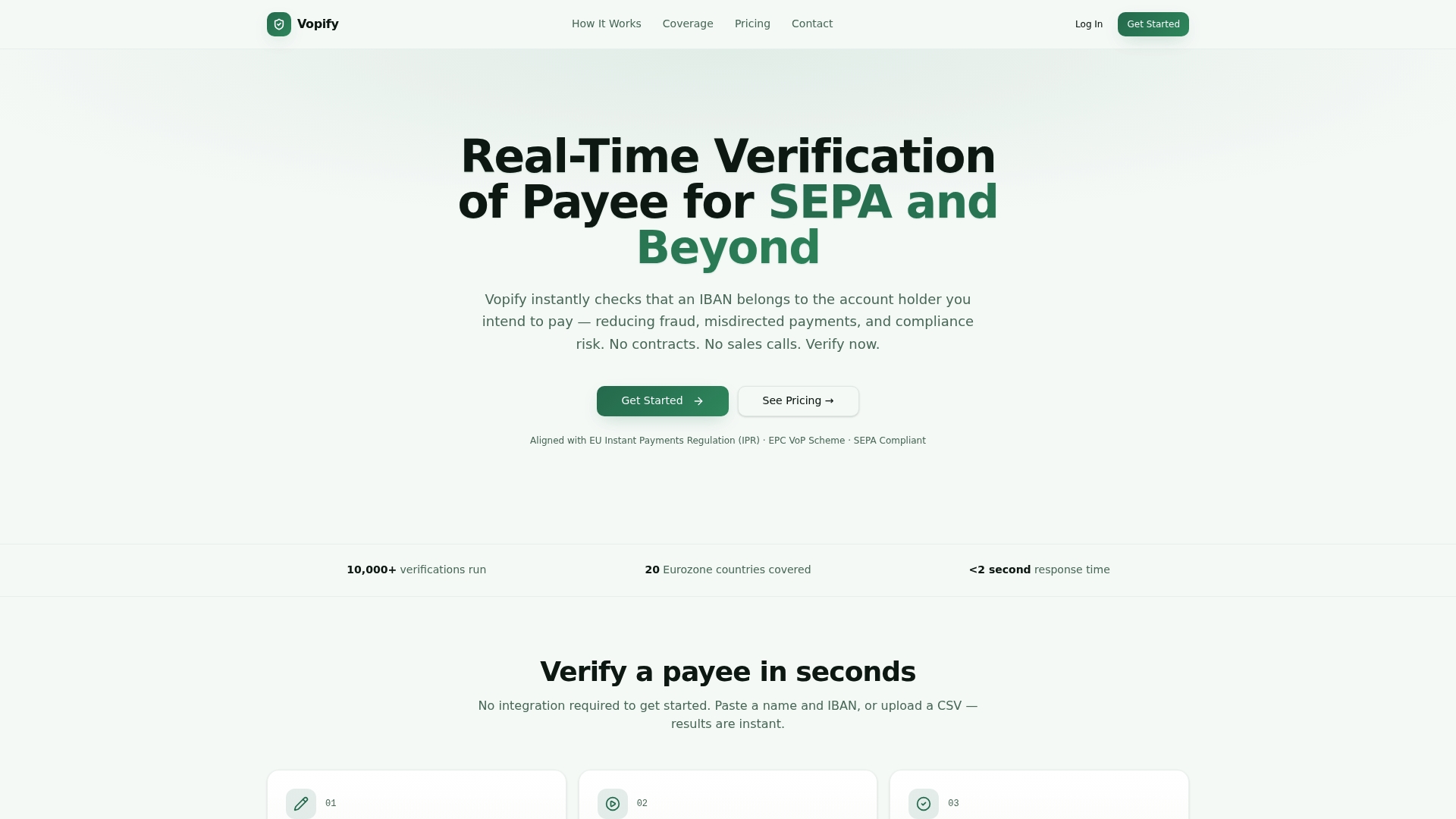
That speed matters most for the exact scenario finance teams dread: a supplier "updates" their bank details right before a large payment goes out. Running that new IBAN through Vopify's verification service before you release funds costs you seconds and catches the mismatch a manual review would miss. For teams cleaning up an entire vendor master file at once, the bulk verification tool processes the whole batch in one pass instead of one supplier at a time.
Start with a pilot on your highest-value suppliers this month. Check their current IBANs against Vopify, see what your real match rate looks like, and build your rollout plan around actual data instead of guesswork about how clean your vendor file really is.
Sources
- Verification Of Payee (VoP): a strategic lever to secure payments and cash management - Datalog Finance
- How Verification of Payee protects your business - Serrala
- Verification of Payee: Why It Doesn’t Stop Payment Fraud | Treasury Intelligence Solutions GmbH
- Ibanchecker