
Alipay verifies an account and the payee name as a single, blocking check. If the name you provide doesn't match the name registered to that Alipay account, the transfer won't go through. There's no partial match, no fuzzy score, no "close enough." It's a pass or a hard stop.
For accounts payable and treasury teams, that changes how you should build your payment flow:
- Run the Alipay verification call before you release funds, not after.
- Treat any blocking error code as a stop, not a warning to note and move past.
- Log every request, response, and manual override so a disputed payment has a paper trail.
If your payment system already passes a payee name into the transfer call, Alipay's own name-matching check is already doing work for you. The question is whether your team is set up to act on the result.
Key Takeaways
Alipay validates an account and its payee name as one inseparable check, and any mismatch is a blocking event that finance teams must treat as a hard stop, not a warning to note and pay anyway.
| Point | Details |
|---|---|
| Name match is binary | Alipay returns a pass or a blocking failure, never a partial or fuzzy match on the payee name. |
| Three API outcomes to plan for | Handle SUCCESS, COULD_NOT_CHECK, and blocking errors like ALIPAY_ACCOUNT_NUMBER_NOT_MATCHED differently in your workflow. |
| Personal accounts create B2B gaps | Many Alipay recipients are individuals, not the corporate entity you invoiced, so require bank details for high-value payments. |
| Log everything | Persist request, response, error code, and approver identity for every exception to protect your audit trail. |
| Vopify extends the same logic | Vopify verifies payee names against IBANs in real time, with dashboard, bulk CSV, and a planned API gate for corporate payment rails. |
Table of Contents
- What Does Alipay Account Verification Actually Check?
- Building an Alipay Verification Workflow Into Your AP Process
- Where Alipay Verification Falls Short for B2B Payments
- How Vopify Fits Into an Alipay Verification Workflow
- Why Speed Pressure Is the Real Threat to Payment Accuracy
- Get Payee Verification Right Before You Send Corporate Funds
- Sources
What Does Alipay Account Verification Actually Check?
Alipay's transfer and recipient APIs validate the Alipay ID (a phone number, email, or login) and the submitted payee name together, as one unit. There's no separate "resolved name" field that hands you a normalized version of the account holder's name to eyeball, the way some bank verification systems do. Alipay gives you a binary outcome: the pair checks out, or it doesn't.
Platforms that build on top of Alipay's rails, including Wise's CNY recipient verification, run a combined validation at the moment a recipient is created. Three outcomes typically come back:
- SUCCESS. The account exists and the submitted name matches the registered real name. Proceed.
- COULD_NOT_CHECK. The verification service couldn't complete the check, usually a timeout or a temporary API issue. This is non-blocking but requires a decision, not a shrug.
- Blocking failure, such as
ALIPAY_ACCOUNT_NUMBER_NOT_MATCHED. The account and name don't line up. Stop the payment.
Under a third of these outcomes require human judgment call, but that third is where most operational risk lives.
On the technical side, older and newer Alipay transfer endpoints pass the payee name through different parameters, either payee_real_name or payee_info.name depending on which version you're integrated against. According to Alipay's developer documentation, supplying that name field is what triggers the automatic match check at transfer time. Skip the field, and you lose the check entirely. Name length limits and character rules also vary by endpoint version, so it's worth confirming exact constraints against the current API spec rather than assuming the legacy rules still apply to a newer integration.
Pro Tip: Log the exact error string Alipay returns, not just a generic "failed" flag. PAYEE_USER_INFO_ERROR and PAYEE_NOT_EXIST point to different root causes, and your exception queue should route them differently.
Building an Alipay Verification Workflow Into Your AP Process
Verifying an Alipay payee isn't a one-time favor to compliance. It's a step that belongs at two specific points in your process: when you onboard a new supplier, and again right before you release payment.
- Capture the right data upfront. Get the supplier's Alipay login ID (phone or email), their full name in both Latin transliteration and native script if available, and a supporting document like an invoice number or the supplier's legal entity name.
- Run the API check at recipient creation. Don't wait until payment day to discover a mismatch. Verify when the supplier record is first built.
- Verify again before payment release, especially for recurring suppliers whose details might have changed.
- Block on any failure code. Don't let a payment through on a blocking outcome, even under deadline pressure. That pressure is exactly when mistakes get waved through.
- Build a defined exception path for COULD_NOT_CHECK. Options include a timed automatic retry, a manual supplier confirmation call, or a temporary hold that requires named approver sign off.
- Persist everything. Request payload, response, error code, timestamp, who approved any exception, and how it was resolved.
Pro Tip: Set a retry limit on COULD_NOT_CHECK outcomes, like three attempts over 24 hours, before escalating to manual review. Without a limit, these can sit in limbo indefinitely while a supplier waits to get paid.
The payee identifier you capture at onboarding is what makes step two possible without re-collecting data every payment cycle. Get it right once, and the rest of the workflow runs on autopilot until something changes.
Where Alipay Verification Falls Short for B2B Payments
Alipay was built for consumer and individual accounts first. That matters more than most finance teams realize when a supplier sends you an Alipay ID instead of corporate bank details.
A lot of supplier payments routed through Alipay actually land with an individual agent or representative, not the corporate entity you invoiced. The name match will pass cleanly. It just isn't matching against the legal entity you have a contract with.
Relying on Alipay account verification alone for high-value B2B payments can leave real gaps in the invoice and legal documentation chain that corporate treasury and tax teams require. A clean name match confirms the payment lands with the named individual. It says nothing about whether that individual is authorized to receive funds on behalf of the company you're paying.
For larger or regulatory-sensitive payments, that gap is a real problem, not a technicality:
- Require corporate bank account details for high-value invoices, and use Alipay verification as a supplementary check rather than the sole gate.
- Apply multi-factor confirmation, a phone call plus written confirmation, for any first-time beneficiary regardless of channel.
- Retain documentary evidence tying the Alipay account to the corporate entity, not just to a named individual.
- Treat API timeouts and COULD_NOT_CHECK outcomes as operationally risky by default, with a documented retry and escalation policy rather than an ad hoc judgment call each time.
For corporate-to-corporate transfers, a verified bank account check closes gaps that a name match on a personal Alipay account simply can't.
How Vopify Fits Into an Alipay Verification Workflow
Vopify runs real-time verification that matches a provided account identifier against the registered account holder's name, cutting the risk of paying the wrong person or the wrong entity. The same logic that makes Alipay's account and name check useful (catch the mismatch before money moves) is what Vopify applies across a broader set of payment rails, including SEPA verification for corporate bank transfers.
Three integration patterns cover most AP setups:
- Dashboard checks for teams verifying suppliers one at a time, low volume, high scrutiny.
- Bulk CSV upload for onboarding an entire supplier list at once, useful when you're migrating vendor master data or doing an annual compliance sweep.
- API gating, planned for programmatic high-volume verification, to block a payment run automatically until every recipient clears.
Vopify reports fast response times and has processed thousands of verifications across multiple Eurozone countries. Teams handling recurring supplier payments, high-volume onboarding, or anything requiring an auditable verification trail get the most value from building this into the payment pipeline rather than treating it as a manual side task.
| Adoption trigger | Recommended pattern |
|---|---|
| Occasional new supplier | Dashboard check |
| Bulk vendor onboarding | Bulk CSV upload |
| High-volume recurring payments | API gate (planned) |
Why Speed Pressure Is the Real Threat to Payment Accuracy
The rollouts that work best start narrow: pick your highest-risk supplier segment, usually new vendors or anyone requesting a change to existing payment details, and gate those payments on verification before touching the rest of the book. Expand once the exception process holds up under real volume, not before.
The pattern worth watching isn't the technology. It's the pressure finance teams feel at month end to push a payment through despite an unresolved COULD_NOT_CHECK flag. That's precisely the moment a documented, non-negotiable exception process earns its keep. Speed and compliance aren't actually in tension here. A five-minute automated check that blocks a six-figure misdirected payment is the fastest path available, even though it doesn't feel that way in the moment.
— David
Get Payee Verification Right Before You Send Corporate Funds
Vopify gives finance teams a faster, cleaner way to confirm a payee before money leaves the building, without the long onboarding contracts or manual back-and-forth that traditional verification processes usually involve.
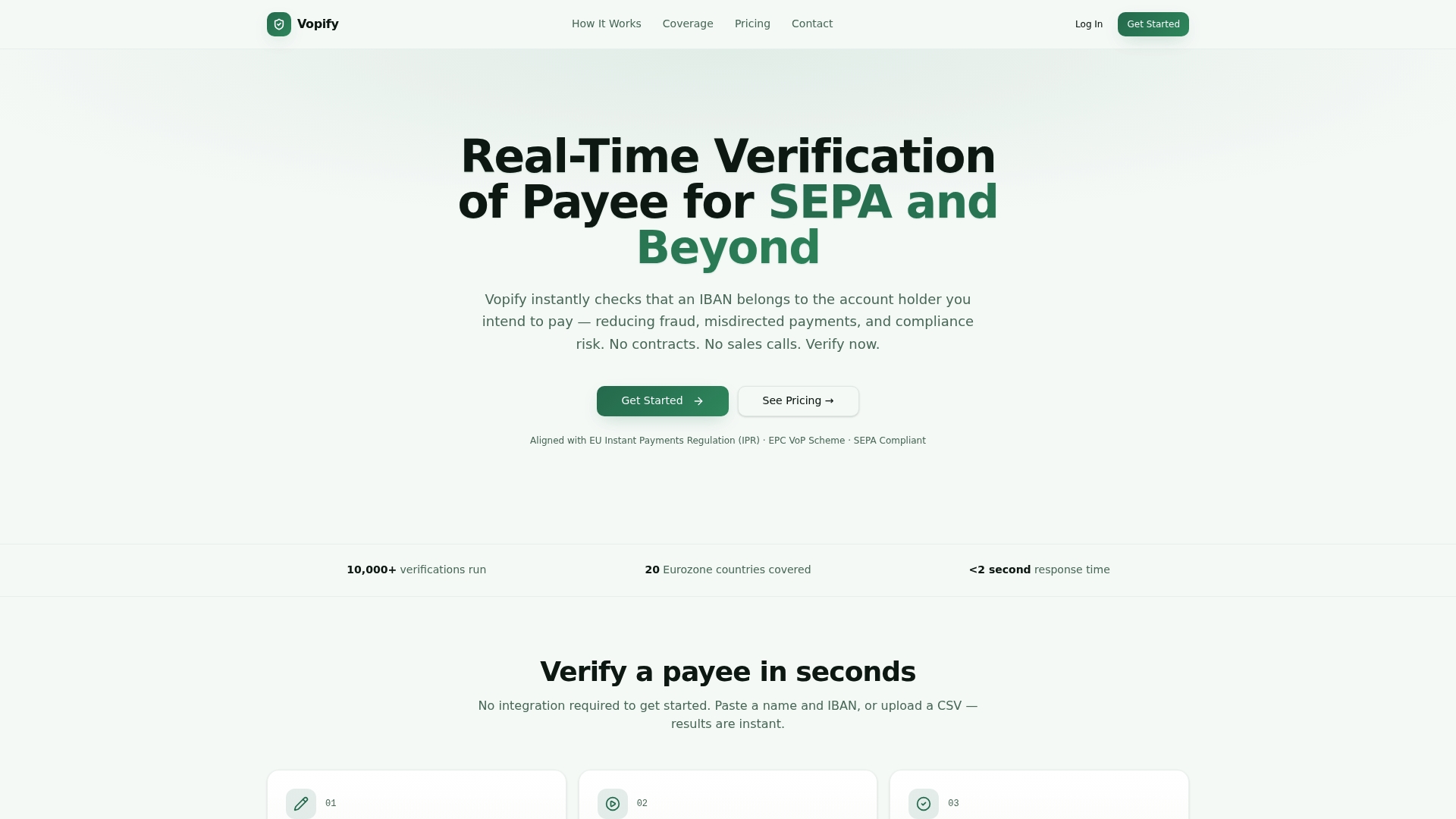
You get a name and account match in seconds, whether you're checking a single Alipay recipient, running a bulk CSV against your entire supplier list before a payment cycle, or building toward the planned API gate for programmatic, high-volume verification. For corporate payments where an Alipay name match alone doesn't satisfy your documentation requirements, IBAN verification covers the corporate bank transfer side of the same problem, and global coverage spans the payment rails most finance teams actually use.
If your team is still verifying suppliers manually or skipping the check under deadline pressure, start a verification on your next new supplier and see the result before you release the payment.