
BIC and SWIFT refer to the same ISO 9362 bank identifier, and the two terms are used interchangeably across the banking industry. There is no functional difference between a "BIC code" and a "SWIFT code" on a wire form. What matters practically is format (8 or 11 characters) and the fact that most international transfers also require an IBAN or account number alongside it.
TL;DR:
- Most international transfers require both a correct SWIFT/BIC code and an IBAN or account number to prevent delays or rejections.
- A SWIFT/BIC code consists of eight or eleven characters, identifying the bank, country, location, and optional branch; connection status is crucial.
- US domestic transfers use routing numbers and do not involve SWIFT/BIC or IBAN, which are only necessary for international transactions.
- Verifying the payee's name against the IBAN before sending reduces fraud risk and prevents misdirected payments, especially for large or recurring transactions.
- Using automated tools to check SWIFT/BIC codes and payee details in real time significantly decreases the risk of errors and accelerates payment processing.
Table of Contents
- BIC vs SWIFT: Definitions and Who Sets the Standard
- Anatomy of a SWIFT/BIC Code: 8 vs 11 Characters
- How SWIFT/BIC Relates to IBAN and US Routing Numbers
- Where to Find and Verify a SWIFT/BIC Code
- Why International Transfers Get Delayed, Rejected, or Expensive
- A Verification Workflow That Catches Errors Before They're Costly
- Final Checklist Before You Send an International Wire
- An Editorial Take on Operational Risk
- How Vopify Helps: Instant Payee Verification
- Sources
BIC vs SWIFT: Definitions and Who Sets the Standard
The confusion starts with history. SWIFT stands for the Society for Worldwide Interbank Financial Telecommunication, the Belgium-based cooperative that built the global messaging network banks use to send payment instructions to each other. BIC stands for Business Identifier Code, the actual string of letters and numbers assigned to each financial institution on that network.
SWIFT built the network. BIC is the code. Somewhere along the way, people started calling the code by the network's name, and it stuck. Today, SWIFT itself acts as the registration authority for BICs, issuing and maintaining every code under the ISO 9362 standard. That's the technical anchor point: ISO 9362 defines the format, and SWIFT administers the registry.
You'll see both terms on bank forms, invoices, and payment portals, sometimes on the same page. A form asking for your "SWIFT code" and another asking for your "BIC" both want the identical string of characters.
A few reference points worth knowing if you ever need to double-check a claim about how these codes work:
- ISO 9362 is the formal international standard governing the code's structure.
- SWIFT.com publishes the official BIC directory and registration documentation.
- Connected vs. non-connected BICs is a real distinction SWIFT maintains, and it matters more than most guides admit (more on that below).
Anatomy of a SWIFT/BIC Code: 8 vs 11 Characters
Every BIC follows the same skeleton, and once you know the pattern, you can read one at a glance instead of just copying it blindly. The structure defined by ISO 9362 breaks down into four segments:
- Bank code (4 letters): identifies the institution itself, like
DEUTfor Deutsche Bank. - Country code (2 letters): the ISO country code, like
DEfor Germany orUSfor the United States. - Location code (2 characters): identifies the city or region, like
FFfor Frankfurt. - Branch code (3 characters, optional): pinpoints a specific branch, like
500. When it's absent, the code defaults toXXX, meaning the bank's primary office.
Put it together and DEUTDEFF500 reads as: Deutsche Bank, Germany, Frankfurt, branch 500; knowing these details helps ensure accurate payments. Drop the branch code and you get the 8 character version, DEUTDEFF, which points to the bank's head office rather than a specific location.
Here's the part most explainers skip. SWIFT distinguishes between "connected" and "non-connected" BICs. A connected BIC belongs to an institution that can actually send and receive messages on the SWIFT network. A non-connected BIC exists in the directory for identification purposes only, often for smaller institutions or specific legal entities that route their traffic through a correspondent bank. If you're validating a code for a payment, connection status matters as much as the character count.
How SWIFT/BIC Relates to IBAN and US Routing Numbers
A SWIFT/BIC code tells the payment network which bank. It does not tell anyone which account. That's the job of the IBAN, or International Bank Account Number, in countries that use it, and it's the single most common point of confusion for people sending their first international transfer.
Think of it like mailing a package. The SWIFT/BIC is the delivery company and regional depot. The IBAN is the actual street address and unit number. You need both, and mixing them up (or assuming one covers the other) is a common reason wires bounce back.
According to Starling Bank's breakdown of the two standards, IBANs can run up to 34 characters, encoding the country, bank, branch, and account number in one string, while SWIFT/BIC codes stay fixed at 8 or 11 characters and route the message rather than the money itself. Most transfers into Europe, the UK, and dozens of other countries need both fields filled in correctly.
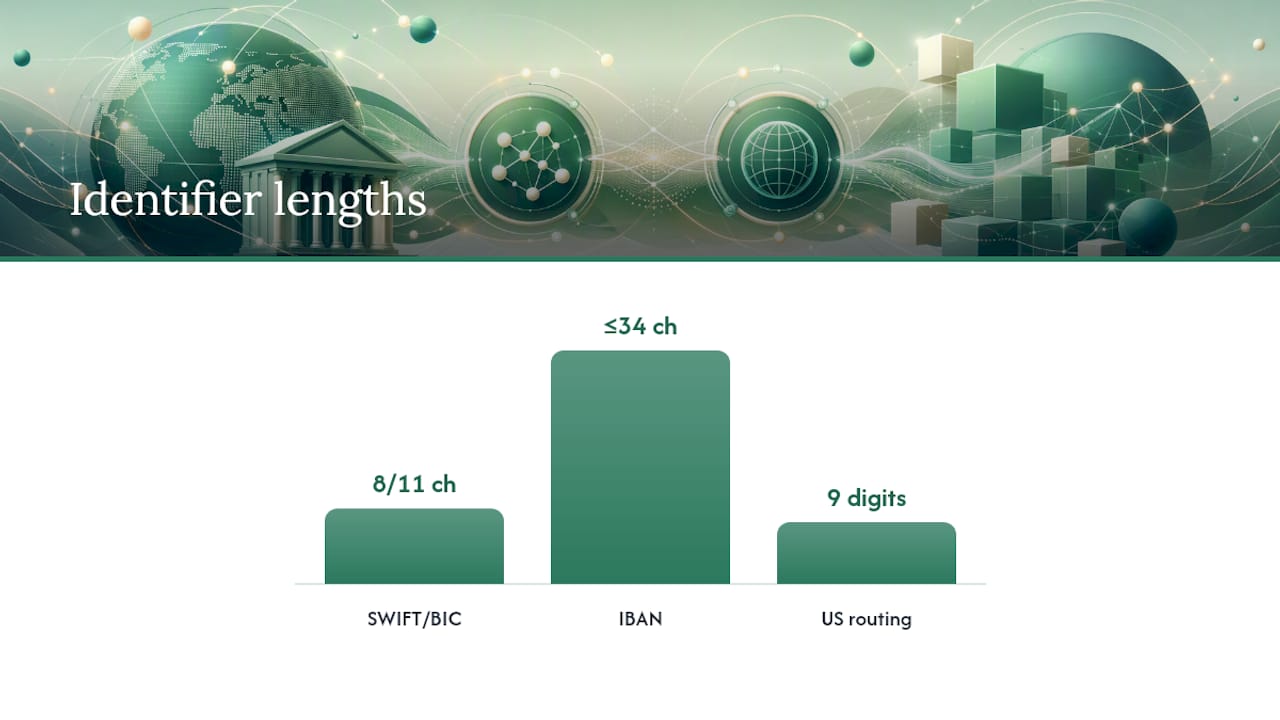
The United States doesn't use IBAN at all. Instead, domestic transfers run on a completely different rail: the 9-digit routing number, used for ACH transfers and direct deposits within the US banking system. A routing number identifies the bank and branch for domestic purposes; it is not interchangeable with a SWIFT/BIC and won't work if you plug it into an international wire form expecting a BIC.
So when do you actually need a SWIFT/BIC as a US-based sender? Whenever the money is leaving the domestic system entirely, whether that's paying an overseas supplier, sending a family member abroad, or settling an invoice in euros. For those transfers, expect the receiving bank or wire service to ask for:
- The recipient's SWIFT/BIC code
- The recipient's IBAN (if the destination country uses one) or local account number
- The beneficiary's full legal name, matching their bank records
- The beneficiary's address, and sometimes a payment reference or purpose code
Miss any one of these and the transfer either gets delayed for manual review or rejected outright. Banks in SEPA countries (the Eurozone's payment system) lean almost entirely on IBAN plus BIC. US domestic transfers never touch either field. Knowing which system your recipient's bank sits in saves a phone call later.
Where to Find and Verify a SWIFT/BIC Code
Never guess a SWIFT/BIC, and never lift one from a random forum post. Here's the order of reliability, from best to worst:
- Ask the recipient directly for their bank's SWIFT/BIC, ideally pulled from a recent bank statement or their online banking portal. This is the single most reliable source because it comes straight from the account holder.
- Check the bank's official website. Most banks, especially larger ones, publish their SWIFT/BIC on a dedicated page for international transfers.
- Use the official SWIFT directory for a cross-check, particularly when you need to confirm whether a code is connected to the messaging network or just a reference entry.
- Call the bank's customer service line if anything looks off, especially for smaller regional banks or credit unions that may not publish their code prominently.
- Cross-reference with a validation tool, like Vopify's SWIFT/BIC validation guide, before you submit a large or first-time transfer.
Third-party "SWIFT code lookup" sites can be useful for a quick sanity check, but treat them as a starting point, not a final answer. These directories aggregate data that isn't always current, and a stale entry is exactly how a payment ends up stuck at a correspondent bank for a week. Confirm the character count (8 or 11), confirm whether it points to a head office or a specific branch, and when the amount is significant, confirm it with the bank directly.
Why International Transfers Get Delayed, Rejected, or Expensive
International wires rarely travel in a straight line. When the sending and receiving banks don't have a direct relationship, the payment routes through one or more correspondent banks, each of which can add its own processing fee and its own delay. That's why a transfer that should take a day sometimes takes four, and why the amount that lands can be noticeably smaller than the amount sent.
The most common failure points, in order of frequency:
- Incorrect SWIFT/BIC, often a transposed character or an outdated branch code.
- Wrong or malformed IBAN, particularly when someone drops a digit or includes spaces incorrectly.
- Mismatched beneficiary name, where the name on the transfer doesn't match the name on the receiving account.
- Missing intermediary bank details, required when no direct correspondent relationship exists between the two banks.
When one of these goes wrong, the payment doesn't just disappear. It typically gets flagged for manual investigation, held at an intermediary bank, or returned to the sender, sometimes with a fee deducted for the trouble. For a business processing dozens of supplier payments a month, that investigation time adds up fast, both in staff hours and in strained vendor relationships.
Pro Tip: Decide who pays the correspondent fees before you send, not after. Most wire forms let you choose between "sender pays all fees" (OUR) and "shared fees" (SHA). Picking the wrong option is a small decision that quietly changes how much your recipient actually receives.
A few habits cut the failure rate dramatically: double-check every field against the source document, request a transfer confirmation number, and reconcile the amount received against the amount sent once the transfer clears rather than assuming it went through clean.
A Verification Workflow That Catches Errors Before They're Costly
Checking the SWIFT/BIC format is step one. It's not the whole job. A code can be perfectly valid, connected, and correctly formatted, and the payment can still land in the wrong account if the name attached to that IBAN doesn't match who you think you're paying. That gap is exactly where misdirected payments and invoice fraud slip through.
A practical workflow finance teams use looks like this:
- Confirm the SWIFT/BIC is correctly formatted and connected to the messaging network.
- Validate that the IBAN follows the correct structure for its country.
- Verify the beneficiary name actually matches the account holder tied to that IBAN, not just the name on an invoice.
- Add a final human confirmation step for high-value or first-time payments before releasing funds.
The third step is the one most manual processes skip, because until recently it required a phone call or a slow verification request through the bank. Automated name-to-IBAN checks close that gap in seconds instead of days. Vopify's payee verification service runs that exact check, matching a submitted name against the account holder tied to a given IBAN in real time.
Vopify has processed more than 10,000 verifications across 20 Eurozone countries, returning results in under two seconds per check.
That speed matters most for accounts payable teams processing batches of supplier payments, where a single unverified change to a bank account (a classic invoice fraud pattern) can otherwise slip through unnoticed until the money is gone. A two-second automated check, run before the wire is released rather than after, is a fundamentally different risk position than catching the problem during a bank's investigation two weeks later.
Final Checklist Before You Send an International Wire
Run through this before you hit submit on any transfer leaving the domestic banking system:
- Confirm the SWIFT/BIC is correct and the right length (8 or 11 characters).
- Confirm the IBAN or account number matches what the recipient provided, character for character.
- Confirm the beneficiary's legal name is spelled exactly as it appears on their bank account.
- Decide who pays the correspondent fees and include any required payment reference.
- Run a final verification, either a direct call to the recipient or an automated check, and keep a record of the confirmation.
Five minutes of checking beats two weeks of chasing a misdirected payment through correspondent banks.
An Editorial Take on Operational Risk
The real cost of a misdirected international payment is rarely the transfer fee. It's the days of investigation, the strained vendor call, and the quiet erosion of trust when a supplier says money never arrived. Most finance teams still treat SWIFT/BIC and IBAN accuracy as a data-entry problem, checked once and forgotten. It's actually an ongoing control, because account details change more often than anyone expects, and the only real defense is verifying the name behind the number every time, not just the format of the code.
— David
How Vopify Helps: Instant Payee Verification
Vopify gives you a faster gut check than the standard bank confirmation process, matching a payee's name against their IBAN in under two seconds instead of the days a manual bank inquiry usually takes. That speed matters most when you're clearing a batch of supplier payments and can't afford to phone-verify each one individually.
The service works for both single lookups and bulk CSV uploads, covering multiple countries, so accounts payable teams can build the check directly into their payment run rather than treating it as a separate manual step. Because it works from just a name and an IBAN, there's no lengthy onboarding contract standing between you and your first check. If your team processes recurring supplier or payroll payments, check Vopify's supported network coverage to see whether your corridors are included, or head to Vopify to run a verification and see how the results come back before you finalize your next batch of transfers.