
Micro deposit verification, in the context AP and treasury teams actually operate in today, means instant IBAN and account-holder name matching before a payment goes out. It is not the old test-transaction method banks used to confirm account ownership. Adopt real-time name-to-IBAN checks at onboarding and payment initiation, and you cut misdirected payments and authorized-push fraud without adding days to your process. Vopify runs that check in under two seconds.
TL;DR:
- Real-time IBAN and name verification quickly detects typos, outdated details, and fraud attempts by matching live data at payment time, not using stale databases.
- The verification process requires only the account holder name and IBAN, with results categorized into exact, partial, no match, or verification failure.
- Implementing checks at both onboarding and payment initiation stages offers the most effective fraud prevention and reduces manual reconciliation costs.
- Response times for single checks are typically under two seconds, with bulk verification scaling from under a minute to an hour depending on file size.
- Automation of decision rules for match outcomes and disciplined data handling are critical to prevent errors and ensure verification effectiveness.
Table of Contents
- What Is Real-Time IBAN/Name Verification and Why It Matters
- How IBAN/Name Checks Actually Work
- Where to Put Verification in Your Payment Workflow
- Reading Match Results: Decision Rules for Exact, Partial, and No Match
- Building an Implementation Checklist Your Team Will Actually Follow
- What Performance and Pricing Should You Expect?
- What Actually Breaks in Real Deployments
- Why Vopify Fits This Workflow
- Where to Read More on Verification of Payee Standards
- Sources
What Is Real-Time IBAN/Name Verification and Why It Matters
Real-time IBAN and name verification checks whether the account holder name a supplier or employee gives you actually matches the name registered on that IBAN, at the moment you're about to pay it. The check happens against live payment network data, not a stale database snapshot, which is why it catches typos, outdated bank details, and fraud attempts that slipped past manual review.
The operational case is straightforward. A finance team processing hundreds of vendor payments a month cannot manually confirm every bank detail change, and phone-based confirmation doesn't scale. Verification of Payee systems solve this by returning a categorical match result before funds move, which is exactly the control point where fraud losses get prevented rather than discovered after the fact.
Who actually uses this inside a company:
- Accounts payable clerks validating new supplier records before the first invoice payment
- Treasury and compliance teams enforcing payment controls across multiple banking relationships
- Developers embedding verification into ERP or treasury management system workflows
- Finance leadership reviewing exception reports for holds and mismatches
The benefit isn't just fraud prevention. It also collapses the manual reconciliation work of chasing down a bounced or misdirected payment after the fact, which typically costs far more in staff time than the verification check itself.
How IBAN/Name Checks Actually Work
The technical picture is simpler than most finance teams expect. A verification request needs two fields at minimum: the account holder name and the IBAN. Optional fields, like account type (business or individual) or a routing flag, sharpen the match but aren't required to get a result.
There are two integration paths, and the right one depends on volume and timing:
- Single-check API calls for real-time verification at the moment of payment initiation or supplier onboarding, returning a result in seconds.
- Bulk CSV or dashboard uploads for verifying an entire supplier master file at once, useful for periodic data hygiene sweeps rather than transaction-time checks.
Response outcomes typically fall into four buckets: exact match, partial or close match (often with a suggested normalized name), no match, or unable to verify. The ABN AMRO IBAN-Name Check API also returns metadata like whether the account is business or private, which helps automated systems decide without a human touching every result.
Pro Tip: Log every reason code and normalized name suggestion as a structured field in your ERP, not as free text in a note. That's what makes automated reconciliation possible later.
On the data-handling side, requests and logs should never store more payee information than the check requires, and access to verification logs should be limited to roles that actually need them for audit or dispute resolution.
Where to Put Verification in Your Payment Workflow
Placement determines whether verification stops fraud or just creates paperwork. Three control points matter, and each does a different job.
- At onboarding: catches bad data early and keeps your supplier master file clean, but a name change six months later slips through if this is the only check.
- At payment initiation or signing: the strongest fraud control, since it validates the exact IBAN about to receive funds, and Vopify's guidance for AP teams treats this as the highest-value checkpoint precisely because it stops the highest-risk errors before money moves.
- In batch/bulk runs: useful for re-validating an entire vendor file periodically, but you need a policy for partial results and a defined SLA for when the batch job needs to finish before the next payment run.
When verification is unavailable, decide the fallback in advance rather than during an incident: either hold the payment for manual confirmation through a trusted channel, or apply a documented risk-acceptance policy signed off by finance leadership.
Reading Match Results: Decision Rules for Exact, Partial, and No Match
A verification result is only useful if your team reacts to it the same way every time. Build decision rules once and automate as much of the response as possible.
- Exact match: proceed automatically, and store the result code and timestamp for audit purposes. No human involvement needed.
- Partial match: flag the payment automatically, surface the suggested normalized name, and route it to a reviewer with a defined turnaround window, not an open-ended queue.
- No match: hold the payment. Require confirmation through a trusted channel, like a callback to a known contact number, before releasing funds.
- Unable to verify or timeout: default to a conservative policy, either a short hold with retry or manual escalation, since treating a timeout the same as a match is how errors slip through.
Systems like LexisNexis Safe Payment Verification build these categorical outcomes into the product specifically so payment decisions can be made before execution rather than after a loss.
Building an Implementation Checklist Your Team Will Actually Follow
Verification only works if the data feeding it is clean and the process around it is disciplined. Start with these fundamentals:
- Standardize name fields (legal entity name, not "DBA" or informal names) and validate IBAN format before the check ever runs.
- Log reason codes, timestamps, and the identity of whoever approved an exception, since this is what an audit trail actually needs.
- Assign reviewer roles with a hard SLA window for partial matches, and a clear escalation path when that window is missed.
- Limit data retention for payee information to what your contract with the verification provider requires, and confirm minimal data exposure to any third party in that contract.
Pro Tip: Treat name normalization as a policy decision, not a technical afterthought. Deciding upfront how you handle "Jon" versus "Jonathan" or missing middle initials prevents half your partial-match backlog.
Vopify's guide to bank account ownership verification walks through how these practices differ from older, slower ownership-confirmation methods that many finance teams are still running on habit.
What Performance and Pricing Should You Expect?
Sub-two-second response times for a single live check are the realistic bar for modern Verification of Payee services, and vendor documentation from Isabel Group confirms this is standard, not aspirational. Bulk jobs scale differently, ranging from under a minute to roughly an hour depending on file size.
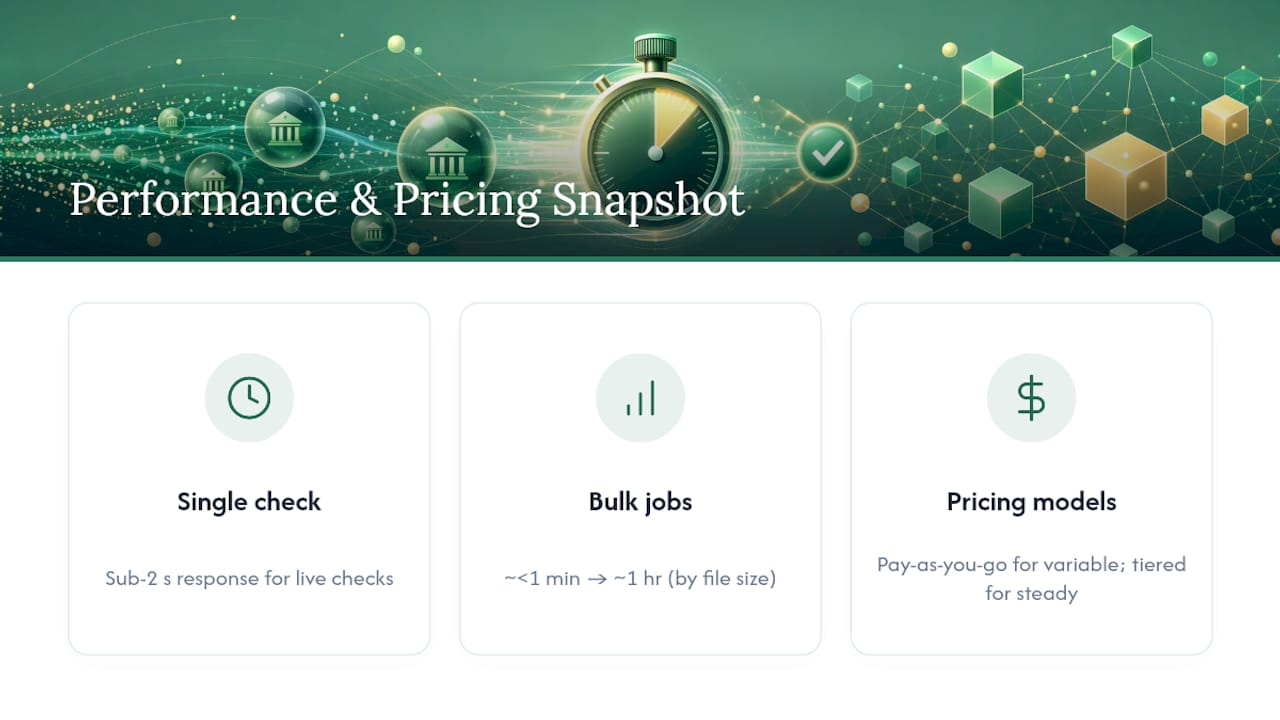
Pricing generally falls into two shapes: pay-as-you-go credits for lower, variable volume, or tiered subscriptions for teams running consistent monthly checks. When negotiating a contract, ask for specific SLA commitments on response time, uptime, bulk job processing windows, and support response times, not just a general uptime promise.
What Actually Breaks in Real Deployments
Vopify's own data, drawn from processing more than 10,000 verifications across 20 Eurozone countries with sub-two-second response times, tells a consistent story: the technology rarely fails. Teams fail around it.

The most common mistake is skipping name normalization policy and letting every partial match pile into an unreviewed queue. The second is treating onboarding checks as sufficient, then wondering why a supplier's bank details changed mid-relationship without anyone catching it. Teams that get this right run verification at both onboarding and payment initiation, with a reviewer SLA that's actually enforced, not aspirational.
Instant verification earns its cost when payment volume or fraud exposure is meaningful. A five-payment-a-month operation might get by with manual confirmation. Anyone running dozens of vendor payments weekly cannot.
— David
Why Vopify Fits This Workflow
Vopify gives finance and AP teams exactly the control point this guide describes: instant name-to-IBAN matching at the moment it matters most, without a long contract or a slow onboarding process of its own.
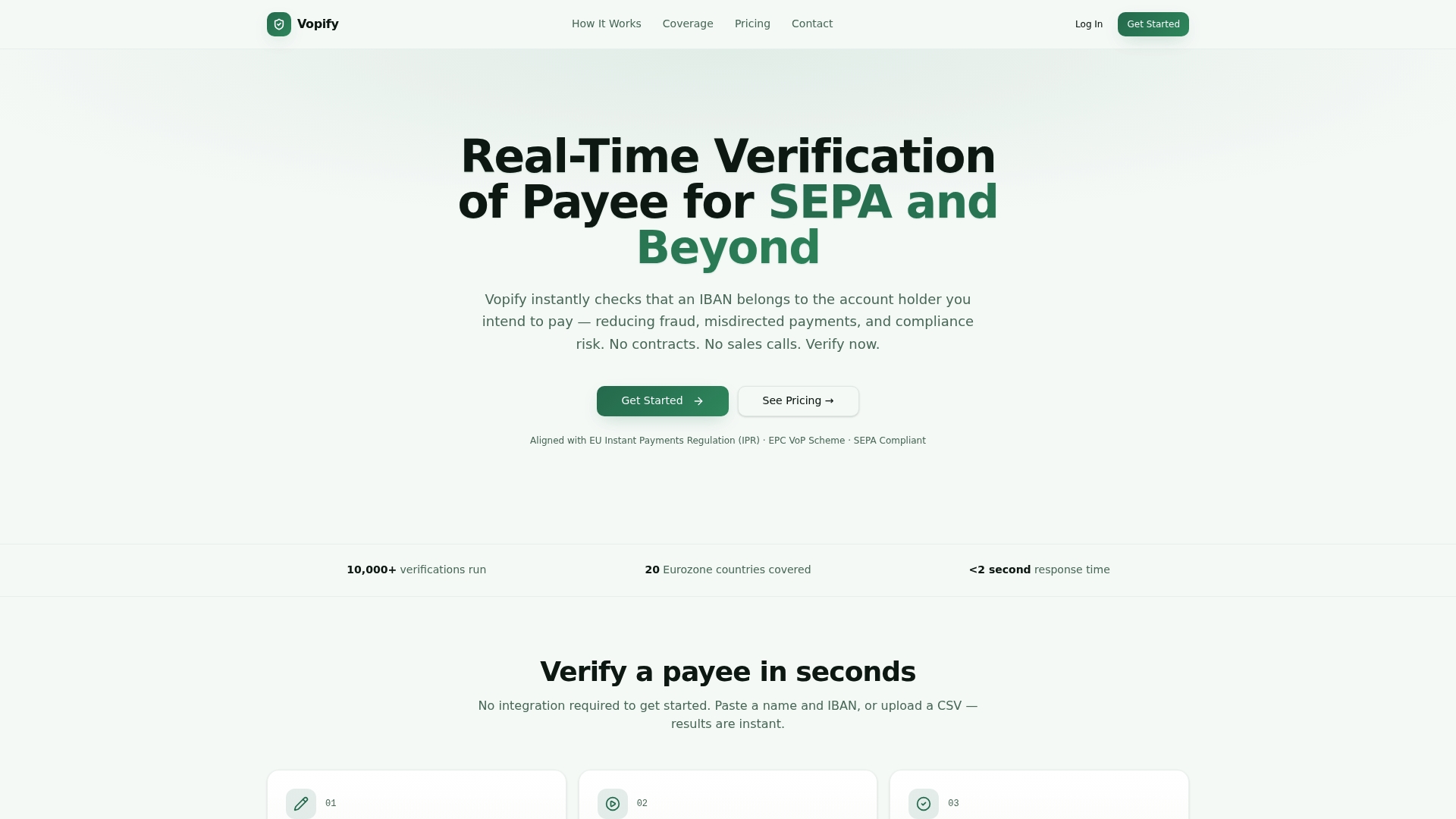
You get a single-check API for real-time verification at payment initiation, plus bulk CSV upload for validating your entire supplier file at once, all through one dashboard. Vopify has processed more than 10,000 verifications across 20 Eurozone countries, with responses returning in under two seconds, and coverage extending to India, Indonesia, South Korea, and Alipay accounts in China. Verification runs through SEPA-compliant Verification of Payee infrastructure, so you're not building compliance logic from scratch. Pricing runs on credit bundles or a subscription, whichever matches your payment volume better. If you're processing supplier payments weekly and still relying on manual confirmation calls, run a CSV batch through Vopify's IBAN verification tool on your current vendor file and see what it flags.
Where to Read More on Verification of Payee Standards
For deeper technical reading, the East Nets overview of Verification of Payee explains scheme-level implementation details, and the ABN AMRO developer portal documents the API fields and metadata structure referenced throughout this guide. Teams building payout automation should also review BrokerPay's guidance on automated payout integration for related API design patterns.
Sources
- Verification of Payee (VoP)
- IBAN-Name Check | ABN AMRO | Developer Portal
- Verification of the beneficiary's name