
Mule account detection, as used here, means instant name-to-IBAN verification: matching a supplier's stated bank details against the actual registered account holder before you send funds. For finance teams, the payoff is immediate. It stops misdirected payments and invoice fraud before they leave your bank, not after someone notices a call went to voicemail. This is not the criminal-mule tracing that banks run internally; it's a pre-payment check any AP team can run.
TL;DR:
- Name-to-IBAN verification confirms account ownership but does not verify the legitimacy or financial soundness of a supplier.
- Run payee verification at onboarding, when bank details change, and before high-value or first-time payments to mitigate fraud risks.
- Proper triage protocols classify results as exact, close, no match, or unreachable, with specific actions for each to prevent erroneous payments.
- Automated or bulk verification processes are suitable for high-volume teams but must prioritize accurate supplier data and timely re-verification.
- Verification should be part of a layered fraud prevention approach, combined with behavioral monitoring, sanctions screening, and strict recordkeeping.
Table of Contents
- What Instant Name-to-IBAN Verification Actually Checks
- When Should You Run Payee Verification Checks?
- How to Triage Match, Close Match, No Match, and Unreachable Results
- Single Checks, Bulk CSV, or API: Choosing an Implementation Path
- Where Does Payee Verification Sit Legally and Regulatorily?
- What Does Effective Verification Look Like in Practice?
- What Other Technologies Support Mule Account Detection?
- How Should Teams Maintain Their Verification Systems Over Time?
- What Behavioral Red Flags Go Beyond a Name Match?
- What I've Learned Rolling Out Verification Without Breaking Payment Runs
- Verifying Payee Details Before You Pay, at Scale
- Sources
What Instant Name-to-IBAN Verification Actually Checks
Name-to-IBAN verification, sometimes called Verification of Payee (VoP) or Confirmation of Payee (CoP), asks a simple question before money moves: does the name on this invoice match the name registered to this bank account? The check returns one of four standard responses: exact match, close match, no match, or verification not possible.
Close matches are the most common outcome, and they're rarely fraud. They usually come down to:
- A trading name on the invoice versus the legal entity name on the bank account.
- Missing or extra legal suffixes ("Ltd," "LLC," "GmbH")
- Payments routed through a factoring company or payment intermediary
- A sole trader invoicing under a business name but banking personally
What this check will not tell you: whether the supplier is legitimate, financially sound, or the real party to your contract. Name matching confirms whose account it is, not whether you should be paying them at all. That distinction matters for anyone tempted to treat a "match" result as a full vendor clearance. It isn't one. Pair it with know-your-business checks and confirmed contact details, the same way you'd never treat a single credit check as a complete underwriting file.
When Should You Run Payee Verification Checks?
Not every payment needs the same scrutiny, and running verification on every recurring invoice to a supplier you've paid fifty times adds friction without adding safety. The risk concentrates at specific moments, and that's where checks earn their keep.
- At supplier onboarding. Capture the exact legal name registered to the bank account, not the name printed on the letterhead. This single step prevents the majority of downstream close-match warnings.
- Whenever bank details change. A changed IBAN on an existing, trusted supplier is one of the oldest fraud patterns in accounts payable. Verify before the next payment, not after.
- Before high-value or one-off payments. Large wires and first-time payees carry the most downside if something's wrong, so they justify a check even if your policy exempts routine, low-value recurring transactions.
- On a defined re-verification cadence. Many finance teams set 12 to 24 months for standing suppliers, with exceptions for low-risk, low-value accounts that see infrequent activity.
Authorized push payment fraud has caused significant consumer losses in the UK in recent years, with recovery rates being much lower than the total losses. Verification catches the mismatch before the transfer clears, not after the money's already gone.
How to Triage Match, Close Match, No Match, and Unreachable Results
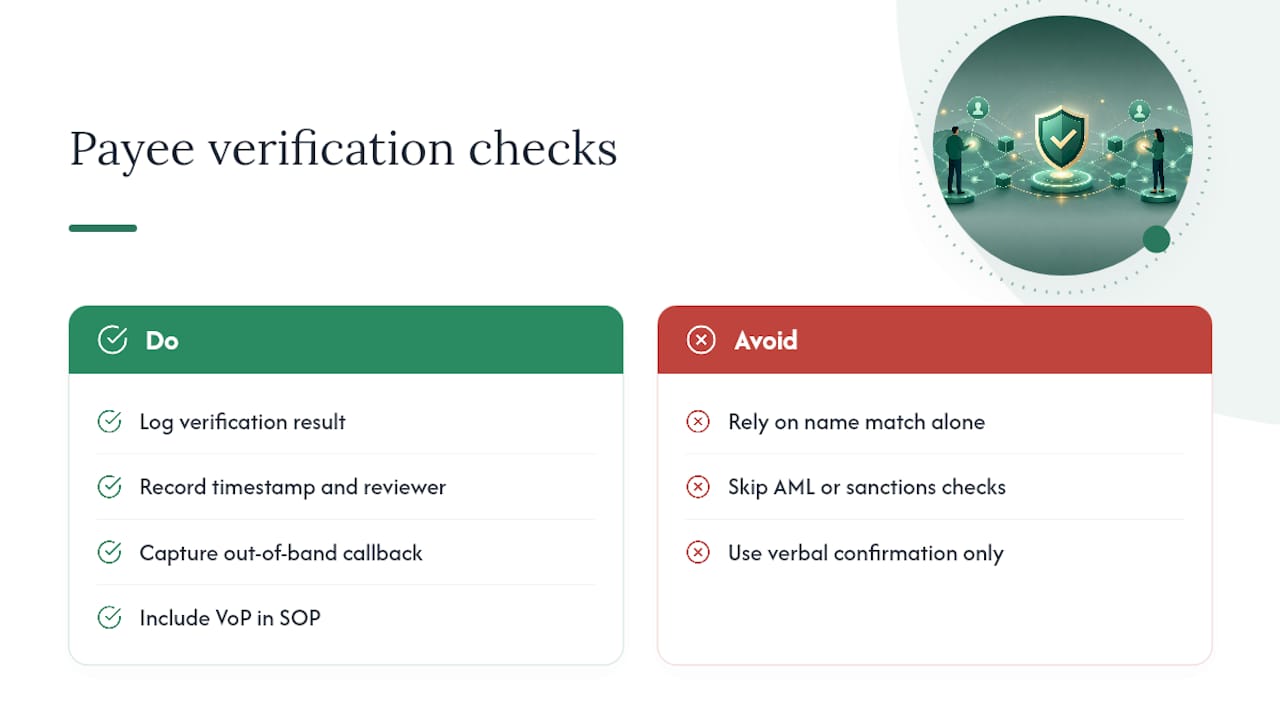
A verification result is only useful if your team knows exactly what to do with it. Build these into a documented SOP, because auditors and, increasingly, banks will ask for one.
Exact match: Proceed with the payment and log the result against the supplier record. No further action needed, but the log matters for audit trails later.
Close match: Don't panic and don't automatically reject. Check for formatting issues first: trading name versus legal name, missing suffixes, or an intermediary account. Request the confirmed legal name in writing from the supplier, and hold any large payment until you have it. Small recurring payments to an established supplier can often proceed with a note on file.
No match: Halt the payment. This is the one outcome that demands out-of-band verification. Call a phone number you already have on file, not one from the invoice email, or check a business registry independently. VoP results are meant to sit inside a layered control stack, not act as the only gate, so document exactly how the mismatch was resolved before releasing funds.
Verification not possible: First confirm the IBAN structure was entered correctly. If the format checks out but the receiving bank simply doesn't support real-time verification, a small controlled test payment paired with a recorded supplier confirmation closes most of these cases without exposing you to meaningful risk.
- Store the bank-registered legal name in a dedicated supplier master data field
- Use that field, not the invoice header, as the source for payment file generation
- Log every verification result, the date it ran, and who reviewed it
Pro Tip: Never let the invoice email be your source of truth for a bank-registered name. Pull it from your own onboarding record every time, especially on a no-match.
Single Checks, Bulk CSV, or API: Choosing an Implementation Path
How you deploy verification depends on payment volume and how much of your AP workflow is automated already. There's no single right answer here, just a right fit.
Small teams processing a handful of new suppliers a month do fine with manual single checks through a dashboard, entering a name and IBAN and getting a result back in seconds. Teams managing a large or messy supplier master file benefit more from bulk CSV verification: upload the whole supplier list, get flagged results back, and clean up close matches and no matches before they ever reach a payment run. This is also the fastest way to deal with legacy supplier data nobody has touched in years.
Higher-volume operations running straight-through processing need API integration, checking every payment inline as it's generated rather than in a separate batch step. Verification vendors should support all three patterns so a team can start manual and graduate to automated as volume grows.
Whichever path you choose, the data you capture matters more than the interface:
- Legal account holder name (exactly as registered to the bank)
- IBAN and country code
- Supporting evidence document (invoice, contract, onboarding form)
- Date of last successful verification
Response times matter more than most finance teams realize going in. A single check that takes 15 seconds doesn't sound slow until you're running it live at the point of payment approval, with someone waiting on the other end of a call. Vopify's own verification network returns results in under two seconds and has processed more than 10,000 verifications across 20 Eurozone countries, a scale that makes sub-two-second response times a realistic operational target rather than a marketing claim. For bulk runs, expect throughput measured in the thousands of records per batch rather than one-by-one processing.
Where Does Payee Verification Sit Legally and Regulatorily?
Verification of Payee sits inside a growing regulatory push across payment schemes, not as an optional nicety but as an expected control. The EU's Instant Payments Regulation now requires payment service providers across the Eurozone to offer payee-name verification alongside instant SEPA credit transfers, shifting VoP from a competitive feature to baseline infrastructure. The UK has run its own Confirmation of Payee scheme for years, with major banks required to participate.
None of this makes name verification a legal shield on its own. A match result confirms account ownership; it says nothing about anti-money laundering exposure, sanctions status, or beneficial ownership, all of which sit under separate compliance obligations like know-your-business checks and sanctions screening. Treat VoP as one documented control within a broader fraud and compliance framework, not a substitute for it.
For AP and compliance teams, the practical implication is recordkeeping. Regulators and auditors increasingly expect a documented trail: what result came back, when, who reviewed a mismatch, and what evidence justified releasing or holding a payment. A verbal "we called and it seemed fine" doesn't hold up in a review. A logged out-of-band callback with a timestamp does. Build your SOP with that audit trail in mind from day one, because retrofitting documentation after a regulator or auditor asks for it is far harder than capturing it as you go.
What Does Effective Verification Look Like in Practice?
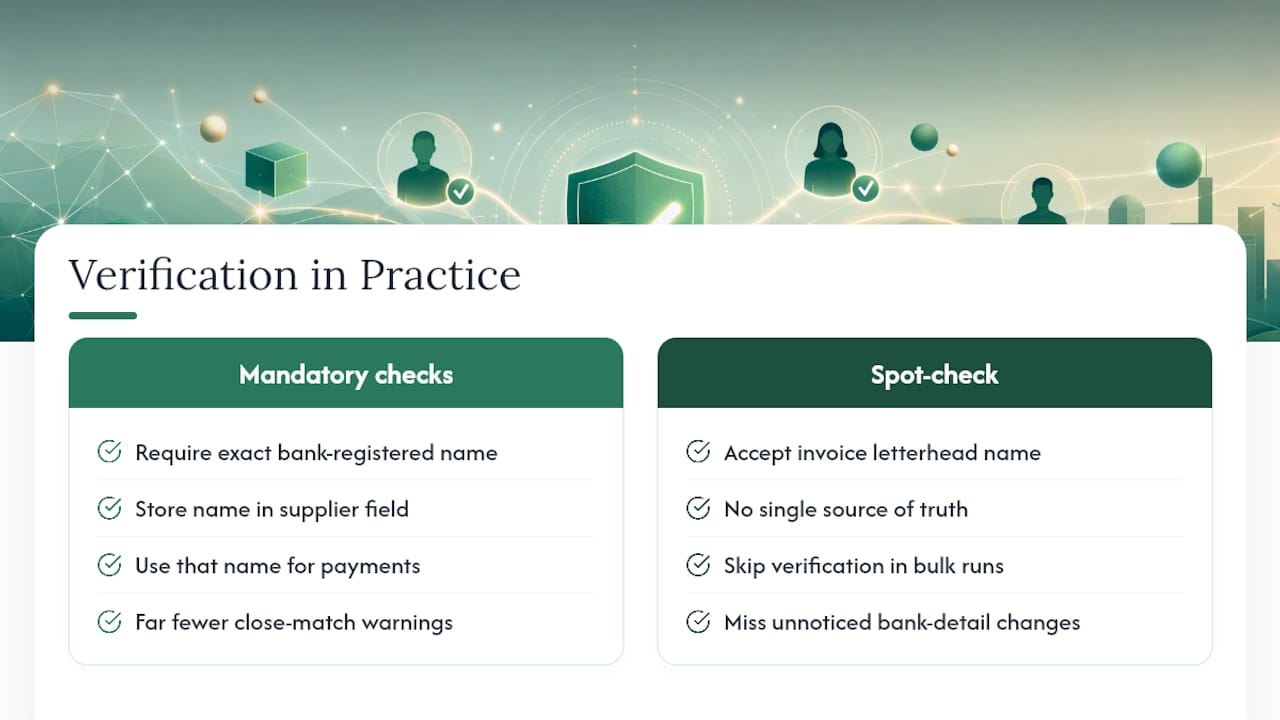
The clearest real-world pattern shows up in how supplier onboarding changes once a legal-name field becomes mandatory. Finance teams that require the exact bank-registered name at intake, rather than accepting whatever sits on the invoice letterhead, see far fewer close-match warnings later. Storing that name in a dedicated supplier field and using it as the source for every payment file removes the majority of downstream friction, since most "mismatches" turn out to be a trading name problem solved once at the source rather than repeatedly at payment time.
The inverse pattern is just as instructive. Teams that skip verification during bulk payment runs, treating it as something to run only on new suppliers, consistently miss the exact scenario VoP is built to catch: an existing, trusted supplier whose bank details changed without anyone noticing. Fraud rings target established vendor relationships precisely because those payments sail through with the least scrutiny. A supplier you've paid for three years is not lower risk on a bank-detail change; if anything, it's higher risk, because nobody expects to double-check it.
The operational lesson holds across company sizes: verification works when it's mandatory at the moments that matter (onboarding, bank-detail changes, large payments) and fails quietly when treated as a spot-check reserved for unfamiliar names.
What Other Technologies Support Mule Account Detection?
Name-to-IBAN verification is one layer, and effective fraud control stacks it with tools that watch behavior over time rather than a single transaction. Transaction monitoring systems flag unusual patterns, a payment far outside a supplier's typical invoice amount, an unusual payment frequency, or a first-time large transfer to a long-standing vendor.
Machine learning models sit on top of that monitoring, scoring payments against historical behavior and flagging anomalies a rules-based system would miss. These models get better with volume and time, which is exactly why they complement rather than replace point-in-time checks like VoP. A name match happens once, at the moment of payment; behavioral monitoring runs continuously in the background.
Sanctions and watchlist screening rounds out the stack, checking payee names against government and international restricted-party lists independent of whether the bank account name matches. None of these tools substitute for each other. A payment can pass name verification, clear sanctions screening, and still trip a behavioral anomaly flag because the amount or timing looks wrong for that supplier relationship. Layered controls catch what any single check alone would miss.
How Should Teams Maintain Their Verification Systems Over Time?
A verification process set up once and left alone degrades. Supplier master data drifts as businesses rebrand, merge, change banking relationships, or get acquired, and a verification field that was accurate three years ago quietly becomes stale.
Set a regular data hygiene cycle, re-confirming legal names and IBANs for standing suppliers on a fixed schedule rather than only when something breaks. Review your triage SOP at least annually against actual mismatch cases: if close matches are piling up for the same handful of suppliers, that's a signal to fix the underlying master data, not to keep re-running the same check.
Watch verification response types over time as well, not just individual results. A supplier that suddenly shifts from consistent exact matches to close matches deserves a direct call, even if the formatting explanation looks plausible on paper. Keep the audit log itself under review too, since a documentation trail that's technically complete but inconsistent in format is hard to defend to an auditor months later. Small, regular maintenance beats a large cleanup project every few years.
What Behavioral Red Flags Go Beyond a Name Match?
A verification result is a snapshot, not a full risk profile, and several behavioral patterns matter regardless of what the name check returns. Newly opened accounts receiving payments immediately after being registered as a supplier warrant a second look, especially when onboarding documentation is thin. Rapid changes to bank details shortly after onboarding, or multiple bank-detail change requests within a short window, are worth flagging even when each individual VoP check comes back clean.
Watch for payment requests that don't match a supplier's established invoicing pattern: a sudden jump in amount, an unusual currency, or a request to split one invoice into several smaller payments. Personal accounts receiving business-scale payments deserve scrutiny too, since legitimate sole traders exist but so do accounts set up purely to receive and quickly move funds. None of these signals alone proves fraud. Together, layered against a clean name match, they tell you when a "match" result shouldn't be the end of the conversation.
What I've Learned Rolling Out Verification Without Breaking Payment Runs
The biggest operational mistake I see is teams disabling verification during bulk payment runs "just this once" to hit a deadline, then never turning it back on properly. That one exception becomes the norm, and the control quietly disappears exactly when volume (and risk) is highest.
The second mistake is storing a supplier's trading name as the payment record instead of capturing the bank-registered legal name at onboarding. Every close match after that is self-inflicted, not a fraud signal.
The fix is boring but effective: mandate the legal account-holder name at onboarding, validate IBAN structure automatically at data entry, and re-verify automatically whenever a bank-detail change request comes in. Write a short, plain-language onboarding email template asking suppliers for their exact bank-registered name up front. It saves far more time later than it costs at intake.
— David
Verifying Payee Details Before You Pay, at Scale
Vopify built its verification engine around the exact workflow this article walks through: instant name-and-IBAN matching, with single checks for low-volume teams and bulk CSV verification for cleaning up a full supplier master file before a payment run.
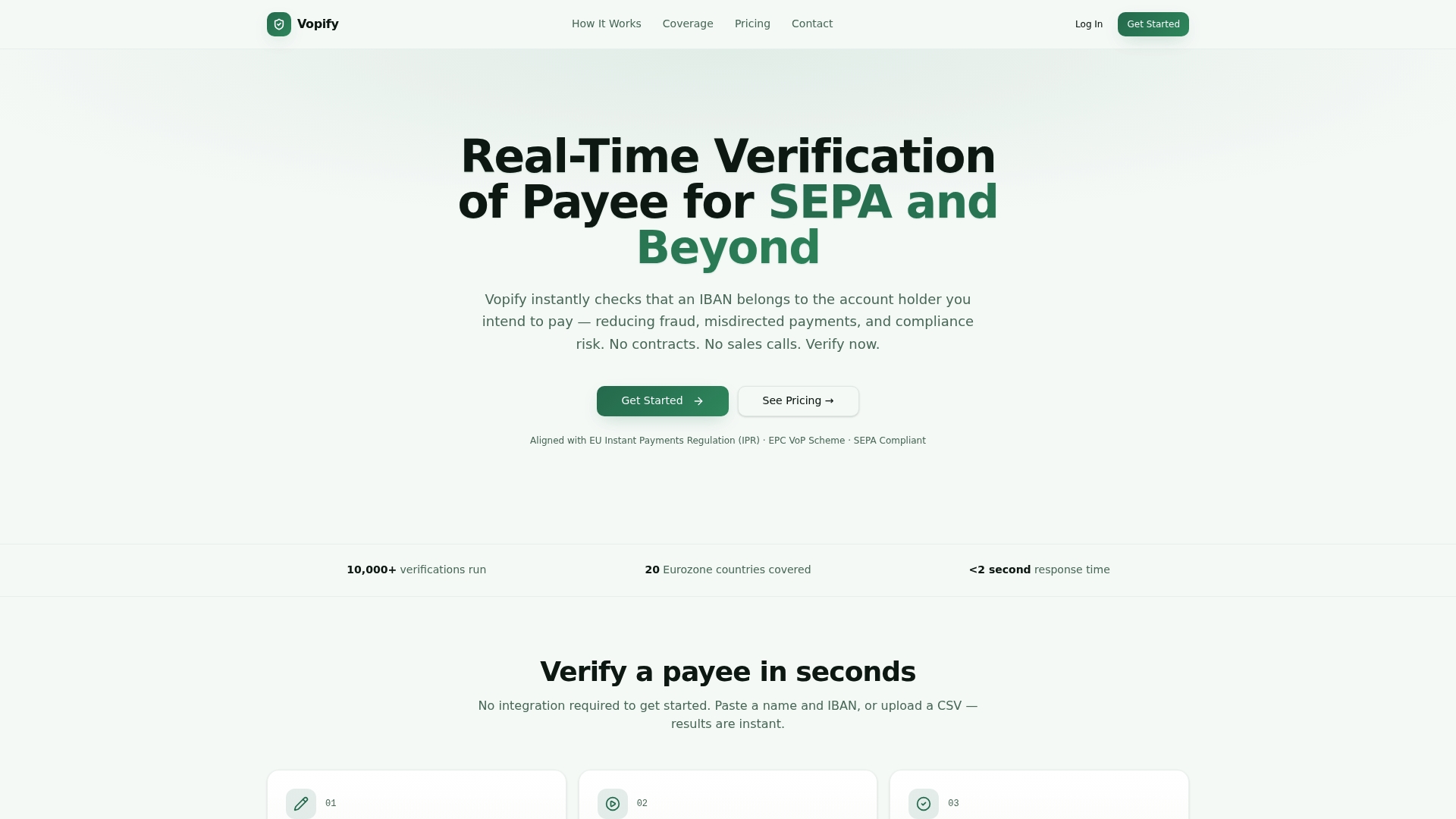
Checks return in under two seconds, and the platform has processed more than 10,000 verifications across 20 Eurozone countries, so the throughput described in the implementation section above isn't theoretical. If your team runs recurring supplier payments and wants a documented, auditable check at onboarding and on every bank-detail change, start with a pilot verification run on a small high-risk supplier cohort, or clean an existing supplier file through the bulk tool before your next payment cycle. Both options work through a dashboard first, with credit bundles or a subscription depending on your volume, and API access is on the way for teams ready to build verification directly into their payment pipeline.
Sources
- Financial crime & fraud prevention: UK payment fraud losses topped £1.28bn in 2025, new UK Finance report finds
- Ibanchecker
- IBAN Verification: Secure Your Bank Transfers
- Verification of Payee – SEPA | SEB