
Vendor impersonation fraud is an attack where criminals pose as a real supplier to redirect a legitimate payment into an account they control, usually by hijacking an email thread or requesting a "routine" bank-detail change. The moment any request touches payment routing or account numbers, treat it as a verification event, not paperwork: pause the payment, confirm the vendor through a known-good phone number already on file, and loop in your AP lead or treasury contact before anything moves.
TL;DR:
- Verifying any changes to vendor bank details through known-good channels can prevent most impersonation fraud attempts, especially before the payment is processed.
- AI and anomaly detection tools complement manual checks by flagging unusual payment patterns or lookalike domains, but they cannot replace thorough verification procedures.
- An immediate pause, evidence preservation, and multi-layer verification are crucial within the first 72 hours of suspect fraud to maximize recovery chances.
- Regular internal audits comparing vendor bank accounts with employee accounts and strict workflow controls significantly reduce impersonation risks.
- Building a security culture that normalizes verification and runs frequent staff training improves detection and reduces success rates of fraud attempts.
Table of Contents
- What Is Vendor Impersonation Fraud and Why It Targets AP Teams
- How Does a Vendor Impersonation Attack Actually Unfold?
- What Are the Red Flags of Vendor Impersonation Fraud?
- Which Preventive Controls Actually Reduce Vendor Fraud Risk?
- How to Build a Verification Workflow AP Staff Will Actually Follow
- What Should You Do in the First 72 Hours After an Incident?
- How Realtime Payee Verification Fits Into an AP Control Framework
- What Legal and Compliance Obligations Apply After a Vendor Impersonation Incident?
- How Do You Train AP Staff to Spot Social Engineering?
- Where Do AI-Based Anomaly Detection and Fraud Monitoring Tools Fit?
- How Do You Rebuild Trust With Vendors After an Incident?
- The Governance-First View on Stopping Vendor Impersonation
- Making Verification Routine: A Practical Next Step for AP Teams
- Sources
What Is Vendor Impersonation Fraud and Why It Targets AP Teams
Vendor impersonation fraud is a subset of business email compromise (BEC), and it goes by several names depending on who you ask: invoice redirection, payment diversion, or supplier impersonation. All describe the same mechanic. An attacker inserts themselves into a real vendor relationship, then manipulates the administrative process around invoicing and payment to reroute funds to an account you don't intend to pay.
AP departments are attractive targets precisely because they're good at their jobs. Recurring vendors, predictable invoice cycles, and reply-thread familiarity build the exact trust patterns an attacker exploits. Your team is trained to process changes quickly and keep vendors paid on time, and that speed becomes the vulnerability once a fraudulent request looks routine enough to slip past normal scrutiny.
The threat is also getting harder to spot. Generative AI now produces convincing invoice templates, cloned email signatures, and voice-cloned callback audio, which is pushing loss potential higher across multi-channel attacks that combine email and voice. A single suspicious email used to be the tell. Now the phone call confirming that email can be faked too.
How Does a Vendor Impersonation Attack Actually Unfold?
Most vendor impersonation schemes follow a five-stage chain, and knowing each stage helps you spot it before money moves.
Reconnaissance. Attackers mine public filings, past invoices, LinkedIn profiles, and sometimes recorded sales calls to learn vendor names, invoice formats, and who at your company handles payments. Vendor self-service portals with weak access controls are a common leak point, since they often expose invoice numbers and contact names to anyone who registers.
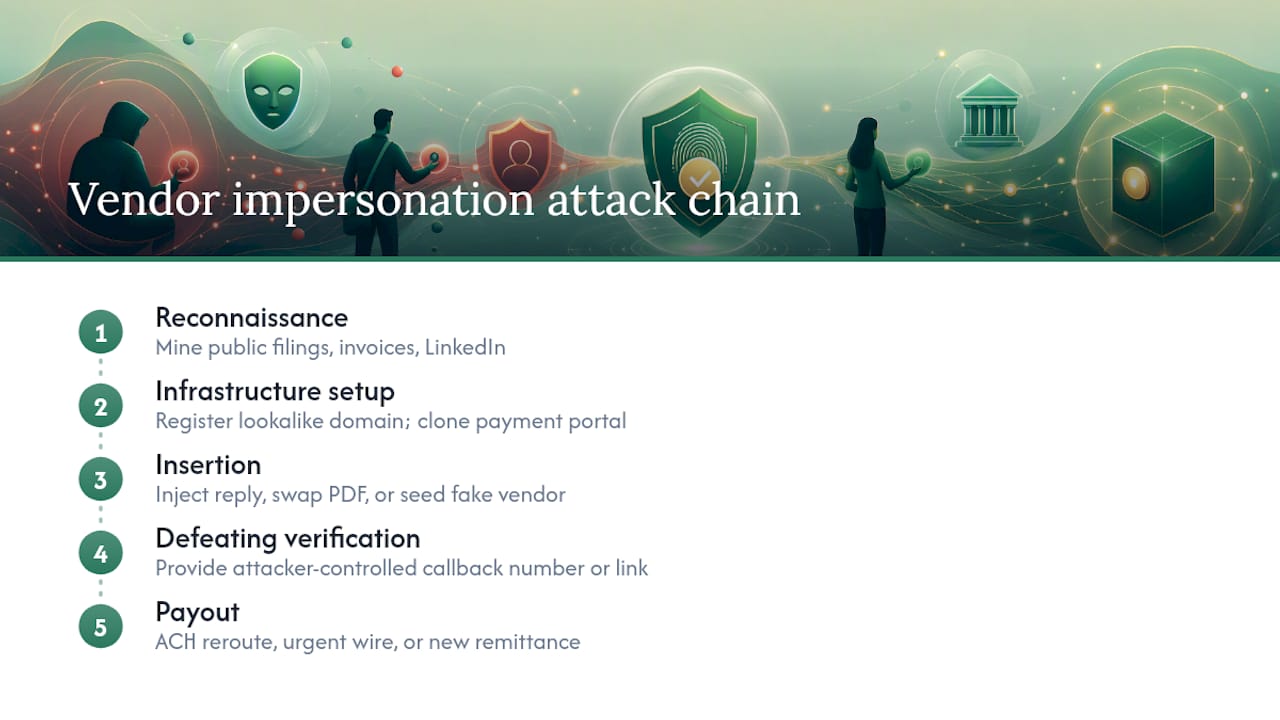
Infrastructure setup. The attacker registers a lookalike domain (a swapped letter, an extra hyphen), sometimes clones the vendor's actual payment portal, and sets up a phone number that will answer as "the vendor" if you call back. Cloned login pages and newly registered lookalike domains frequently exist well before the fraudulent request ever lands in your inbox.
Insertion. This is where the fraud enters your workflow: a reply injected into a real email thread, a swapped PDF attachment on an otherwise normal invoice, or a brand-new vendor seeded into onboarding with fabricated documentation.
Defeating verification. If your process requires a callback, the request conveniently includes a "updated" phone number or support link, one the attacker controls.
Payout. The final move is usually an ACH reroute, a suddenly urgent wire transfer, or a one-off invoice with new remittance details. This is the stage where the loss becomes real and often irreversible.
What Are the Red Flags of Vendor Impersonation Fraud?
Certain signals show up again and again across confirmed cases, and AP staff who know them cold catch far more fraud at triage than any single software filter will.
- A bank-detail or remittance change arriving inside an existing email thread rather than through your formal vendor update process.
- A sender domain that's almost right: an extra letter, a swapped domain extension, or a "no reply" address replacing a known contact.
- A request that insists you verify through a specific number or portal link included in the message itself, rather than one already on file.
- Unusual urgency or secrecy, phrases like "please process before end of day" or "don't mention this to the usual contact."
- Callback audio that sounds slightly off: unnatural pacing, odd word choices, or a voice that matches audio the vendor has posted publicly, since AI voice cloning increasingly defeats callback-only verification.
None of these alone proves fraud. Together, especially urgency paired with a self-supplied verification channel, they should stop a payment cold.
Which Preventive Controls Actually Reduce Vendor Fraud Risk?
Most organizations already hold the data needed to catch vendor impersonation. Tax IDs, historical bank records, and invoice patterns sit in the ERP right now. The failure is procedural: ad-hoc changes get processed without anyone revalidating identity against that data, an operational gap treating identity checks as an afterthought rather than a lifecycle event tends to enable.
Five controls close most of that gap:
- Centralize and deduplicate your vendor master. Match records on high-confidence fields like Tax ID and bank account, not just vendor name, since exact-name matching misses duplicates that fuzzy-matching algorithms catch. Merge duplicates, never delete them. Deleting breaks the audit trail and creates reconciliation problems for trailing twelve months of spend and tax reporting.
- Treat every payment-change request as an identity revalidation event. A new bank account isn't a data-entry task. It's a trigger to reverify the vendor against the record you already trust.
- Separate who can edit vendor records from who can approve payments. If one person can change a bank account and also release the payment, you have no real control, regardless of how many approval steps exist on paper.
- Verify through channels the attacker doesn't control. Call the number stored in your vendor master, never one supplied in the request, and use a secure vendor portal for change confirmations when one exists.
- Layer email authentication, but don't rely on it alone. SPF, DKIM, and DMARC block a lot of spoofed mail, but lookalike domains and compromised vendor inboxes route around all three, so external domain monitoring still matters.
Pro Tip: Run a quarterly audit that cross-references vendor bank accounts against employee bank accounts in payroll. It sounds unrelated to impersonation fraud, but the same insider-facilitated fraud patterns often show up in both systems, and duplicate-detection tools built for one catch issues in the other.
How to Build a Verification Workflow AP Staff Will Actually Follow
A workflow only works if it survives contact with a busy Friday afternoon. This sequence is built to hold up under pressure.
- Pause the payment the moment anything about routing or account details changes. No exceptions for urgency, since urgency is the tell.
- Preserve the evidence immediately. Screenshot the email, save headers, log any phone numbers used. You'll want this if the case escalates.
- Check the vendor master record before doing anything else. Compare the new details against what's already on file.
- Call the known-good number stored in that record, never a number pulled from the request itself.
- Get vendor confirmation in writing through the secure portal or a verified contact, not a reply to the suspicious thread.
- Require dual signoff before the change goes live: one person confirms the vendor, a second approves the payment release.
Insert a realtime payee check right before you save new bank details and again before the payment run itself. Those are the two moments where a fast IBAN and name match catches what a manual callback might miss. Escalate anything above your standard threshold, anything involving a first-time bank change on a high-spend vendor, or anything arriving through an unfamiliar channel straight to a supervisor rather than processing it solo.
What Should You Do in the First 72 Hours After an Incident?
Speed determines whether money is recoverable. Once you suspect vendor impersonation fraud, the clock matters more than the paperwork.
- Pause every related payment immediately, including any scheduled runs touching that vendor.
- Preserve everything: emails with full headers, call logs, portal screenshots, and the original invoice alongside the fraudulent version.
- Open a formal incident ticket so the response is documented from minute one, which matters for both the bank and any later investigation.
- Contact your bank or payment processor directly, giving exact timestamps and requesting a payment trace or recall. Recovery odds drop fast after the first 24 hours.
- Reach the real vendor through a known-good contact, not the compromised thread, and cross-check remittance details against your records.
- Escalate internally to security, legal, and treasury, and prepare to file with the FBI's Internet Crime Complaint Center (IC3) and notify relevant industry partners.
Once the immediate fire is out, audit the vendor master for how the fraudulent record got in, update whatever control failed, and retrain the staff involved. Skipping that last step just guarantees a repeat.
How Realtime Payee Verification Fits Into an AP Control Framework
Realtime payee verification checks whether a name and an IBAN actually belong to the same account holder before you commit funds, removing the guesswork a manual callback leaves behind. Vopify performs that check instantly, matching a name against an IBAN in under two seconds, and supports single lookups, bulk CSV uploads for batch vendor reviews, and API access for teams building the check directly into onboarding or payment-run logic. Vopify has processed over 10,000 verifications across 20 Eurozone countries to date. The right integration point is simple: run the check before saving new bank details, and again immediately before the payment run.

What Legal and Compliance Obligations Apply After a Vendor Impersonation Incident?
Confirmed vendor impersonation fraud usually triggers reporting obligations that go beyond internal cleanup, and finance leaders who treat this purely as an operational loss often miss requirements with real consequences.
In the United States, incidents should be reported to the FBI's Internet Crime Complaint Center (IC3), which tracks BEC and vendor impersonation losses nationally and can sometimes assist with fund recovery through its Recovery Asset Team if reported quickly. Publicly traded companies need to evaluate whether a material loss triggers disclosure obligations under SEC rules, and any organization holding cardholder or banking data should check whether the incident counts as a reportable breach under state data-breach notification laws, which vary by jurisdiction and by the type of data exposed.
There's also a contractual angle worth checking before you assume the loss is final. Some commercial insurance policies and vendor contracts include specific language around fraudulent payment redirection, and whether your policy covers social-engineering losses (as opposed to only direct hacking losses) depends entirely on the exact wording. Legal counsel should review this early, not after the claim is denied.
Internally, documentation discipline matters as much as the report itself. Regulators and insurers alike will ask for the timeline: when the request arrived, when it was flagged, what verification was attempted, and when payment was paused. A messy or incomplete internal record can weaken both a recovery claim and a compliance filing, so the incident-response evidence preservation described earlier isn't just good practice. It's often the difference between a covered loss and an uncovered one.
How Do You Train AP Staff to Spot Social Engineering?
Technical controls stop a lot of vendor impersonation attempts, but the last line of defense is almost always a person deciding whether a request feels right. Training that treats this seriously, not as a once-a-year compliance video, changes outcomes.
Effective programs run short, frequent simulations rather than long annual sessions. A quarterly test invoice with a subtly wrong domain, or a simulated urgent callback request, teaches staff to notice the specific patterns that show up in real attacks far better than a slideshow does. Industry data backs this up directly: many organizations still report gaps in employee training as a primary reason impersonation attempts succeed, which suggests the training gap is often the actual point of failure, not the technology.
Training should also explicitly normalize slowing down. A lot of AP cultures reward speed, closing invoices fast, hitting payment-run deadlines, and that culture works against fraud detection unless leadership makes clear that pausing a suspicious payment is never treated as underperformance. Staff need to hear, from a manager, that a false alarm costs nothing and a missed real one costs everything.
Finally, make the verification steps memorable by tying them to real near-miss stories from within your own organization or industry, not hypothetical scenarios. A story about an actual attempted fraud, even one that failed, sticks with staff far longer than a generic list of red flags ever will.
Where Do AI-Based Anomaly Detection and Fraud Monitoring Tools Fit?
Technology can't replace the verification workflow described earlier, but it can catch things a human reviewer would miss at scale, especially across high transaction volumes where a single anomaly is easy to lose in the noise.
AI-based anomaly detection tools typically watch for pattern breaks: a vendor's payment suddenly going to a new bank, an invoice amount deviating sharply from that vendor's historical range, or a payment request arriving outside the vendor's usual billing cycle. These tools flag deviations for human review; they don't make the final call, and treating an anomaly-detection alert as automatic proof of fraud creates its own operational risk of false positives grinding AP to a halt.
Payment fraud monitoring platforms that sit inside the payment rail itself, watching for behavioral anomalies at the moment of transfer, add a second layer beyond anomaly detection on invoice data. Some due-diligence platforms extend this further into vendor onboarding itself, using AI to cross-reference new vendor documentation against public records, which is worth exploring if your onboarding volume is high enough to make manual review a bottleneck. AI's capabilities in financial due diligence work well for surfacing document inconsistencies, though it still requires a trained reviewer to interpret what the tool flags.
The realistic framing: anomaly detection and monitoring tools reduce the volume of cases that reach human review, and realtime payee verification handles the specific moment of highest risk, the instant before a new account gets paid. Neither substitutes for the other.
How Do You Rebuild Trust With Vendors After an Incident?
Recovery after confirmed vendor impersonation fraud has two tracks running at once: getting money back if possible, and repairing a vendor relationship that fraud just weaponized against both parties.
Vendor communication should happen fast and factually. Call the vendor through a known-good contact, explain exactly what happened without assigning blame prematurely, and ask them to confirm whether their own systems were compromised, since the attacker may have breached the vendor's email rather than yours. Many vendors have been targeted before and will recognize the pattern immediately.
Internally, the vendor master record involved needs a full audit before you resume normal payments to that vendor. Reverify every field, not just the one that was compromised, since an attacker sophisticated enough to hijack one detail may have probed for others. Document what changed, when, and who approved the fix.
Trust restoration also means being transparent about what controls are changing. Vendors that lost money or nearly did want to know their contact won't be redirected the same way again. Some finance teams formalize this with a written confirmation of verification procedures sent to top-spend vendors after any incident, which reassures the vendor and doubles as documentation for auditors and insurers.
The financial remediation side runs in parallel: work with your bank on any remaining recovery efforts, update your incident file as new information surfaces, and close the loop with whoever filed the IC3 report if new evidence emerges. None of this happens overnight, but organizations that treat vendor communication as seriously as internal cleanup tend to keep the relationship intact.
The Governance-First View on Stopping Vendor Impersonation
The instinct after a vendor impersonation scare is to buy a tool. The better instinct is to fix the workflow that let a payment-change request slide through without anyone revalidating identity against records you already had. Tools help, but governance is what actually holds.
Start small. Pick your twenty highest-spend vendors, or every new bank-detail change for a month, and apply strict verification there before rolling it out everywhere. You'll learn your real false-positive rate and staff friction points before they become a company-wide headache.
Culture matters more than any single control. If pausing a payment to verify feels like an accusation, staff will stop doing it. Make verification the routine, boring step it should be, not an exception reserved for suspicion.
— David
Making Verification Routine: A Practical Next Step for AP Teams
Every control covered here, dual signoff, known-good callbacks, vendor master hygiene, works better with a fast, reliable way to confirm that a name and an IBAN actually match before money moves. That's the specific gap Vopify closes: instead of a manual callback that takes a day to schedule, you get a name-to-IBAN match in under two seconds, whether you're checking one vendor or running a bulk CSV upload across your entire supplier list.
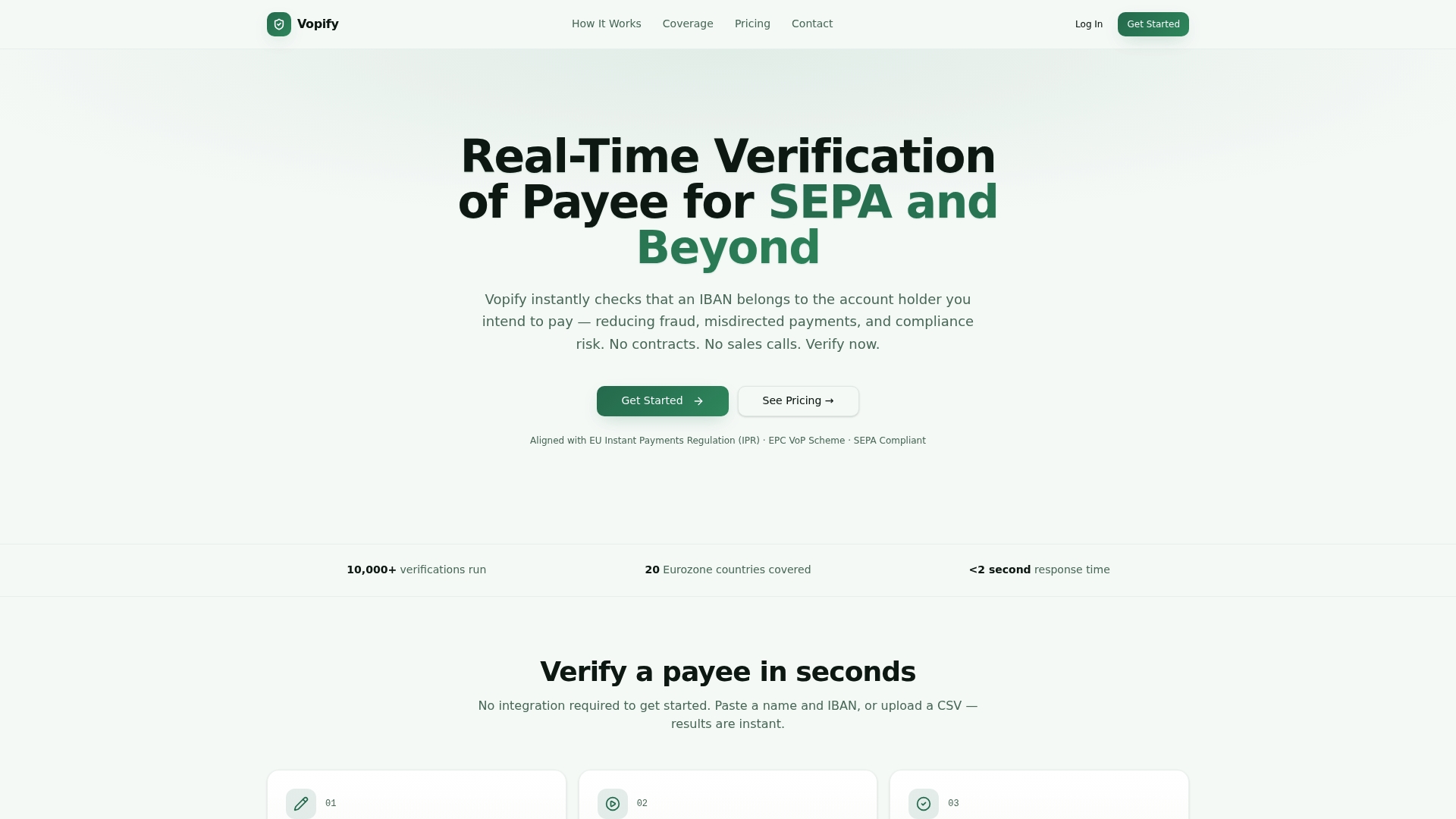
A practical way to start is a focused pilot rather than a company-wide rollout. Apply real-time verification to your top-risk vendors by spend, or to every new vendor bank change, for thirty days. That window is enough to see your actual false-positive rate and how much time it saves your team compared to manual verification calls. Vopify fits into that pilot through a dashboard for manual checks, bulk CSV uploads for batch reviews, and a planned API for teams that want the check running automatically inside onboarding or payment-run logic. The Verification of Payee service covers SEPA countries with sub-two-second response times, and IBAN verification coverage extends to India, Indonesia, South Korea, and Alipay accounts in China for teams paying cross-border vendors. If your next payment run includes a vendor whose bank details changed recently, that's the exact record to check first.
Sources
- Resemble
- What Is Vendor Impersonation Fraud? — Doppel
- Malicious redirection and invoice fraud — RBS insights
- How to audit your vendor master file for duplicate supplier records — Transparent Global
- Vendor impersonation fraud: How it happens & how to prevent it — Veridion