
Beneficiary name verification confirms that the name you have on file matches the actual account holder before money moves. Run it before saving a new beneficiary and again before any high-risk payment goes out. Doing this catches typos, outdated records, and mule accounts before they cost you money, and it directly cuts your exposure to Authorized Push Payment fraud and misdirected payments.
TL;DR:
- Running beneficiary name verification at creation and before high-risk payments can significantly reduce fraud, errors, and mismatched transfers.
- Checks typically return one of four outcomes: match, close match, no match, or match not possible, influencing whether a manual review is necessary.
- Verification APIs should respond in under two seconds to smoothly integrate into payment workflows and avoid workflow delays.
- Broad coverage across payment rails and countries is critical, especially for high-risk or international payments, with fallback methods like micro-deposits as backup.
- Effective operation requires logging all attempts, setting appropriate review thresholds, and treating verification as part of a workflow, not just an API call.
Table of Contents
- What Is Beneficiary Name Verification?
- How Does the Verification Process Actually Work?
- What Are the Best Integration Patterns for Verification APIs?
- Why Do Some Verifications Fail or Come Back as Partial Matches?
- How Do You Operate Verification at Scale?
- How Vopify Approaches Real-Time Verification
- What I've Learned From Watching These Rollouts
- Get Started With Vopify's Verification Coverage
- Sources
What Is Beneficiary Name Verification?
Beneficiary name verification, often called Verification of Payee (VoP) or Confirmation of Payee (CoP), checks whether the account name a payer enters matches what the receiving bank has on record for that account. It's a real-time comparison, not a static database lookup. It's designed specifically to cut down on Authorized Push Payment fraud and payments sent to the wrong account.
The terminology varies by market and vendor. You'll see it called payee name verification, account name matching, or simply "name check." All of it points to the same operation: name in, IBAN or account number in, match result out.
For finance teams, the payoff shows up in three places:
- Fewer payment reversals and the cleanup work that comes with them
- Cleaner reconciliation because fewer payments land in disputed or unknown accounts
- Faster, safer vendor onboarding since new supplier records get checked before they enter your payment run
Skip this step, and you're relying on manual review or trust. Neither scales, and neither catches a fraudster who's changed one letter in a company name on a fake invoice.
How Does the Verification Process Actually Work?
A typical check sends three pieces of data to a verification service: the beneficiary name as entered, the IBAN or account number, and sometimes a routing or sort code depending on the rail. The service queries the receiving bank's live records and returns a result almost immediately.
That result usually falls into one of four categories:
- Match — the name and account line up; proceed with confidence.
- Close match — minor differences (a missing middle initial, a legal entity suffix) that need a human glance before you proceed.
- No match — the name and account don't correspond; this is where you stop and investigate.
- Match not possible — the receiving bank or rail can't return a result, often because of coverage gaps or account status.
Bank-side help portals define these same four categories and generally recommend pausing a payment or contacting the beneficiary directly when a mismatch appears. One detail developers often miss: a "no match" result doesn't automatically block a payment. Verification of Payee schemes explicitly allow payments to proceed regardless of the check outcome — the bank is required to show the result to the payer, not force a stop. That decision sits with your workflow, not the API.
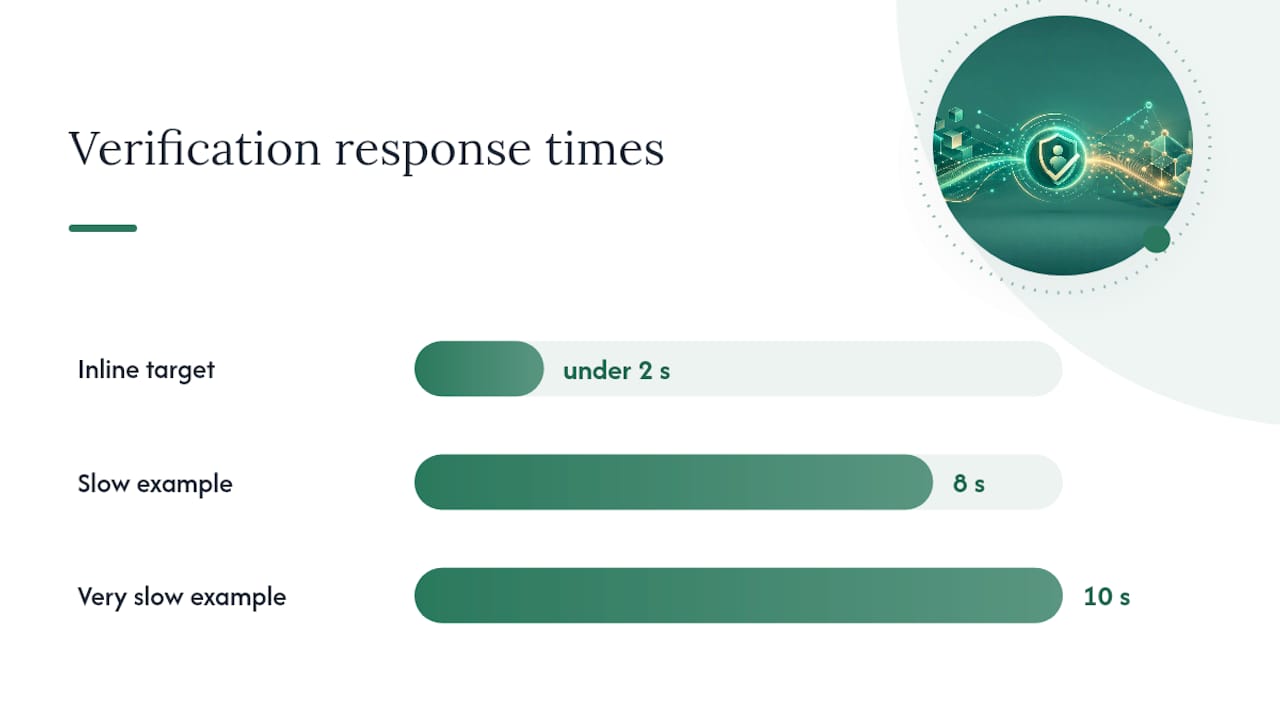
Response speed matters for adoption. A check that takes eight or ten seconds breaks the flow of adding a new vendor inside an ERP screen. Aim for verification that returns in under two seconds so it can sit inline in beneficiary creation forms without users noticing a delay.
What Are the Best Integration Patterns for Verification APIs?
Where you place the check depends on your risk tolerance and your payment volume. Two placements matter most:
- At beneficiary creation. Verify the name and IBAN the moment a new payee record is added, before it ever reaches a payment run. This catches most fraud attempts (fake invoices, spoofed supplier emails) at the cheapest possible point.
- Pre-send for high-risk payments. Even a verified beneficiary record can go stale. Running a second check immediately before a large or first-time payment catches account closures and recent changes.
Developer-facing verification APIs generally follow a consistent shape: you send a name and an account identifier and get back a match outcome plus a reason code you can branch on in your integration logic. Build your beneficiary creation form or payment UI to call this synchronously and hold the "save" or "send" action on the result, rather than firing it as a background job you check later.
Bulk uploads are where teams get tripped up. Most verification networks aren't built to process a 10,000-row vendor file inline. The practical fix is to pre-verify your vendor master data as a separate step, then flag any failed rows for manual cleanup before they ever hit a payment batch.
- Build retry logic for transient failures (timeouts, temporary rail outages), rather than treating every failure as a hard "no match."
- Set an SLA expectation with your provider for both single-check and batch-verification response times, and monitor it.
Pro Tip: Don't wait for a failed payment to discover your vendor master file has bad IBANs. Run a one-time bulk pre-verification pass on your existing supplier list the week you launch this. It surfaces years of accumulated errors in a single afternoon.
Where a live name-check network doesn't cover a given rail or country, some providers fall back to micro-deposit or one-time-password flows to confirm account ownership. These work, but they add a day or two of latency compared to an instant name check, so reserve them for accounts your primary verification can't reach.
Why Do Some Verifications Fail or Come Back as Partial Matches?
Most mismatches aren't fraud. They're formatting. A beneficiary listed as "Jonathan A. Smith" on a bank record and entered as "Jon Smith" in your system will often trigger a close match rather than a clean pass. Common culprits:
- Middle names, initials, or suffixes present in one record and missing in the other
- Punctuation and diacritics that get stripped or altered during data entry
- Legal entity names (Ltd., LLC, GmbH) abbreviated differently across systems
Banks generally leave the tolerance policy for "close match" results up to the payer, which means you need to define your own internal rule for how much variation you'll accept automatically versus route to a human. Verification is also simply unavailable in some cases: accounts on non-supported rails, closed accounts, or institutions that haven't joined a given VoP scheme. In those situations, the honest answer is "match not possible," not a false confirmation. Scheme rules differ by payment rail and region, so confirm what your specific network requires before you build a rejection policy around it.
How Do You Operate Verification at Scale?
A checklist gets you through implementation. The real work is deciding what happens after a check returns a result, and that comes down to sequencing and measurement.
- Run checks at three trigger points: on beneficiary creation, on any beneficiary detail change, and again pre-send for payments above your internal risk threshold.
- Log everything. Store the request, the response, and the timestamp for every check. This is your audit trail for disputed payments and for demonstrating compliance if a regulator or auditor asks.
- Build a fallback path. When verification returns "no match" or "match not possible," route to phone or email confirmation with the vendor rather than defaulting to either an automatic block or an automatic pass.
- Set automation thresholds deliberately. Clean matches move straight through; close matches and no matches go to a review queue, with the threshold tuned as you gather data on false positives.
Watch three numbers after launch: your mismatch rate (how often checks return something other than a clean match), your recovery rate (how many mismatches get resolved and paid successfully after review), and your verification latency (how long checks add to your payment workflow end to end).
Pro Tip: If your mismatch rate sits above a moderate level early on, look at your data entry process before you blame the verification service. Copy-paste errors from invoices and email signatures are the single biggest driver of avoidable mismatches.
How Vopify Approaches Real-Time Verification
The service runs instant name-and-IBAN checks for both individual and business accounts, designed to integrate into existing payment workflows without changing how transfers are initiated. Its coverage documentation lays out which rails and countries are supported, which matters because coverage gaps are exactly where "match not possible" results pile up. Technical guidance on detecting mule-account patterns is also published, covering use cases beyond simple typo-catching.
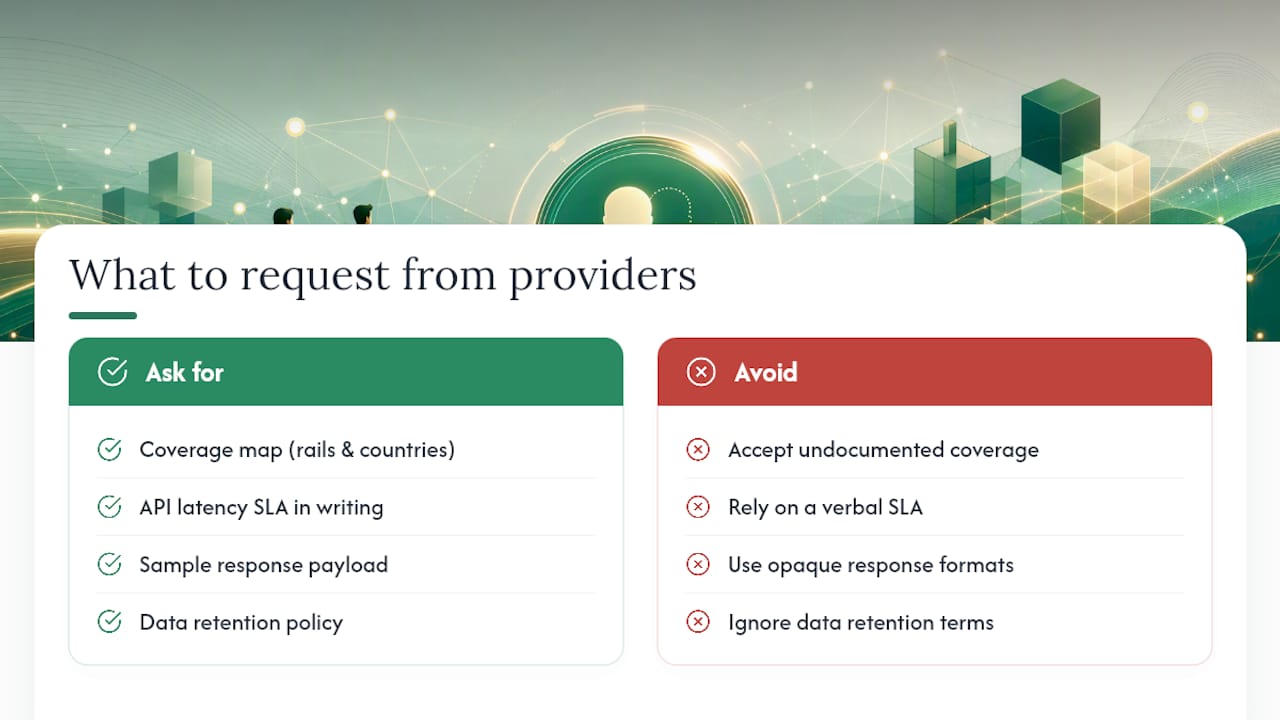
Whichever provider you evaluate, ask for the coverage map, the API latency SLA in writing, a sample response payload, and the data retention policy for the names and account numbers you'll be sending through their system.
What I've Learned From Watching These Rollouts
The teams that get this right treat verification as a workflow decision, not just an API call. Prioritize single-check verification on your highest-risk payees first. A close match still needs a human. Automation handles the clean matches; people should always own the judgment calls on everything else.
— David
Get Started With Vopify's Verification Coverage
The checklist above only works if the underlying check is fast enough to sit inline and broad enough to cover the accounts you actually pay. Vopify verifies payee names against IBANs in under two seconds, across SEPA countries, India, Indonesia, South Korea, and China through Alipay, for both single lookups and bulk supplier files.
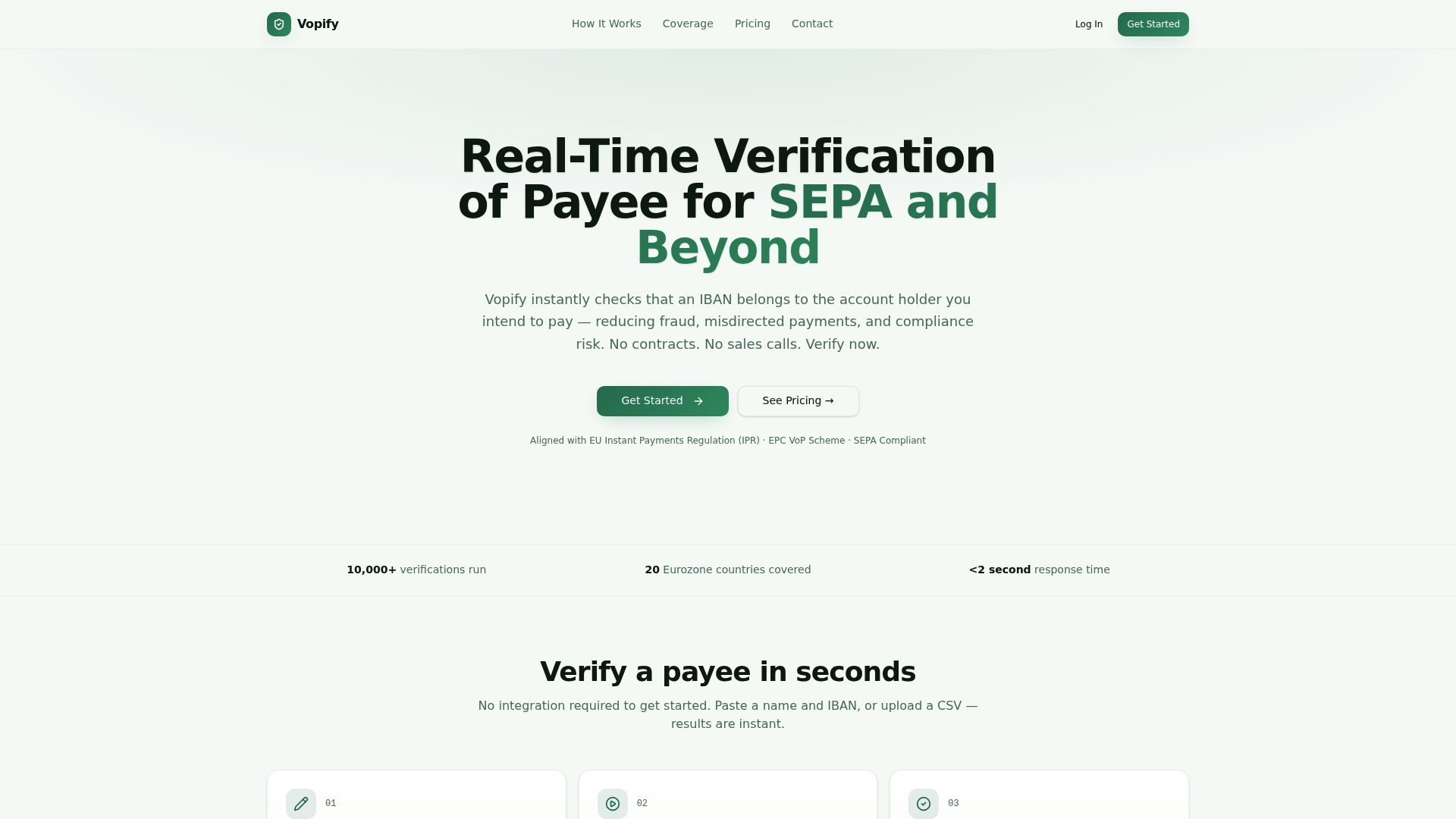
If you're building the beneficiary-creation check described earlier in this guide, start by reviewing which payment networks are supported to confirm your corridors are covered, then request access to run your first batch of verifications against your existing vendor master data.
Sources
- Payee Name Verification — Federal Reserve Bank Services
- Beneficiary Verifications - Platform Overview — Integrated Finance developer docs
- Beneficiary Name Check FAQ's — ANZ Digital Services Help
- Verification of Payee (VOP) — CPG