
In this context, "nacha account validation" means real-time name+IBAN payee verification, not NACHA's ACH routing-number rule. The immediate action: validate every payee before you initiate payment, and treat a No Match as a stop-and-investigate event, not a formatting error. Tools like Vopify perform this check in real time against live banking data, giving AP teams a pre-execution signal they didn't have five years ago.
TL;DR:
- Real-time name and IBAN verification confirms account ownership but does not prove invoice legitimacy or vendor authenticity.
- Use structured IBAN validation first, followed by live verification both during onboarding and prior to payments to reduce errors.
- Discrepancies should trigger escalation protocols, such as callback verification or documentary proof, with clear approval workflows in place.
- A verification result of No Match signals a likely issue and should halt the payment, while Close Match requires secondary review, and Match can proceed with proper logging.
- Ongoing maintenance includes periodic rechecks of vendor data, strict access controls on verification logs, and integrating validation into your automated payment system to prevent drift.
Table of Contents
- What Name+IBAN Verification Actually Checks (and What It Doesn't)
- Why Real-Time Verification Matters for U.S. AP and Treasury Teams
- How to Validate ACH Accounts: A Five-Step Pre-Execution Process
- Turning Match Results Into Action: Triage Rules for Every Outcome
- Integrating Validation Into Your Payment Stack Without Adding Friction
- Where the Verification Data Actually Comes From
- Where Compliance Fits Into Your Validation Program
- Handling Verification Data Without Creating a New Risk
- Keeping Verification Accurate as Vendor Data Ages
- What Verification Adds to Fraud Detection and Prevention
- What Actually Moves the Needle Here
- Building Pre-Execution Validation Into Your Payment Workflow
- Sources
What Name+IBAN Verification Actually Checks (and What It Doesn't)
This isn't the NACHA Account Validation Rule that governs ACH routing and account number checks for domestic transfers. It's a different control: confirming that the name on file for a payee actually matches the name attached to the bank account tied to that IBAN, checked in real time against live banking networks.
Verification systems typically return one of four outcomes, sometimes paired with a confidence score:
- Match — the name and account line up cleanly.
- Close Match — a partial correspondence, often from abbreviations, middle names, or trading names versus legal names.
- No Match — the name does not correspond to the account holder on record.
- Not applicable — the receiving bank isn't connected to the verification network, so no result is returned.
None of this proves an invoice is legitimate or that the vendor relationship itself is real. A verification check confirms account ownership, not business intent, and naming inconsistencies (a DBA versus a legal entity name, for instance) can trigger false Close Match results even on entirely legitimate accounts.
Why Real-Time Verification Matters for U.S. AP and Treasury Teams
Business email compromise remains one of the most expensive fraud categories hitting U.S. finance departments, and the mechanism is almost always the same: a convincing email requests a "updated" bank account for an existing vendor. Real-time name+IBAN checks catch this pattern at the exact moment it matters, before the wire leaves the building.
The operational case goes beyond fraud prevention. Verification done right also delivers:
- Fewer returned payments from stale or mistyped account details, since structural and name checks catch errors before submission.
- Cleaner vendor master data, because every verification event forces a fresh look at what's on file.
- Faster payment triage, since automated checks flag exceptions instead of requiring manual review of every line.
- A documented audit trail that shows exactly when and how each payee was confirmed.
Here's the catch treasury teams get wrong: a verification pass is a warning light, not a fraud-proof seal. Treasury practitioners are explicit about this — a Match result tells you the name and account correspond, nothing more. It has to sit inside a broader control stack that includes vendor governance, callback verification, and approval workflows, not replace them.
How to Validate ACH Accounts: A Five-Step Pre-Execution Process
Most failed implementations skip straight to "run a check" without building the surrounding process. A validation result is only as good as the workflow around it. Here's the sequence that actually holds up under audit scrutiny.
-
Capture the exact account-holder name at onboarding. Use a dedicated field for the legal name tied to the bank account, separate from the vendor's trading name or DBA. This single habit eliminates a large share of false Close Match results down the line.
-
Run structural IBAN validation first. A MOD-97 checksum and format check catch typos and malformed account numbers before you ever touch a real-time lookup. It's a cheap first filter that removes technical noise.
-
Run the real-time name-to-account check at both onboarding and pre-payment. Any time bank details change on a vendor record, and again immediately before funds move, re-run the verification. Combining structural checks with live name matching and independent callbacks covers the failure modes each method misses on its own.
-
Escalate discrepancies with an out-of-band callback. Never confirm a bank change by replying to the email or portal message that requested it. Call the vendor using a phone number from your existing master file, not one supplied in the change request, and ask for a bank letter or recent statement as documentary backup.
-
Apply dual approval and a cooling-off window on recent changes. Any bank-detail update should trigger a second approver and, ideally, a short waiting period before the first payment goes out on the new details.
Pro Tip: Build your cooling-off window into the approval system itself, not just your policy document. A rule that only lives in a PDF gets skipped during month-end crunch; a rule enforced by the payment platform doesn't.
Turning Match Results Into Action: Triage Rules for Every Outcome
A verification result only has value if your team knows what to do with it. Ambiguity here is where most programs stall, either blocking too many legitimate payments or waving through ones that deserved a second look.
The core discipline: automate the easy calls, escalate the ambiguous ones, and never let "Not applicable" become an excuse to skip verification entirely.
- Match: Proceed automatically, but log the result for audit purposes and keep it in your exception-monitoring dataset in case patterns emerge later.
- Close Match: Route to a second approver who reviews the specific discrepancy (nickname, abbreviation, missing middle name) before releasing funds.
- No Match: Block the payment immediately. Standard practice calls for halting the transaction and verifying through an independent, pre-verified contact, never by replying to the same channel that submitted the invoice. Request a bank letter or statement and document the resolution before funds move.
- Not applicable: Fall back to alternate controls. When a bank isn't connected to the verification network, micro-deposits or documentary proof fill the gap, and the fallback method itself should be logged for the audit trail.
| Outcome | Required action | Who signs off |
|---|---|---|
| Match | Proceed, log result | Automated, spot-audited |
| Close Match | Confirm discrepancy details | Second approver |
| No Match | Block, callback, document | Compliance or treasury lead |
| Not applicable | Micro-deposit or documentary proof | AP supervisor |
Integrating Validation Into Your Payment Stack Without Adding Friction
The teams that get the most value from account validation build it into the system of record, not into a side spreadsheet someone checks manually. That distinction shows up fastest when vendor data drifts out of sync between your ERP and your payment platform.
Pull validation data from a single authoritative vendor master at the moment of payment, not from a cached copy synced days earlier. Version-mismatch errors between systems are a leading cause of payment failures, and reading live from one source eliminates that category of error outright.
A few practical rules keep the system running clean:
- Require all bank-detail changes to go through an authenticated vendor portal, never an email thread.
- Pair a cooling-off window with the change, so a newly updated account doesn't get its first payment released same-day.
- Automate structural and name-matching checks so staff only touch the exceptions that actually need judgment.
- Store a dedicated "account holder name" field and use it for matching instead of a trading name to cut down on avoidable Close Match noise.
Pro Tip: Set a triage SLA for each outcome type. High-volume AP teams often give Close Match cases a two-hour window and No Match cases an immediate block with a 24 to 48 hour resolution deadline, so exceptions don't stall an entire pay run while one vendor gets sorted out.
Where the Verification Data Actually Comes From
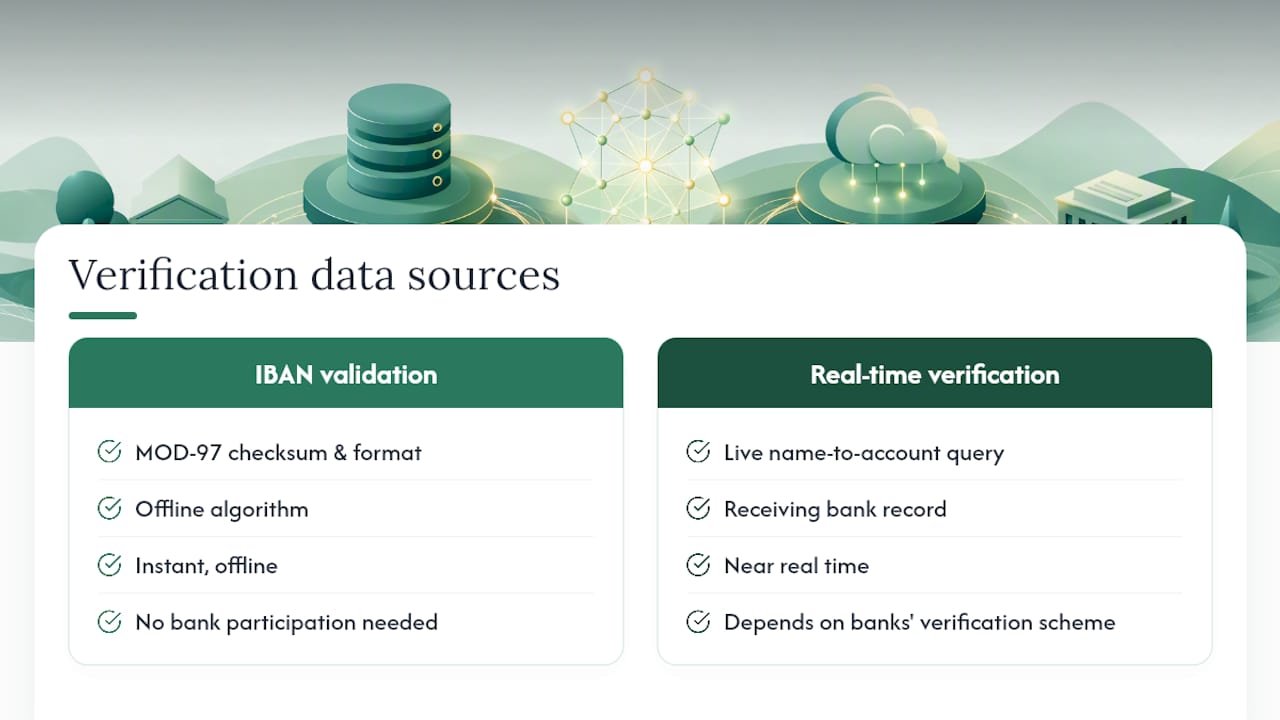
Real-time verification doesn't pull from a static list of known-bad accounts. It queries live banking infrastructure at the moment of the check, comparing the name you submit against the name the receiving bank has on record for that account.
For SEPA-zone payments, this happens through banks participating in Verification of Payee schemes across the Eurozone, which return a match result in near real time. Coverage outside SEPA varies by market and by which banking networks have built out equivalent verification rails. That's why a "Not applicable" result matters as information in itself: it usually means the receiving institution hasn't connected to the relevant network yet, not that anything is wrong with the account.
This is also why IBAN validation vs. verification is a meaningful distinction for AP teams to understand. Structural IBAN validation, the MOD-97 checksum, and format rules, is a static, offline calculation you can run against any IBAN instantly. Real-time verification is a live query against the account holder's bank, and it depends entirely on both banks in the transaction participating in a verification scheme. A vendor's IBAN can pass structural validation perfectly and still return "Not applicable" on the name check simply because their bank hasn't joined the network yet.
Where Compliance Fits Into Your Validation Program
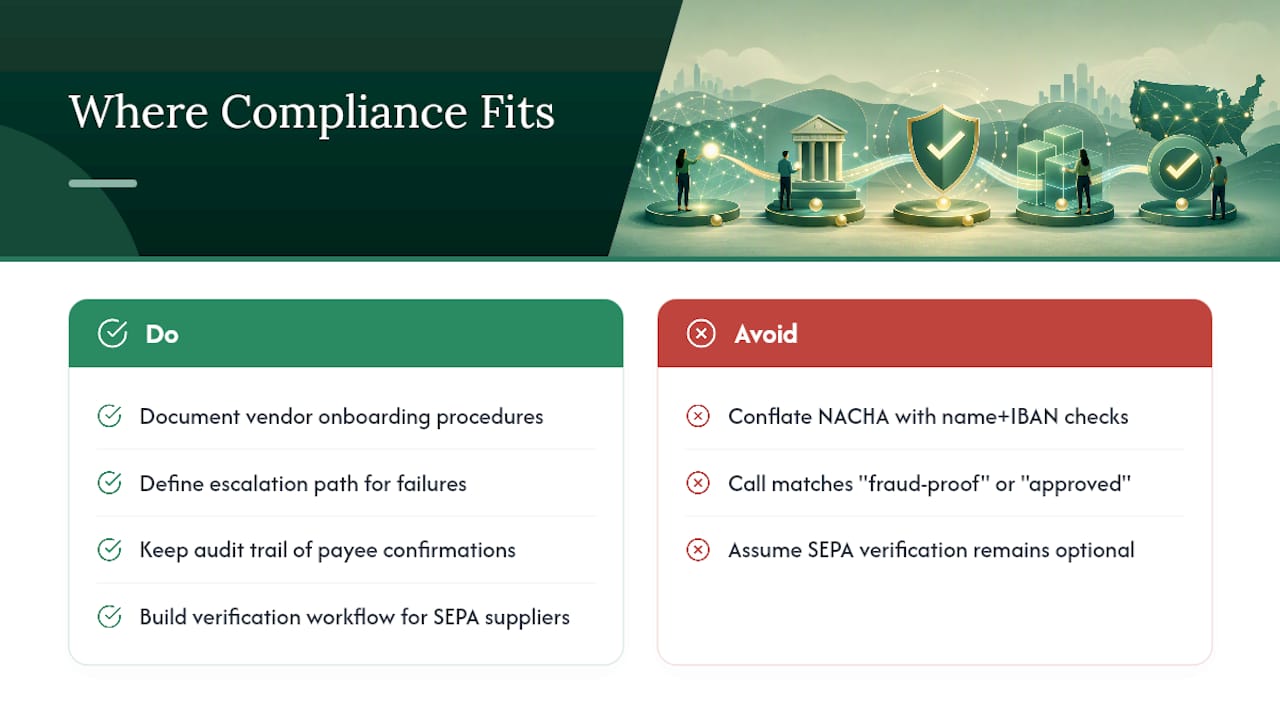
NACHA guidelines for validation govern a separate compliance track, ACH origination rules for U.S. domestic transfers, and they don't cover the name+IBAN checks this article focuses on. Don't conflate the two when you're building policy documentation, because auditors and examiners will ask which framework you're actually operating under.
What does apply here is standard AP and treasury governance: documented procedures for vendor onboarding, a clear escalation path for verification failures, and an audit trail that shows when and how each payee was confirmed before payment. Regulators and internal auditors increasingly expect to see evidence that a firm has some pre-payment verification control in place, even when no specific statute mandates the exact method.
For companies operating internationally, the EU's Instant Payments Regulation is pushing Verification of Payee toward becoming a default expectation across SEPA transactions, which matters directly if your vendor base includes European suppliers. U.S. teams paying into that zone should expect verification checks to become closer to standard practice rather than optional, and building the workflow now avoids scrambling later.
Keep your compliance documentation focused on what the control actually does: confirms name-to-account correspondence at a point in time. Overstating what a Match result proves, calling it fraud-proof or transaction-approved, creates exposure if a loss occurs despite a clean verification result on file.
Handling Verification Data Without Creating a New Risk
Every verification check moves sensitive data: bank account numbers, account holder names, and often the underlying business relationship details. Treat this data with the same rigor you'd apply to any financial PII, because a verification log that leaks is itself a liability, not just an operational record.
A few practices matter more than they might seem at first glance:
- Restrict access to verification results and raw IBAN data to the specific roles that need it, not the entire AP team.
- Encrypt verification logs at rest and in transit, since they're effectively a record of every bank account your company has ever paid.
- Set a retention policy for verification data rather than keeping it indefinitely. Audit needs are usually satisfied by a few years of history, not permanent storage.
- Confirm any third-party verification provider you use maintains its own data protection commitments and doesn't resell or repurpose the account data it processes.
The tension here is real: you need enough verification history to spot patterns (a vendor whose bank details change unusually often, for example) without turning your verification log into an attractive target in its own right. Segmenting that data from your general vendor database, with tighter access controls than the rest of your AP system, is the practical middle ground most compliance teams land on.
Keeping Verification Accurate as Vendor Data Ages
A verification check run at onboarding tells you the truth as of that day. Vendors close accounts, switch banks, and get acquired, and none of that updates your records automatically. The accuracy of your validation program degrades quietly over time unless you build in a mechanism to catch it.
Periodic bulk rechecks of the vendor master catch accounts that have gone stale since their last verification, closed accounts, changed ownership, or banks that have since joined a verification network and can now return a real result instead of "Not applicable." Running this quarterly, or at minimum annually for high-volume vendors, catches drift before it turns into a failed payment or a fraud incident.
Name normalization deserves its own maintenance cycle too. As your vendor base grows, inconsistent data entry, one AP clerk types the legal name, another types the DBA, compounds into a rising rate of Close Match results that have nothing to do with actual risk and everything to do with data hygiene. A standing rule that all bank-account-holder names get entered exactly as they appear on the vendor's own bank documentation, checked against that dedicated field rather than the general company name, keeps this noise down as your vendor list scales.
What Verification Adds to Fraud Detection and Prevention
Wire fraud losses tied to compromised or spoofed vendor communications remain a persistent problem for U.S. companies, and the entry point is almost always a bank-detail change request that looks legitimate. Real-time verification interrupts that pattern at the one moment where a check is cheap and a mistake is expensive: right before the payment executes.
The value isn't that verification catches every fraud attempt. It's that a No Match result on a vendor whose details supposedly haven't changed is one of the strongest available signals that something is wrong, stronger than most manual review processes catch on their own. Treasury and payments researchers frame this correctly: verification works best paired with behavioral anomaly detection and strict vendor master governance, not as a standalone fraud shield.
Combined with dual approval and out-of-band callbacks, a name+IBAN check closes off the specific attack vector, redirected legitimate invoices, that costs U.S. finance teams the most. Fraud that doesn't rely on a bank-detail change, like a purely fabricated invoice from a shell vendor, sits outside what any account validation method can catch, which is exactly why it has to sit alongside vendor due diligence rather than replace it.
What Actually Moves the Needle Here
The lesson that keeps surfacing in payment fraud postmortems isn't complicated: teams that verify at onboarding rarely get paralyzed by verification later. Front-loading the work, capturing clean names, running structural checks, confirming account ownership before the vendor ever gets paid, means the pre-payment check at the moment of execution is a formality that confirms nothing has drifted, rather than a scramble to sort out a mess.
The instinct to treat a No Match as an annoying delay is the wrong instinct. It's the highest-value signal your payment stack produces, and treating it as a routine exception to clear quickly is how legitimate fraud attempts slip through. Tools like Vopify exist precisely because manual callback verification doesn't scale past a certain vendor count, but the discipline behind the tool matters more than the tool itself. A fast, accurate Match result on a vendor whose details actually changed fraudulently is worse than a slow, correct No Match.
— David
Building Pre-Execution Validation Into Your Payment Workflow
Vopify gives you what a phone-based callback can't: an instant, documented check on every payee before funds move, without adding a manual step your AP team has to remember to run.
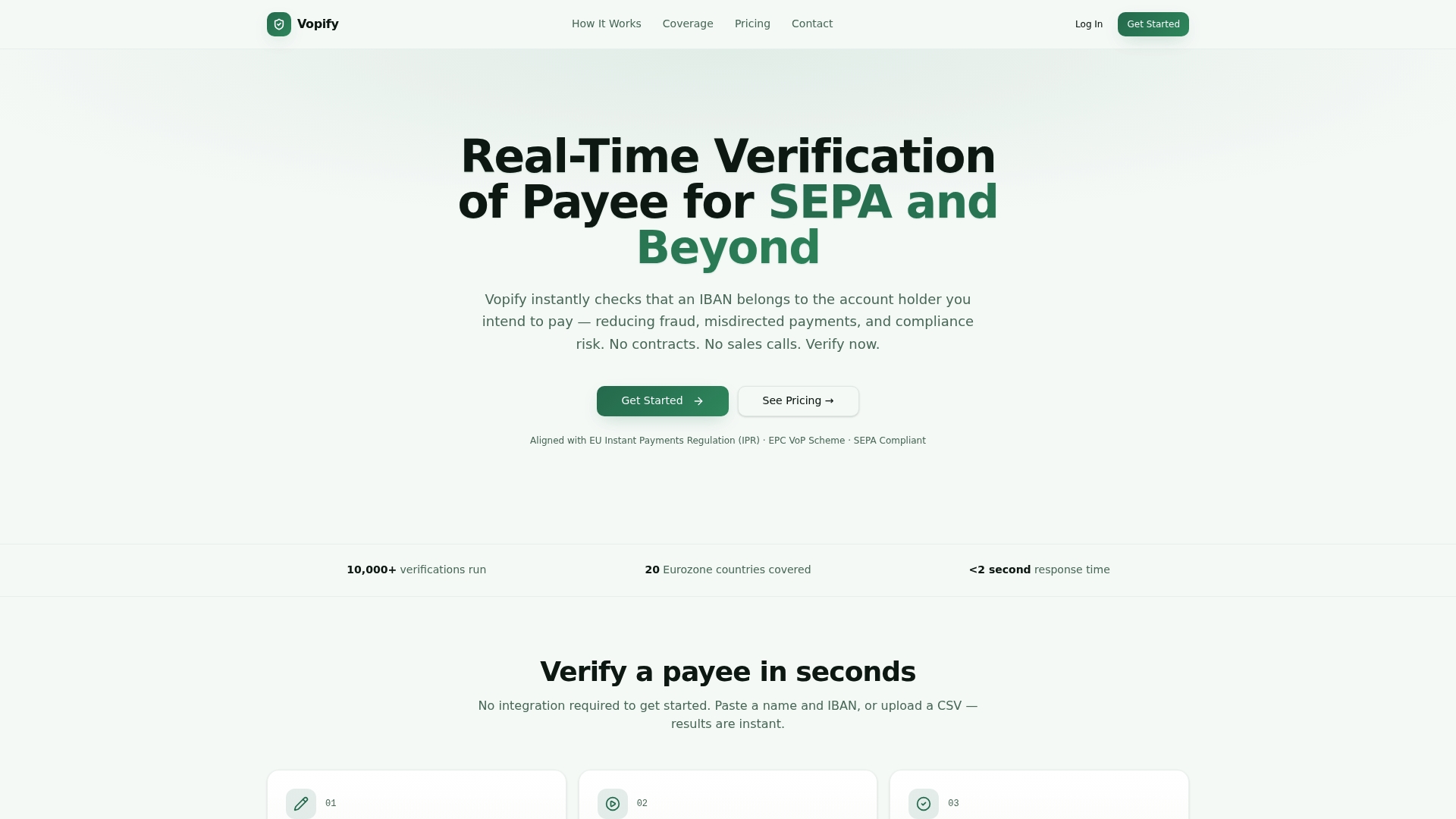
The platform checks a submitted name against the account holder on file for that IBAN in under two seconds, covering individual and business accounts across SEPA countries plus India, Indonesia, South Korea, and Alipay accounts in China. You can run a single check on a one-off payee or upload a batch CSV to verify your entire vendor file at once, which matters if you're catching up on a backlog of unverified suppliers. Results land in a dashboard with Match, Close Match, or No Match outcomes, and pricing runs on either a pay-as-you-go credit model or a subscription, so you're not locked into a long contract to find out if it fits your workflow. API access for high-volume, programmatic verification is on the roadmap for teams that want it wired directly into their payment platform.
If your vendor base spans multiple countries, check Vopify's supported networks and coverage to confirm your payee footprint lines up, then start with a small batch upload through Vopify to see how the results fit into your existing approval workflow.
Sources
- Why payee verification is becoming critical payments infrastructure
- VoP in practice: a warning light, not a fraud-proof seal
- Verify supplier payment details — step-by-step
- Accounts payable IBAN verification: a step-by-step guide