
SEPA name matching compares the payee name you enter with the name on the account behind the IBAN. It returns one of four results before you send the money: match, close match, no match, or other. The rules come from the European Payments Council (EPC) Verification of Payee (VoP) scheme and the EU Instant Payments Regulation. Below is what each result means, which name differences cause trouble, and what your accounts payable team should do next.
TL;DR
- VoP checks that the name and IBAN you supply belong to the same account holder at the receiving bank, for both standard SEPA credit transfers and SEPA instant credit transfers.
- A match means the names are identical after standard clean-up. A close match means a small difference. A no match means the name does not fit the account.
- Euro-area banks had to offer the check from 9 October 2025. Non-euro EU countries follow in 2027.
- Most mismatches come from legal-name versus trading-name differences, abbreviations, diacritics and transliteration. Keep supplier master data in the legal-name form.
- If you pay from the US, your bank may not run the check for you. You can still verify suppliers before you release the payment.
Table of Contents
- What SEPA name matching is
- Why the rules exist: the Instant Payments Regulation
- The four results and what each one means
- Which name differences affect the result
- What the check does not do
- Do SEPA name matching rules apply to US businesses?
- How AP teams should prepare
- Perspective
- Check names before you pay with Vopify
- FAQ
- Sources
What SEPA name matching is
Verification of Payee lets a payer confirm, before starting a payment, that the name and IBAN given for a payee correspond to the account holder at the receiving payment service provider. It is designed for SEPA Credit Transfers (SCT) and SEPA Instant Credit Transfers (SCT Inst).
The flow has two sides. The payer's bank sends a request containing the name and IBAN. The receiving bank, called the responding PSP, compares the name to the account holder record and sends back a result. The payer sees that result before authorizing the payment.
The IBAN alone tells you the account is valid in format. It does not tell you whose account it is. That gap is where invoice fraud and honest typing mistakes both do their damage, and it is the gap name matching closes.

Why the rules exist: the Instant Payments Regulation
The EU Instant Payments Regulation (IPR) was adopted on 13 March 2024. Under it, payment service providers must offer payers a verification of payee service covering both standard and instant credit transfers, free of charge to the payer. The ECB lists the deadline for euro-area Member States as 9 October 2025 and for non-euro Member States as 9 July 2027.
The EPC VoP scheme rulebook is the common technical standard banks use to meet that duty. The EPC describes the scheme as a standard underlayer for interoperability that helps PSPs meet the legal requirements of the IPR.
If you want a compliance-side walkthrough of the deadline, our piece on SEPA confirmation of payee for compliance teams covers it in more detail.

The four results and what each one means
The responding bank is responsible for the matching outcome. It must support all required response types: Match, Close Match and No Match. The ECB adds a fourth outcome to the list payers can see: "other", used when a check could not be completed.
| Result | What it means | What you should do |
|---|---|---|
| Match | The name is identical to the account holder name after standard clean-up | Release the payment |
| Close match | The name is similar but not identical, such as a minor spelling or formatting difference | Confirm the correct name with the payee, then correct your record |
| No match | The name does not correspond to the account holder | Do not pay. Contact the payee through a known channel |
| Other | The check could not be completed | Retry, or verify through another route before paying |
Match
Under the EPC recommendations, a match is an exact match of the payee name, whether a person or a company, after standard data clean-up. Clean-up includes removing honorifics and ignoring upper and lower case. So "MR John Smith" and "john smith" can still produce a match.
A match is the green light, but it only says the name fits the IBAN. It does not say the invoice is genuine. A fraudster who controls a real account in their own name can match their own name.
Close match
A close match means the names differ in a way the responding bank treats as minor. Typical examples are a missing middle initial, a slightly different order of names, or a small typo. In many bank interfaces, the payer is shown the name on the account or a prompt to correct it.
The ECB's guidance on VoP messages says that for a close match the PSP should explain the result and may suggest corrective actions. What you actually see depends on your bank, because the wording of the message and the amount of detail shown vary.
No match
A no match means the name you entered does not correspond to the holder of that IBAN. For this result, the guidance says the PSP should warn of risks and may suggest checking details or contacting the beneficiary.
Treat a no match on a first-time payee, or on a supplier that just changed bank details, as a stop sign. Call the supplier on a number you already hold, not one from the email that asked for the change.
Other
Sometimes the receiving bank cannot answer: the account type may not be supported, or the service may be temporarily unavailable. That is not a pass. Build a rule that an "other" result on a new or changed payee sends the payment to a manual check.
Which name differences affect the result
The rulebook cannot account for every way people and companies write names. In practice, a few categories cause most of the friction.
Legal name versus trading name
Businesses often invoice under a brand name while the bank account sits under the registered legal entity. "Northwind Foods" on the invoice may be "Northwind Holdings B.V." at the bank. EPC recommendations treat legal entities as well as natural persons, so the safest data is the registered name as it appears in the company register and on the bank mandate.
Legal-form suffixes and abbreviations
GmbH, S.r.l., B.V., S.A. and their variants appear in different forms across countries. A missing or abbreviated suffix is one of the most common reasons a name falls from match to close match. Our deeper look at the algorithms behind this is in VoP name matching algorithms for AP teams.
Diacritics and transliteration
Names with accents, umlauts or non-Latin origins are a known problem area. The IPR itself notes that transliterations and diacritics can mean a payee name and account identifier almost match, and the document calls for Union-wide rules and standards. For your data, that means storing names exactly as the supplier's bank holds them, accents included, rather than normalizing them to plain ASCII.
Joint accounts, individuals and sole traders
A sole trader may hold an account in a personal name while invoicing under a business name. Name order (first name first or surname first) and middle names also vary between countries. If a supplier is a one-person business, ask which name the account is held under.
Data entry mistakes
Typos, a stray space, a pasted line break from a PDF invoice: all of these can reduce an exact match to a close one. They are also the easiest to prevent with a validated supplier record.
What the check does not do
Name matching is a strong control against misdirected payments and certain fraud patterns, but it has a clear scope.
- It confirms name against IBAN. It does not confirm that the invoice is legitimate or that the goods were delivered.
- A mule account opened in the fraudster's own name can return a match. See our article on mule account detection for AP teams for the extra signals to look for.
- Results are only as good as the name you provide. Poor master data produces false alarms.
Do SEPA name matching rules apply to US businesses?
The regulatory duty sits with payment service providers. The IPR requires PSPs to offer the verification service to the payer, and the deadlines apply to PSPs in EU Member States. A US company is not itself bound by the rule, and whether your US bank shows you a VoP-style result when you send a euro payment depends on the bank. Ask your bank or treasury platform whether it supports it for your SEPA payments.
The practical point is separate from the legal one. Your European suppliers' banks answer these checks, so your suppliers' data will be held to the legal-name standard. If you pay European suppliers, you can run the same check yourself before releasing funds, regardless of what your own bank offers. The bank-side check happens at payment time. A pre-payment check on supplier onboarding or on bank-detail changes catches the problem earlier.
How AP teams should prepare
The EPC advises that corporates make sure the name on invoices matches the name registered with the bank, because even small differences can lead to failures or delays. Here is a workable routine.
- Store the legal name and the bank-registered name. Add a field for the exact account holder name, separate from the trading name.
- Verify at onboarding. Run name and IBAN through a check before the first payment to any new supplier.
- Re-verify on every bank-detail change. This is where business email compromise attacks concentrate.
- Define a rule for each result. Match proceeds. Close match goes to a reviewer who confirms the name with the supplier. No match is blocked. Other is retried, then checked manually.
- Correct the master record, not only the payment. If a close match is confirmed, update the stored name so the next run produces a match.
- Track your match rate. A falling rate points to data quality problems. We explain how in payee match rate: what it measures and how to improve it.
If you reconcile payments to bank deposits as part of the same close process, the same data discipline applies; a short guide to event revenue reconciliation shows how reports and deposits are matched line by line.
For definitions and the codes you will see in practice, read VoP match codes and IBAN checks for AP teams.
Perspective
Most teams treat name matching as something the bank does to them. We see it the other way around: it is a data quality tool you can use before the bank ever gets involved.
When a supplier's name and IBAN pair fails, the cause is almost never exotic. It is a trading name where a legal name should be, a missing suffix, or an accent lost on the way into the ERP. Fixing these once, at onboarding, removes the friction every later payment would hit.
That is why we built Vopify around a simple input: a name and an IBAN, with a result in under two seconds and no contract or integration project to get started. Finance teams get the answer at the moment they need it, and a bad bank detail never reaches the payment run.
The rules are the same whether you pay five suppliers or five thousand. What changes is how much manual checking you can afford. Bulk checks and, as it is planned, programmatic access are how larger AP teams keep the control without adding headcount.
David
Check names before you pay with Vopify
Vopify checks a payee name against an IBAN in real time. It works for individual and business accounts and returns the result in under two seconds. It covers 20 Eurozone countries, and the platform has processed more than 10,000 verifications. You can run a single lookup or upload a CSV of supplier data for a bulk check.
Pricing is published on the site: a one-off check costs $0.70 to $1.00 per verification, or you can choose a subscription: Starter at $240 per month, Growth at $750 per month, or Scale at $2,000 per month.
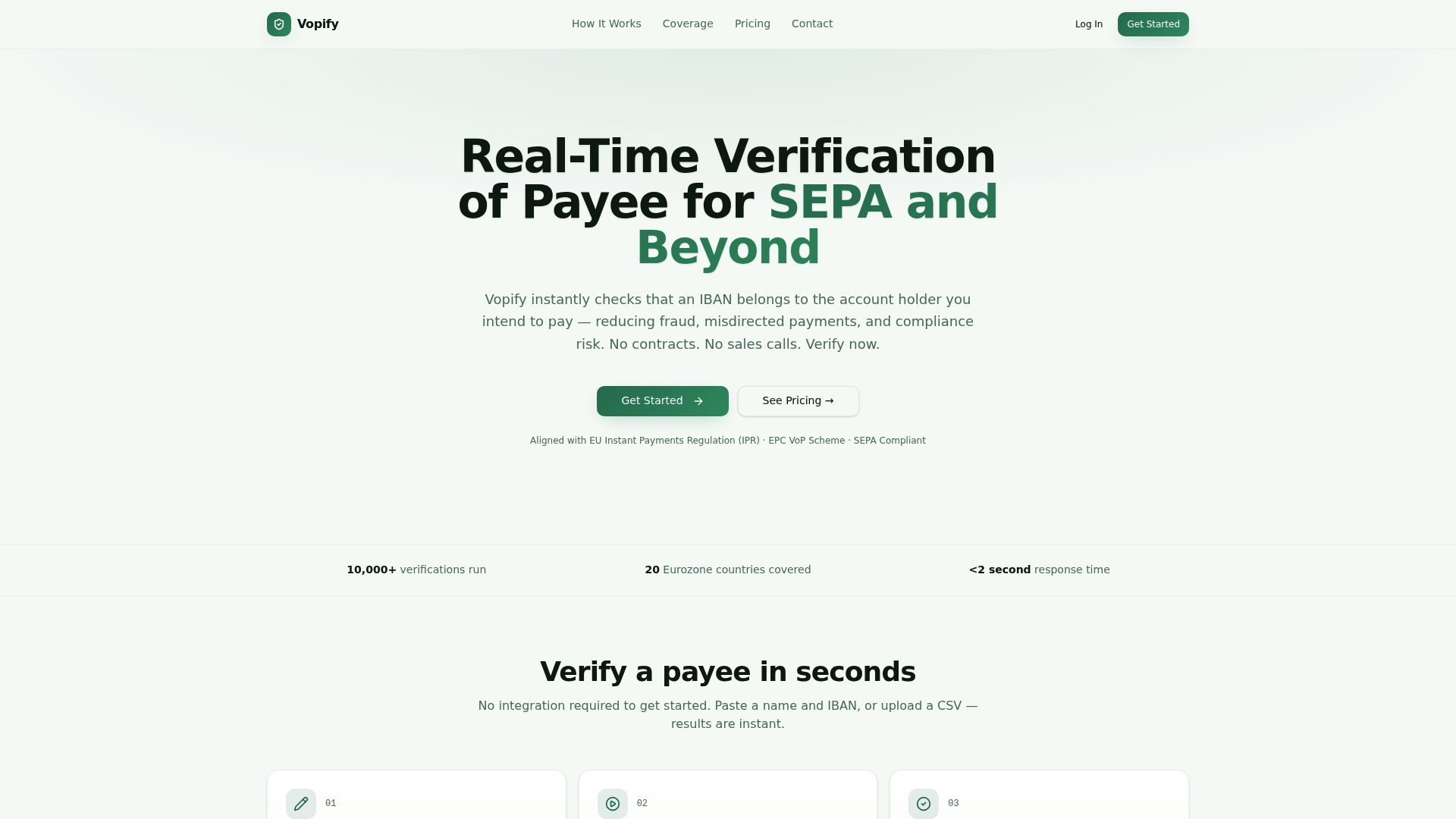
Start with Vopify's payee verification, see how the Verification of Payee service works for SEPA, or check a full supplier file with bulk IBAN verification.
FAQ
What is the difference between a match and a close match?
A match means the name is identical to the account holder name after standard clean-up such as removing honorifics and ignoring case. A close match means the names differ in a minor way, such as a missing initial or a small spelling difference. Confirm a close match with the payee before you pay.
Is Verification of Payee mandatory?
For banks, yes. The Instant Payments Regulation requires payment service providers to offer the service, with a deadline of 9 October 2025 for euro-area Member States and 9 July 2027 for non-euro Member States. It must be offered to the payer free of charge. The payer's own checking routine is a business choice.
Why did my supplier's name return a close match?
The usual causes are a trading name used in place of the legal name, a missing or abbreviated legal-form suffix, or diacritics and transliteration differences. Ask the supplier for the exact account holder name and store it in your supplier record.
Can I pay if the result is no match?
You should not release the payment until you have confirmed the details. Contact the payee through a channel you already trust, not the one in the latest invoice email, and ask for the account holder name and IBAN again.
Sources
- Verification of Payee (VOP), European Payments Council
- EPC Recommendations for the Matching Processes under the VOP Scheme Rulebook
- Instant Payments Regulation, European Central Bank
- Guidance for VoP messages v2.0, European Central Bank
- TIPS-CG meeting document on the Instant Payments Regulation, ECB
- Verification of Payee: a valuable addition to the payment order, European Payments Council
- Event Revenue Reconciliation: Report vs Bank Deposit