
A false positive name match happens when your verification check reports a match on the payee name and IBAN, but the account actually belongs to someone else or the name-to-account link is simply wrong. The immediate rule: treat any Verification of Payee (VoP) or IBAN-name result as one signal in your decision, never as proof the invoice is legitimate. Match, Close Match, No Match, and "verification not possible" (NOAP) each demand a different response, which the rest of this guide breaks down step by step.
TL;DR:
- False positive name matches are mainly caused by data entry inconsistencies, legitimate name variants, joint accounts, virtual IBANs, and script or short-name issues, not fraud.
- Verification engines use fuzzy matching, like Levenshtein distance, to assess name similarity after normalizing names and sometimes applying phonetic matching, with thresholds tuned individually by providers.
- A Match confirms name alignment but does not verify invoice legitimacy, so normal controls remain necessary; a Close Match requires manual review or confirmation, especially for high-value or new vendors.
- Technical issues causing NOAP results should be retested and routed by risk, not treated as warnings; keeping data normalized at entry and maintaining alias lists reduce false positives.
- Real-time checks, such as those from Vopify, significantly cut resolution time for Close and No Match results and support bulk verification, helping prevent delayed or missed fraud detection.
Table of Contents
- What Causes False Positive Name Matches?
- How Does Name Matching Actually Work?
- What Do You Actually Do With Match, Close Match, No Match, and NOAP?
- How Do You Reduce False Positives Without Adding Risk?
- What KPIs Should You Track to Cut False Positives?
- How Vopify's Real-Time Verification Cuts False Positive Name Matches
- Automation Still Needs a Human in the Loop
- Vopify: Real-Time Verification Built for This Exact Problem
- Sources
- FAQ
What Causes False Positive Name Matches?
Most false positives trace back to messy inputs rather than a broken algorithm. A payee's name gets typed one way on the invoice and another way at the bank, and the mismatch triggers a flag that has nothing to do with fraud.
Common technical and data culprits include:
- Typos and formatting drift: missing middle initials, swapped first/last name order, stray punctuation, or honorifics like "Dr." and "Ltd." that one system strips and another keeps.
- Legitimate identity variants: a supplier trading under a business name that differs from the legal name registered with their bank, or a freelancer invoicing under a brand rather than their personal name.
- Joint and trustee accounts: an account held by two people, an estate, or a trustee often won't match a single individual's name cleanly, even when the payment is entirely correct.
- Virtual IBANs, sub-accounts, and omnibus accounts: large corporates and payment institutions route funds through structures where the name on file doesn't map one-to-one to the visible payee, a pattern the EBA has flagged as a recurring source of Close Match and No Match outcomes.
- Cross-script and short-name issues: East Asian names transliterated into Latin characters, or short names common in Korean and Chinese naming conventions, tend to produce more ambiguous scores.
- Provider-specific grammar and thresholds: two verification providers checking the identical name and IBAN can return different outcomes, because each tunes its own scoring rules and the responding bank's own data quality varies too.
None of these causes indicate fraud on their own. They indicate a data mismatch, and your process needs to tell the difference before anyone holds a payment.
How Does Name Matching Actually Work?
Verification engines don't check for an exact string match. They calculate how close two names are, using fuzziness, or edit distance, which measures how many character changes separate one string from another. The industry-standard method is Levenshtein distance, and most providers cap tolerance at roughly one edited character per word to balance catching genuine typos against letting through names that are actually different people.
Before that comparison even happens, the system normalizes both names: stripping honorifics, standardizing punctuation and spacing, and reordering first/last names into a canonical format. Some engines also apply phonetic matching, comparing how names sound rather than how they're spelled, which helps with transliterated names but introduces its own false-positive risk.
Vendor tuning matters more than most finance teams realize. Micro Focus IDOL's release notes document specific grammar and stoplist changes built to cut false positives on short CJK (Chinese, Japanese, Korean) names and improve how the engine parses IBAN context. Stoplists exclude common words and titles from scoring so they don't inflate a similarity score they shouldn't influence.
The result codes you'll actually see:
- Match: the name and account align within the provider's threshold.
- Close Match: a partial or fuzzy match, common enough that industry estimates put the Close Match rate between 8% and 15% of checks in some deployments.
- No Match: the name doesn't align with the account holder on record.
- NOAP (verification not possible): a technical failure, not a negative signal. It means the check couldn't run, often because the responding bank doesn't support the service yet.
What Do You Actually Do With Match, Close Match, No Match, and NOAP?
Every result code needs a defined action, not a judgment call made fresh each time by whoever happens to be processing the invoice that day.
- Match: proceed with your normal payment controls. A Match confirms the name aligns with the account, but it is not invoice authentication, and overwriting your vendor master record based on a Match alone introduces its own risk if the underlying invoice is fraudulent.
- Close Match: compare the returned name against your vendor master data. If there's a genuine discrepancy, request confirmation through a verified, independent channel, not the invoice's own contact details, and log the resolution for audit.
- No Match: hold the payment if the payee is new or the bank details recently changed. Require independent confirmation before releasing funds. The EBA specifically recommends a review process for No Match results on repeat suppliers, since a long-standing vendor suddenly failing a check is a different risk profile than a brand-new one.
- NOAP: retry once. If it fails again, route by value and relationship history rather than treating it as a red flag. NOAP means the check couldn't run, not that something is wrong with the account.
A low-value recurring invoice with a Close Match might auto-retry through your bulk verification workflow with no human touch. A high-value new vendor with No Match gets a phone call to a number you already had on file, not one from the invoice.
Pro Tip: Never use the contact details printed on the disputed invoice to "confirm" a Close Match or No Match. If the invoice is fraudulent, you'll just be calling the fraudster.
How Do You Reduce False Positives Without Adding Risk?
The fix isn't loosening your matching thresholds. It's cleaning up the process around them.
- Normalize names at data entry, not just at the matching engine. Enforce consistent formatting for legal name, trading name, and honorifics when vendors are onboarded.
- Maintain an alias list for each supplier that has a known trading name distinct from their legal entity name, so a Close Match against a known alias doesn't trigger a manual hold every single invoice cycle.
- Apply locale-specific grammar tuning for scripts and short names prone to ambiguity, following the same approach vendor release notes describe for CJK name handling.
- Separate your instant payment flow from bulk payment runs. Forcing real-time VoP checks onto a batch of 500 supplier payments without a fallback path for NOAP results will jam your process on a single technical hiccup.
- Cross-check with a secondary identifier like a VAT number, LEI, or contract reference before you touch vendor master data, rather than letting a single check result overwrite it.
Pro Tip: Keep your alias list in the same system your AP staff use to process invoices, not in a spreadsheet three people forgot exists. A control nobody can find isn't a control.
What KPIs Should You Track to Cut False Positives?
You can't tune what you don't measure. Track the false-positive rate per 1,000 checks, your Close Match percentage, your NOAP rate, and the number of analyst interventions required per 1,000 checks. Review these monthly at minimum, quarterly at most, and adjust matching thresholds when one metric drifts without a corresponding change in fraud attempts.
Store the raw result code, the exact name string returned, and the decision rationale for every held or escalated payment. That record is what an auditor asks for six months later, and reconstructing it from memory is not an option.
- Falling NOAP rate without falling verification volume suggests a technical improvement, not a coincidence.
- A rising Close Match percentage on repeat suppliers usually points to a data quality problem on your side, not the provider's.
- Machine learning enrichment layered on top of raw result codes can pre-triage likely false positives, cutting how many land on an analyst's desk at all.
How Vopify's Real-Time Verification Cuts False Positive Name Matches
Speed changes what "hold and investigate" actually costs you. Vopify verifies payee names against IBANs in under two seconds, which turns a Close Match or No Match from a multi-day delay into a same-session resolution.
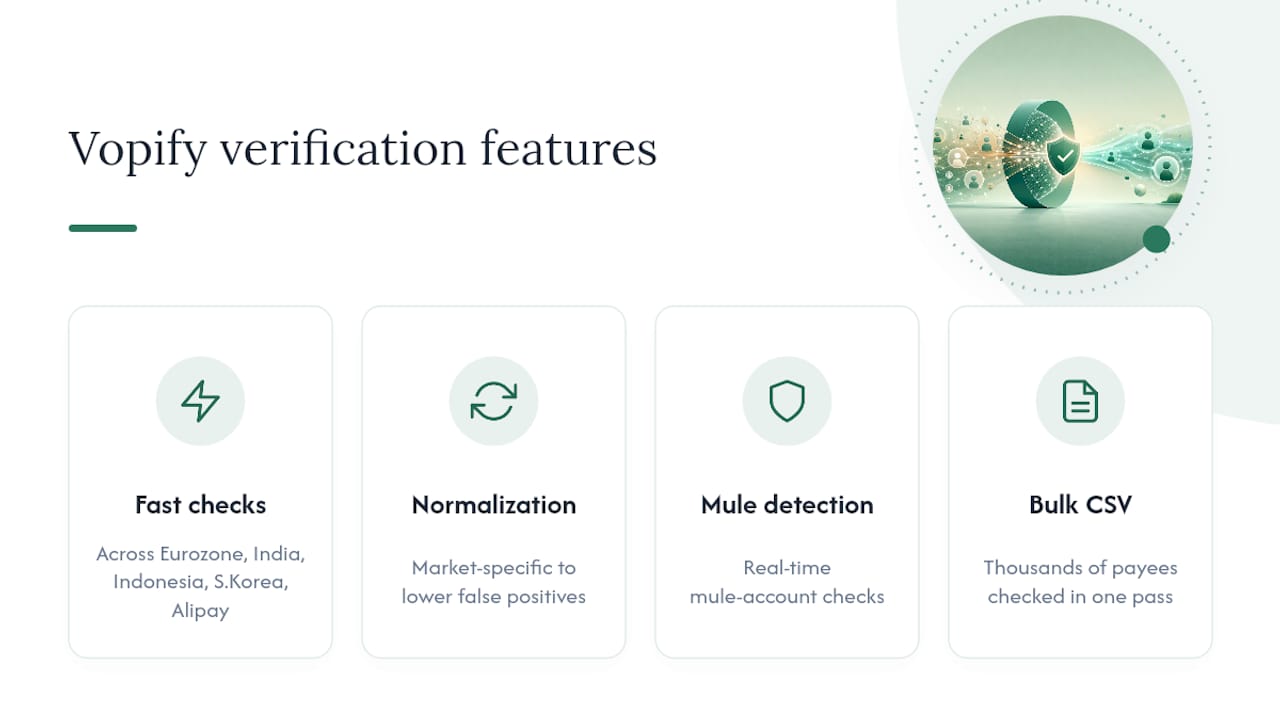
Its name matching and normalization approach is built specifically to cut false positives across the multiple countries it covers, rather than applying one rigid template everywhere. Vopify also runs real-time mule-account detection, adding a fraud signal that a name match alone can't provide, and supports bulk CSV checks for AP teams running supplier verification at volume. If you're evaluating a provider, ask for sample audit logs, how they handle known aliases, and their actual response time under load.
Automation Still Needs a Human in the Loop
Tune your matching thresholds to your own tolerance for interruption, not to some universal default. Run a standing feedback loop between whoever handles payment operations and whoever configures the matching rules, because thresholds set once and never revisited drift out of sync with your supplier base. Hard-blocking every non-Match result will bury your team in manual reviews and frustrate vendors who did nothing wrong.
— David
Vopify: Real-Time Verification Built for This Exact Problem
Vopify gives AP teams a payee name and IBAN check that returns results quickly across multiple countries including Eurozone nations, India, Indonesia, South Korea, and China's Alipay network.
That speed matters because every hour a Close Match sits unresolved is an hour a legitimate invoice goes unpaid or a fraudulent one stays uninvestigated. Vopify's name matching and normalization is designed to lower false positives across those markets rather than apply a one-size-fits-all threshold, and its real-time mule-account detection adds a fraud check that name matching alone doesn't cover. For teams verifying supplier lists rather than single payments, bulk CSV verification checks thousands of payees in one pass instead of one at a time.
If you're evaluating a verification provider, ask for a sample audit log, how alias handling works, and what response time you can expect under real transaction volume. Start with Vopify's verification of payee service and run a check against your own vendor list to see the result codes for yourself.
Sources
For deeper technical grounding, see the EBA's analysis of VoP matching challenges and PaymentBrief's match code reference.
- EBA — Key Challenges for VoP Matching Checks (2025)
- PaymentBrief — Verification of Payee & match codes reference
FAQ
What Is a False Positive Name Match in Payment Verification?
It's a verification result that reports Match or Close Match on a payee name and IBAN even though the account belongs to someone other than the intended recipient.
Does a Match Result Guarantee an Invoice Is Legitimate?
No. A Match confirms the name aligns with the account holder, but it doesn't authenticate the invoice itself, so normal payment controls still apply.
What Does NOAP Mean in Verification of Payee?
NOAP means verification was not possible for technical reasons, such as the responding bank not supporting the check. It should be retried and then routed by risk, not treated as a failed check.
How Common Are Close Match Results?
Some deployments report Close Match rates between 8% and 15% of all checks, which is why a clear routing policy for Close Match matters as much as one for outright No Match.
Can Vopify Help Reduce False Positive Name Matches?
Vopify's normalization and matching approach is built to lower false positives across the countries it covers, and its sub-two-second response time cuts the delay when a Close Match does need manual review.