
Low-volume teams with high approval rates usually come out ahead on per-check or credit-based pricing. High-volume, predictable programs do better on volume-tiered contracts or subscriptions with usage bands. Vopify fits most of these profiles because it offers both credits and subscriptions for real-time name-to-IBAN matching.
TL;DR:
- Approved-only pricing may be more cost-effective if your verification rejection rate exceeds roughly 15-20 percent, but less so for higher approval rates.
- Overestimating peak monthly volume can lead to expensive overage charges if your actual checks surpass tiered contract thresholds.
- Full costs often include hidden fees like retry surcharges, manual reviews, and international lookup fees that vendors may not clearly disclose upfront.
- Real ownership verification involves live bank network queries, which significantly increase pricing compared to simple format validation checks.
- Testing with small credit bundles or pay-as-you-go options helps validate actual blended costs before committing to higher-volume contracts.
Table of Contents
- What are the common verification pricing models?
- What drives up the price of a verification check?
- How do you choose the right pricing model for your team?
- What contract traps and hidden fees should you watch for?
- Why headline price is the wrong number to optimize for
- Where Vopify fits into your verification budget
- Where to check pricing benchmarks and vendor documentation
- Sources
What are the common verification pricing models?
Every vendor in this space packages the same core service, real-time payee verification, into a handful of billing shapes. The differences matter more than they look on a pricing page, because the wrong shape can double your effective cost without changing a single feature.
Per-check (transactional) pricing charges a flat fee for every verification attempt, pass or fail. This model is predictable and easy to budget, which makes it a natural fit for teams running under a few thousand checks a month. You know your cost before you run the check, and there is no guessing about what counts as billable.
Approved-only pricing flips that logic: you pay only when a verification comes back as a confirmed match. Vendors charge a premium for this, typically 20% to 40% above the standard per-check rate, because they absorb the cost of failed lookups themselves. It only pays off when your rejection rate is high enough to justify the markup.
Volume-tiered contracts reward scale. Cross the line into a higher tier and your per-check rate drops, but you commit to a minimum volume or annual spend. Openapi's IBAN Advanced pricing shows this clearly: rates start near €0.09 per call and step down to roughly €0.0245 at high committed annual volumes.
Credit bundles work like prepaid minutes. You buy a block of credits upfront, and larger blocks lower the per-query price. IBANTEST's published pricing is a good public example: a 250-credit pack runs about €0.0399 per query, while a 50,000-credit pack drops to roughly €0.0049 per query.
Hybrid subscription-plus-usage models combine a fixed monthly platform fee with a variable charge per check. Banks and larger institutions tend to prefer this structure because it stabilizes the platform cost while still tracking actual usage, an approach vendors like Crosskey build into their Verification of Payee offerings.
- Per-check: pay for every attempt, predictable for low volume
- Approved-only: pay for matches only, premium priced
- Volume-tiered: rate drops as committed volume rises
- Credit bundles: prepaid blocks, bulk discount built in
- Hybrid subscription: fixed base fee plus variable usage
What drives up the price of a verification check?
Not all verification checks cost the same to deliver, and vendors price accordingly. Understanding which features carry a premium helps you avoid paying for capability you don't need, or worse, underpaying for capability you do.
Format-only IBAN validation, confirming the string is structurally valid, is cheap or even free in many tools. Real ownership verification, matching the account holder's name against the bank's own records, is a different animal entirely. It requires a live query against payment-rail infrastructure, and that gap between format checks and true ownership matching is the single biggest reason prices vary so widely across vendors.
Beyond that baseline distinction, several other factors push unit price higher:
- Real-time bank network access: querying live payment rails costs more than batch or cached lookups.
- Cross-border coverage: each additional country or scheme adds integration and compliance overhead.
- SLA and response-time guarantees: sub-two-second response commitments require infrastructure vendors charge for.
- Manual review or data enrichment: curated datasets and human review steps add labor cost to every flagged case.
- Integration complexity: custom field mapping and bulk CSV onboarding often carry one-time or recurring fees.
Pro Tip: Ask any vendor to break out their price into "format check" versus "ownership match" line items. If they can't separate the two, you're likely overpaying for basic validation dressed up as full verification.
Vopify's own operational profile illustrates what real-time access actually looks like in practice: more than 10,000 verifications processed across 20 Eurozone countries, with response times under two seconds. That kind of throughput and coverage is exactly what drives cost in the models above, it's the reason live network checks aren't priced like format validation.
How do you choose the right pricing model for your team?
Start with your own volume profile, not the vendor's price sheet. Pull three numbers before you talk to anyone: your average monthly check volume, your 90th-percentile (peak) month, and any burst months tied to seasonal AP cycles or new vendor onboarding waves.
Next, estimate your approval rate, meaning the share of verifications that come back as a confirmed match. This single number decides whether approved-only pricing helps or hurts you. Above that threshold, per-check pricing usually produces a lower blended cost, since the approved-only premium outweighs the savings from unpaid rejections.
Here's a simple way to run the comparison:
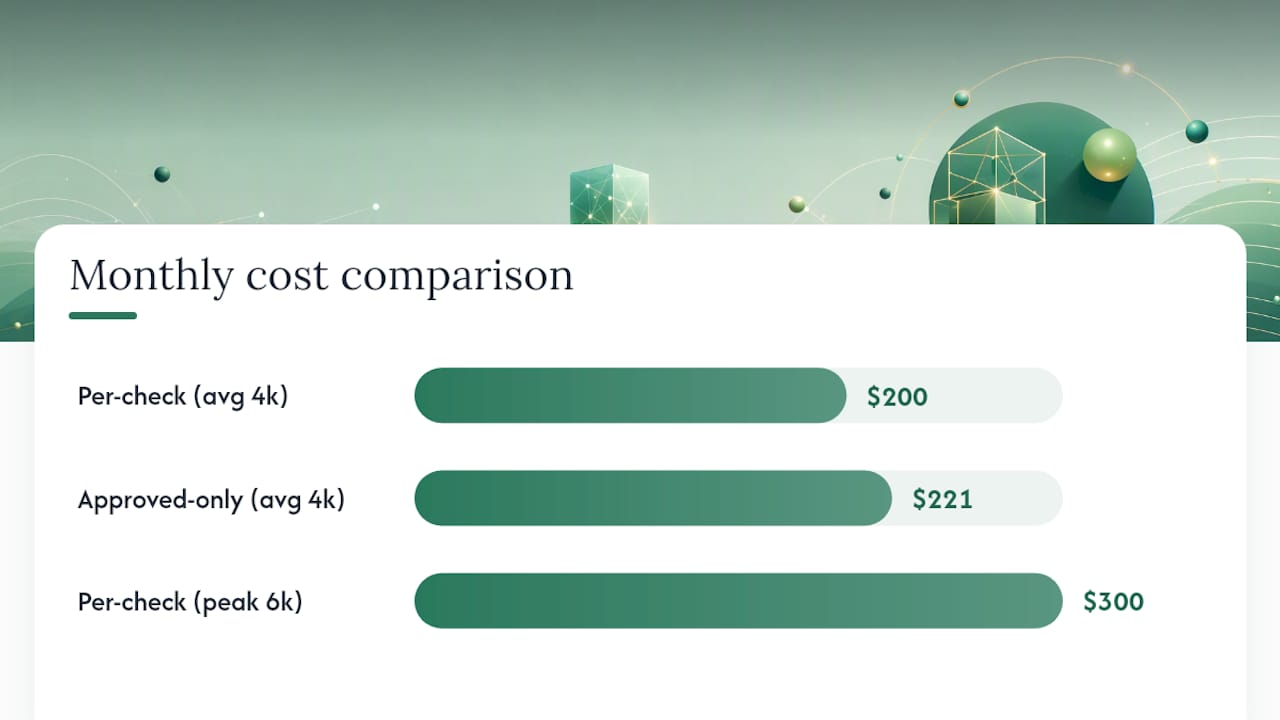
- Estimate monthly volume. Say your team runs 4,000 checks a month on average, with peak months near 6,000.
- Estimate approval rate. If historical data shows 85% of checks pass, only 15% fail.
- Price the per-check model. At a hypothetical $0.05 per check, 4,000 checks cost $200 a month regardless of outcome.
- Price the approved-only model. With a 30% premium on approved checks only, you'd pay roughly $0.065 on the 3,400 approved checks, about $221, while the 600 failed checks cost nothing.
- Compare blended cost. In this scenario, per-check pricing wins because your approval rate is high enough that the approved-only premium isn't worth it.
Run the same math against your peak month, not just your average, since that's where overage charges and tier breaches actually happen. And don't stop at the per-unit price: total cost of ownership includes onboarding fees, integration work, and any manual reconciliation your team does when a check comes back ambiguous. Vendors commonly set overage rates 20% to 35% above the contracted tier price, so underestimating your peak volume can quietly erase a tiered contract's savings.
Pro Tip: Model your peak month, not your average. A contract that looks cheap at 4,000 checks can turn expensive fast if your real ceiling is 6,000 and you fall into overage territory every quarter.
What contract traps and hidden fees should you watch for?
Vendor pricing pages rarely show the full cost of a contract. The gap usually hides in definitions, not headline rates.
- Overage penalties: charges that kick in once you exceed a contracted tier, often priced well above your base rate.
- Retry charges: some vendors bill separately for a second attempt on the same payee, even if the first attempt failed due to a system timeout.
- Manual review fees: flagged or ambiguous matches sometimes carry a separate line-item charge.
- International lookup surcharges: cross-border checks outside your primary contracted markets can bill at a different rate entirely.
Before signing anything, ask the vendor to define exactly what counts as a billable "verification" versus a mere "attempt." That distinction alone can shift your monthly bill by a meaningful margin if attempts and successful checks are billed the same way.
Negotiate for capped overage rates, roll-over credits for unused volume, and a true-up window that lets you reconcile actual usage against your committed tier before penalties apply. Structure any pilot or trial period around your real monthly volume, not a token sample, so the sample invoice you get back actually reflects what a full month will cost. Bringing your own volume estimates into that conversation, rather than accepting a generic quote, is one of the more effective negotiation tools available to procurement teams.
Why headline price is the wrong number to optimize for
The lowest per-check rate on a pricing page tells you almost nothing about what you'll actually pay in month six. A vendor can advertise a rock-bottom rate and still cost more than a competitor once overage penalties, retry fees, and manual review surcharges show up on your first real invoice.
What matters more is billing transparency. Before signing, get a sample invoice modeled on your actual volume, not a hypothetical one. Get the vendor's written definition of a billable "verification." Confirm the SLA obligations are contractual, not aspirational, and check what it costs to exit if the relationship doesn't work out.
Speed and accuracy are table stakes at this point. Predictable total cost of ownership is what separates a good vendor relationship from a recurring budget headache.
— David
Where Vopify fits into your verification budget
If you're weighing per-check against approved-only against a tiered contract, Vopify gives you a lower-risk way to test the real numbers before committing to a long contract. It runs instant name-to-IBAN matching for both individual and business accounts, supports single lookups and bulk CSV uploads for supplier batches, and has processed over 10,000 verifications across 20 Eurozone countries with response times under two seconds.
That combination, real-time bank-network access plus flexible billing, makes Vopify a practical first stop for AP teams still building out their approval-rate data. Low-volume teams can start on pay-as-you-go credits and see their actual blended cost before locking into anything larger. Higher-volume teams running steady monthly batches can move toward a subscription and negotiate tier pricing once real usage numbers exist. Either way, you're testing the model against your own volume instead of a vendor's hypothetical example.
If you're managing a large supplier file, the bulk IBAN verification option handles CSV uploads directly, and the Verification of Payee service covers SEPA compliance requirements for instant payment schemes. Start with a small credit purchase to model your own numbers, or reach out for a volume quote once you know your monthly check count.

Where to check pricing benchmarks and vendor documentation
For public pricing to benchmark against, IBANTEST's credit-pack pricing and Openapi's IBAN Advanced API tiers both show real per-query rates at different volume levels. For a deeper look at approved-only premiums and overage benchmarks, see this breakdown of KYC verification pricing models. Compare notes with Vopify's product pages for trial credits or a volume quote, or explore IBAN and bank account verification options for API and bulk use cases.
Sources
- Prices for calculating and validating IBANs - Pay-per-Use | IBANTEST
- IBAN Advanced API | IBAN Verification and Bank Data
- KYC Cost Per Verification: Pricing Models, Benchmarks, and Hidden Fees