
Business payee verification is a check, made before a payment is released, that the name of the person or company you intend to pay matches the bank account you are about to send money to. It stops a wrong or fraudulent account number from becoming a lost payment. In the U.S., banks can use the Federal Reserve's name-to-account check, while for euro payments to Europe the same idea is built into the SEPA Verification of Payee scheme. This guide explains how it works, how it compares with the manual checks AP teams already run, and how to build it into your workflow.
TL;DR
- Payee verification compares the payee name with the account details (routing and account number in the U.S., IBAN in Europe) before you pay.
- It targets two problems: honest typos and deliberate fraud, such as a fake "we changed banks" email.
- Manual methods like callbacks still matter, but they are slow and depend on the person doing them. Automated name matching adds a fast, consistent check.
- Any bank-detail change should pause payment until it is verified through a channel you already trust.
- If you pay suppliers in Europe or parts of Asia, Vopify checks a name and IBAN in under two seconds.
Table of Contents
- What business payee verification checks
- Why it matters: fraud and misdirected payments
- Ways AP teams verify supplier bank details
- Where U.S. rules and EU rules meet
- Where Vopify fits
- Build payee checks into your AP workflow
- Pricing and getting started
- FAQ
- Sources
What business payee verification checks
At its core, the check asks one question: does this account belong to the party named on the invoice? The inputs are the payee's name and the account identifiers. The output is a match signal you can act on before funds leave.
The U.S. version comes from the Federal Reserve. Its Payee Name Verification service lets financial institutions verify an intended payee's name against an account's routing and account numbers before issuing a payment. The Fed describes it as payment-rail-agnostic, so it is not tied to a single payment method.
In Europe, the European Payments Council describes Verification of Payee (VoP) as a way for payers to check whether the payee's name and IBAN match before a SEPA payment. The response is one of four outcomes: match, close match, no match, or unable to verify. The EPC is also clear that VoP is messaging functionality, not a payment instrument. It sits in front of the payment and does not replace it.
Two details matter for business users:
- Business names are messy. Legal names, trading names and abbreviations differ, which is why a "close match" result exists. Your process needs a rule for what happens on a close match.
- The check is about the account, not the company's reputation. It does not tell you whether a supplier is good. It tells you whether the money will land with the entity you named.
Why it matters: fraud and misdirected payments
Payment errors and payment fraud look alike in the ledger: money went somewhere it should not have. The Federal Reserve says its service is intended to help reduce fraud and misdirected payments and can cut transaction-processing errors.
The scale of the fraud side is large. According to a 2026 B2B payments statistics roundup, business email compromise (BEC) generated $3,046,598,558 in reported losses across 24,768 complaints in 2025. The same source reports that the FBI's Recovery Asset Team froze $679,013,183 of $1,163,919,846 in attempted theft across 3,900 incidents that year, a 58.34% freeze rate. Recovery is possible, but it is far from guaranteed, and it depends on speed.

That is the practical argument for checking before payment instead of after. Once an instant or same-day payment is gone, you are relying on the receiving bank and law enforcement. A check that takes seconds costs far less than a recall.
The typical attack on accounts payable is not sophisticated. A criminal impersonates a real vendor, or takes over a real vendor's mailbox, and asks you to update the bank details. The invoice looks right. The amount is right. Only the account is wrong. We cover that pattern in more depth in our piece on vendor bank change fraud, and the wider controls in stopping misdirected payments.
For a broader view of how push-payment scams unfold and what businesses do about them, these push payment fraud prevention steps are a good companion read.
Ways AP teams verify supplier bank details
Most AP teams use a mix of methods. Each has a place, and each has a weakness.
| Method | What it confirms | Main limitation |
|---|---|---|
| Callback to a known phone number | The vendor really requested the change | Slow, depends on a trustworthy number on file and on staff discipline |
| Bank letter or voided check | The vendor can produce a document naming the account | Documents can be forged or altered, and the file may arrive through the same compromised email thread |
| Micro-deposits (two small deposits) | The vendor can see and report the amounts | Takes days, needs vendor cooperation, and does not always prove the account name |
| Manual lookup or portal check | Varies by bank and country | Inconsistent and hard to scale |
| Automated name-to-account matching | The name matches the account holder on record | Coverage depends on the countries and networks supported |
Callbacks
The FBI has long advised verifying significant transactions through a second channel. Its business email compromise alert recommends setting up other communication channels, such as telephone calls, and arranging that second-factor verification early in the relationship and outside the email environment. A later FBI advisory on payment-diversion fraud recommends confirming changes to existing invoices, bank deposit details or contact information through previously established channels before approving the request.
The rule that follows: call the number you already had, never the number in the email that asked for the change. A callback is a strong control when it is done properly. It is weak when the caller reads out the new account and the vendor says "yes", or when the pressure of a deadline leads someone to skip it.
Documents and micro-deposits
A bank letter proves what a document says, not who sent it. Micro-deposits prove the vendor can access the account, but they take days and need the vendor to respond. Neither is practical for a long tail of suppliers or for urgent payments. If you use QuickBooks, our comparison of two-deposit checks and Vopify walks through the trade-offs.
Automated name matching
Name matching returns an answer in seconds and applies the same rule to every payment, whoever is processing it. It does not replace a callback on a high-risk change. It does remove the situation where a mismatch goes unseen because nobody had time to look.
Where U.S. rules and EU rules meet
In the U.S., there is no single law that tells every business to verify payees. What you will find is guidance from the FBI and bank regulators, network rules for ACH, and a growing set of bank-side tools such as the Fed's service above. Your own bank or payment provider decides which checks it offers you, so ask your treasury contact what is available for your account.
Europe is more prescriptive. Under the EU instant payments rules, banks must offer payee verification. The central bank of San Marino notes that VoP became mandatory on October 9, 2025 for payment service providers based in the European Economic Area, and that providers outside the EEA cannot currently join because of regulatory and technical conditions.
What that means for a U.S. company:
- Your U.S. bank is not automatically part of the European scheme.
- Your European suppliers' banks are, which means their account names are checked on the European side when money arrives by SEPA.
- If you pay European suppliers from the U.S., you cannot assume the name check happened. You can run it yourself before you send.
The Federal Reserve is also developing pre-payment checks for instant payments. In its December 16, 2025 notice on 2026 enhancements, it reported a FedNow pilot of a receiver-account pre-check. The direction of travel is clear: confirm the account before the money moves.
Where Vopify fits
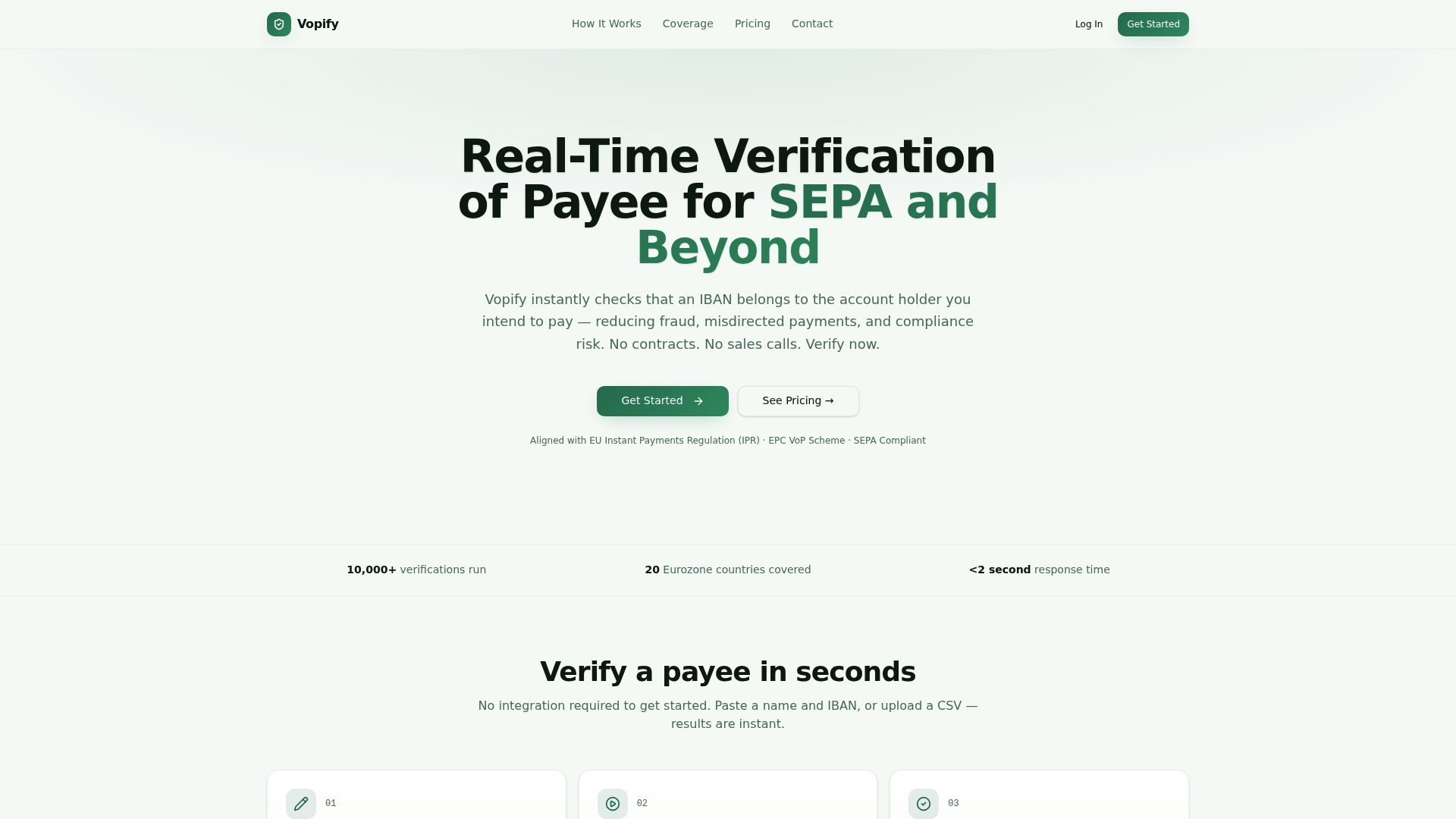
Vopify is built for finance teams and accounts payable departments that need to confirm a payee before paying. You enter a name and an IBAN, and you get an answer in under two seconds. It works for individual and business accounts, with no contract needed to start. The platform has processed more than 10,000 verifications.
Coverage today is SEPA (the Eurozone), India, Indonesia, South Korea and China through Alipay. You can see the current list on the coverage page. That makes it most useful for U.S. companies with suppliers, contractors or subsidiaries in those regions. For background on how the IBAN side works, see our explainer on IBAN and bank account verification, and for the European scheme specifically, our Verification of Payee service page.
You can use Vopify in three ways:
- Single lookup for an urgent payment or a one-off change request.
- Bulk CSV upload to check your whole supplier file. The bulk IBAN verification page explains the format.
- API integration for programmatic, high-volume checks. This is planned, and there is also Vopify MCP for teams that want to use verification inside AI assistants.
What we see in AP teams
Most payee fraud does not beat a control. It slips past a step that was skipped because it was slow. A callback needs a person with time and a trusted number. A letter needs someone to judge it. Under month-end pressure, those steps get shortened.
That is why we built Vopify around speed and simplicity: a name and an IBAN, an answer in under two seconds, no contract and no integration project before the first check. When verification takes a few seconds, it is far more likely to happen on every payment, not only the ones that already look suspicious.
Our view is that name-to-account matching should be the first gate in the vendor workflow, with callbacks reserved for what the match flags. That puts people's time where the risk is, and it leaves a record for audit. For European and Asian payees, we think that is the most practical way to bring the protection banks now give inside the EU to a U.S. company's own payables process.
David
Build payee checks into your AP workflow
A check only works if it is placed at the right points. This sequence suits most mid-sized AP teams.
- Verify at onboarding. Run the name and account details when a vendor is first set up. Keep the result with the vendor record.
- Separate duties. The person who requests a vendor should not be the person who verifies or sets it up. One practitioner audit guide calls the vendor master file a payment-fraud chokepoint for this reason.
- Treat every bank change as a hold. Freeze payment to the changed account until verification is done. Our article on why AP must hold payment first explains the mechanics.
- Run the name match, then the callback. Use the match result to decide how much additional confirmation you need. Call the phone number you already held, not one from the request.
- Decide the close-match rule. A close match often means a trading name versus a legal name. Write down who can approve it, and what evidence they need.
- Keep records. Store the date, the result, who approved the payment and what was checked. Your auditors and your bank will ask.
- Re-check the file on a schedule. A bulk run across your supplier base catches stale or incorrect records before they cost you.
For a deeper set of scenario-based controls, see seven AP checks for common fraud scenarios, and for how match results are read in practice, our guide to VoP match codes and IBAN checks.
Handling mismatches
A "no match" is not proof of fraud. It can be a typo, an old company name, or an account held by a parent company or payment processor. Treat it as a stop sign, not a verdict:
- Do not pay yet.
- Contact the vendor using details already on file and ask for the account name as it appears at their bank.
- Re-run the check with the corrected name.
- Escalate to a second approver if the vendor cannot explain the difference.
An "unable to verify" result means the other bank could not answer, not that the account is bad. Fall back to your callback process for that payment.
Some mismatches have a darker cause. Accounts used to receive stolen funds often do not belong to the payee at all, and we describe the signals in our piece on mule account detection.
Pricing and getting started
Vopify offers pay-as-you-go credits and monthly plans, so you can match the cost to your volume:
- Pay as you go: $0.70 to $1.00 per verification.
- Starter: $240 per month.
- Growth: $750 per month.
- Scale: $2,000 per month.
A sensible way to start is to take the 20 to 50 suppliers you pay most often in covered regions, run them as a bulk CSV, and see how many come back as a full match. Then add a single lookup to your bank-change procedure so that no new account is paid without one. You can start with Vopify here and pick the option that suits your volume.
FAQ
Is business payee verification required in the United States?
No single U.S. law requires every business to verify payees before paying. Federal law enforcement guidance does advise confirming bank-detail changes through established channels, and banks increasingly offer name-checking tools. Ask your bank which services apply to your accounts.
Does payee verification replace a callback?
No. It adds a fast, consistent check in front of the callback. A strong process runs the name match on every new or changed account and keeps the callback, using a number you already held, for changes and any result that is not a clear match.
Does the European Verification of Payee scheme apply to my U.S. bank?
Not directly. The scheme became mandatory on October 9, 2025 for payment service providers based in the EEA, and providers outside the EEA cannot currently join. If you pay European suppliers from the U.S., you can run the name and IBAN check yourself before sending.
What should I do when a result is a close match?
Treat it as a prompt to confirm, not as a pass or a fail. Check whether the difference is a trading name, an abbreviation or a typo, confirm with the vendor through contact details on file, and record who approved the payment and why.
Sources
- Payee Name Verification, Federal Reserve Financial Services
- 2026 Fees and Payment System Enhancements, Federal Reserve Financial Services
- Verification Of Payee (VOP), European Payments Council
- Payment services: clarification on payee verification (VOP), Central Bank of San Marino
- Business Email Compromise, FBI IC3 (2015)
- Processors, Costing Victims Millions in Losses, FBI IC3 (2022)
- B2B Payments Statistics 2026
- How to Audit the Vendor Master File
- Push Payment Fraud Prevention Steps for Businesses