
Confirmation of Payee (CoP) is a UK name-checking service, so its coverage stops at UK domestic payments. The US has no equivalent rule. The EU has a similar scheme called Verification of Payee (VoP) for euro transfers. If your company in the US pays UK or European suppliers, you need to know which of those checks protects the payment and which leaves a gap. This guide maps coverage in each region, shows what a check can and cannot verify, and explains how a US accounts payable team can close the gap today.
TL;DR
- CoP covers UK domestic payments only. Accounts outside the UK are exempt, so a US company sending a wire to a UK supplier is not covered by the bank-side check in the way a UK payer would be.
- The EU's Verification of Payee scheme covers SEPA credit transfers and SEPA instant credit transfers. It matches a name against an IBAN.
- The US has no all-encompassing requirement for strict payee verification. The Federal Reserve offers Payee Name Verification to eligible financial institutions, and the tool is not a company-level check you can run yourself.
- A match is reassurance, not a guarantee. It does not prove a payee is legitimate or that fraud will be caught.
- US finance teams can add their own name-to-IBAN check before releasing a payment to a European supplier.
Table of Contents
- What "coverage" means for payee verification
- UK Confirmation of Payee: what it covers
- Where CoP does not reach
- EU Verification of Payee: the euro equivalent
- What the US has instead
- Coverage side by side
- The practical gap for a US finance team
- A match is not a guarantee
- How Vopify fits
- How to choose and use a verification approach
- FAQ
- Sources
What "coverage" means for payee verification
Coverage has four dimensions, and a scheme can be strong on one and silent on another:
- Geography: which countries' accounts can be checked.
- Institutions: which banks and payment providers respond to a check.
- Payment types: which rails the check applies to, such as instant payments, standard transfers or wires.
- Account types: personal, business, and special cases such as building society accounts or loan accounts.
When people search for Confirmation of Payee coverage, they usually want one of two answers: "Is my bank or my supplier's bank covered?" or "Does this exist where I operate?" The sections below answer both.
UK Confirmation of Payee: what it covers
CoP is an account name-checking service for UK domestic payments. According to Pay.UK's FAQs, it can be offered for CHAPS, Faster Payments and Bacs payments, and it helps ensure payments are sent to the intended account holder.
Participation
Participation in the UK is close to universal. The Payment Systems Regulator's November 2025 compliance report says over 320 organizations offer CoP checks and over 99% of organizations initiating Faster Payments transactions now offer them.
What a check uses
A check can use the payee's name, sort code and account number. Where relevant, it can also use the account type and secondary reference data such as a building society roll number (Pay.UK).
What the results mean
| Result | Meaning |
|---|---|
| Yes | The details match. |
| Close match | A similar name is returned for the payer to review. |
| No, the name is wrong | The name does not match the account. |
| Unavailable | The check could not complete, for example a timeout, a customer opt-out or an account that does not exist. |
Source for the results: Pay.UK.
Treat "Close match" and "Unavailable" as stop signs, not as a green light. A finance team should confirm the payee through a separate, known channel before releasing money.
Where CoP does not reach
The gaps matter most for a US business, because most of your payments to the UK start from an account outside it.
Under the Payment Systems Regulator's Specific Direction 17, most UK payment service providers must send and respond to CoP requests. The exemptions include:
- Payments where either account is outside the UK.
- Payments to repay certain business loans.
- Payments to or from the sending provider's own money or a suspense account.
The first exemption is the one that affects you. A payment from a US bank account to a UK account is cross-border, so the UK scheme does not give you a protected name check on that transfer. The same logic applies in reverse for US payments to euro accounts. Cross-border verification needs infrastructure that routes the query, identifies the right source and returns information the originating bank can use in its payment process, as PYMNTS reported in 2026.
EU Verification of Payee: the euro equivalent
In the euro area, the counterpart is Verification of Payee. The European Payments Council built the VOP scheme to support payment providers that must meet payee verification obligations for credit transfers under the EU Instant Payments Regulation. The scheme sets rules, practices and standards for participating providers in SEPA. Its technical specifications rely on APIs using ISO 20022 resource elements, and it supports both SEPA Credit Transfers and SEPA Instant Credit Transfers.
Two differences from the UK are worth knowing:
- The identifier is an IBAN, not a sort code and account number. The check matches a name against an IBAN.
- The check is built into the payer's bank. A payer using their own bank in the euro area gets the check from that bank. A company outside the euro area does not automatically get it.
If you want a deeper view of the EU timeline from a compliance angle, our piece on SEPA Confirmation of Payee for compliance teams covers it. You can also read how Verification of Payee works on SEPA payments.
What the US has instead
The US does not have a Confirmation of Payee mandate. American Banker reported in 2026 that no all-encompassing regulation requires banks to employ strict verification. In practice, verification may involve micro-deposits or manual name matches by phone or email.
Three pieces of the US picture are worth knowing.
Federal Reserve Payee Name Verification
The Federal Reserve offers Payee Name Verification, a payment-rail-agnostic service that lets eligible financial institutions check an intended payee's name against routing and account numbers before a payment is issued. It is a financial-institution service. A corporate AP team reaches it, if at all, through its bank.
FedNow
The Federal Reserve plans to make payee-name verification available to FedNow Service users through an API as an upcoming enhancement, according to PYMNTS. Check with your bank for current availability.
Nacha rule changes
Nacha's changes require non-consumer ACH originators to conduct risk-based fraud monitoring, effective June 19, 2026. Consumer e-commerce debits for goods must also carry the entry description "PURCHASE," effective March 20, 2026 (American Banker). The first of these means US businesses that originate ACH payments are expected to monitor for fraud on a risk basis. It is not a name-check requirement, but it moves the same direction.
Coverage side by side
| UK CoP | EU VoP | US | |
|---|---|---|---|
| Identifier checked | Name, sort code, account number | Name and IBAN | Name, routing and account number (Federal Reserve service, for eligible institutions) |
| Payment types | CHAPS, Faster Payments, Bacs | SEPA Credit Transfer, SEPA Instant | Rail-agnostic service; FedNow API planned |
| Mandatory? | Yes, for most UK providers under Specific Direction 17 | Required of providers under the Instant Payments Regulation | No all-encompassing requirement |
| Cross-border payer outside region | Exempt | Depends on the payer's bank | Not applicable |
The practical gap for a US finance team
Put the pieces together and a common situation emerges. Your company is in the US. A supplier in Germany, Ireland or the Netherlands sends an invoice with an IBAN. Your treasury team sends the payment from a US bank. No scheme automatically verifies that the name on the invoice belongs to that IBAN before your money moves.
That is the exact condition that business email compromise and vendor bank-change fraud exploit. A fraudster impersonates a supplier, sends new bank details and waits. If you want the full playbook, see our guides on vendor bank change fraud and business email compromise controls for AP.
A workable control has four steps:
- Hold the payment when bank details are new or have changed.
- Run a name-to-IBAN check against the live account.
- Call the supplier back on a number already in your records if the result is anything other than a clear match.
- Log the result with the payment approval so auditors can see it.
Our payment verification controls article lays out seven AP checks for common fraud scenarios, and the one on prepayment verification shows where this step fits in the approval flow.
A match is not a guarantee

Pay.UK is clear that CoP is an extra level of reassurance. It does not automatically guarantee that fraud will be detected or that a customer who falls victim to fraud will be reimbursed (Pay.UK). The UK regulator describes the aim as making it harder for fraudsters to pretend to be someone else and helping to reduce authorized push payment scams and misdirected payments (PSR).
Use a match as one control among several. A name that matches an account tells you the account holder is who the invoice says. It does not tell you the supplier is the one you meant to hire, or that the account is free of mule activity. Pair verification with callbacks, approval limits and vendor onboarding checks. Our piece on mule account detection goes further on that last point.
Our perspective
We built Vopify around a simple observation: the schemes that protect payers are regional, but supplier payments are not. A US accounts payable team can pay a vendor in Spain on Monday and one in India on Tuesday, and no single bank-side scheme covers both.
Our approach is to check the name and the account before the money moves, with no contract, no platform fee and no integration project. You enter a name and an IBAN, and the answer comes back live. We designed the service for the people who actually hold the payment: finance teams, AP specialists, treasury and compliance staff.
We would also say plainly what a check is for. It is a control that turns a guess into evidence, and it belongs in the process next to callbacks and approvals. A team that runs it on every new or changed bank detail catches the errors and the fraud attempts that otherwise surface only after the funds are gone.
David
Wait
How Vopify fits

Vopify checks a payee name against an IBAN in real time, for individuals and businesses. It queries live payment networks and, by our own measure, has processed over 10,000 verifications across 20 Eurozone countries with response times under two seconds. Coverage also extends beyond SEPA to India, Indonesia, South Korea and China (Alipay). The full list is on our coverage page.
What you can use today:
- Single lookups from the dashboard for one-off checks.
- Bulk CSV upload to check an entire supplier file.
- Pay-as-you-go credits at $0.70 to $1.00 per verification.
- Subscriptions: Starter at $240 per month, Growth at $750 per month and Scale at $2,000 per month.
- Vopify MCP, for teams that want to run checks from an AI assistant. See the MCP integration.
API integration for programmatic, high-volume verification is planned.
To run your first check, go to Vopify and enter a supplier's name and IBAN.
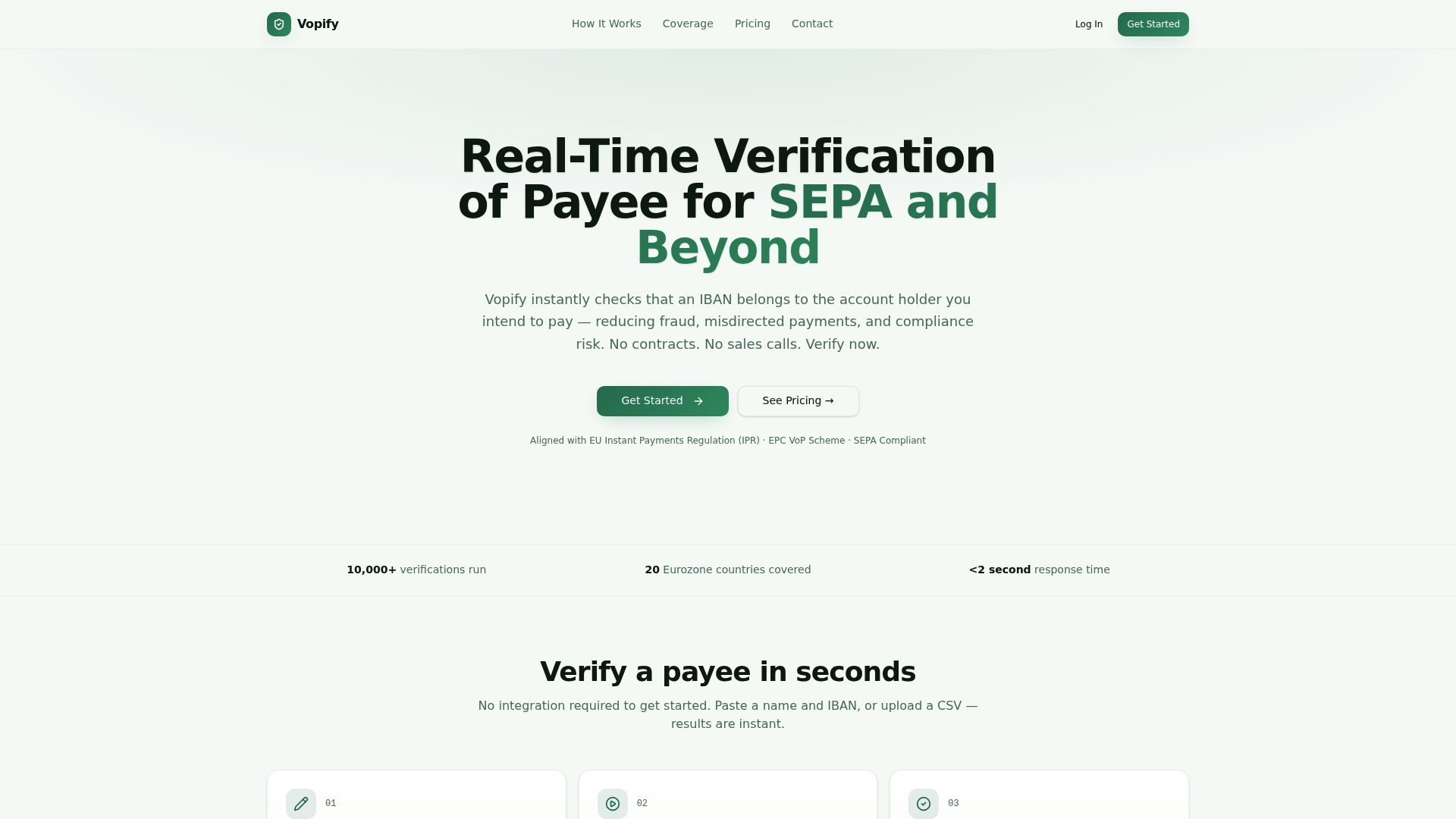
For a broader view of how this fits an AP workflow, read our guide to real-time bank account verification for AP teams.
How to choose and use a verification approach
When you evaluate any payee verification option, test it against these criteria:
- Geography: does it cover the countries where your suppliers bank?
- Speed: can it answer inside your payment approval window?
- Account types: does it handle both personal and business accounts?
- Volume: can it check one payee and a file of five thousand?
- Evidence: does it return a result you can attach to the payment record?
- Commitment: does it require a contract or integration before you can test it?
Bank-side schemes are strong on the first dimension inside their own region and weak outside it. A standalone name-to-IBAN check is strongest where your payments cross borders.
FAQ
Does Confirmation of Payee exist in the United States?
No. The UK's CoP is specific to UK domestic payments. The US has no all-encompassing rule requiring banks to verify payee names, though the Federal Reserve offers Payee Name Verification to eligible financial institutions. Many companies still verify by micro-deposit or phone call.
Does CoP cover payments from the US to the UK?
Not as a protected check. Under the PSR's direction, payments where either account is outside the UK are exempt. A US company paying a UK supplier should verify the account through its own control before sending funds.
What is the difference between CoP and Verification of Payee?
CoP applies to UK domestic payments and uses a sort code and account number. VoP is the European Payments Council's scheme for SEPA credit transfers and SEPA instant credit transfers, and it uses an IBAN.
What does a "Close match" result mean?
A similar name was returned for the payer to review. Do not release the payment until you have confirmed the payee through a separate, trusted channel.
Sources
- FAQs, Pay.UK
- Confirmation of Payee compliance report, Payment Systems Regulator
- Confirmation of Payee: Requirements under Specific Direction 17, PSR
- Verification of Payee (VOP), European Payments Council
- Payee Name Verification, Federal Reserve Financial Services
- How real-time pay is pressuring bank authentication, American Banker
- Europe's Payee Checks Set the Pace as US Plans Take Shape, PYMNTS
- PSR confirms widespread implementation of name-checking system