
To verify an individual payee, confirm before you send money that the name on your payment instruction matches the person who owns the receiving bank account. In the US you do this with a validation or name-matching step that sits next to your payment run, because ACH, FedNow and RTP do not do it for you. This guide covers what to check, which methods exist, how to build the step into accounts payable, and where an IBAN check fits when your payee is abroad.
One note on scope. This is about business payments to freelancers, contractors, sole proprietors, refund recipients and other individuals. It is not about Social Security's representative payee program, which is a different use of the word "payee."
TL;DR
- Verifying an individual payee means matching the payee's name to the account (routing and account number, or IBAN) before funds move.
- No US rule makes the sending bank do this on FedNow or RTP, so your AP team has to own the step.
- Nacha's minimum account validation checks that an account is open and can accept ACH entries. Ownership checks are a risk-based choice you make.
- Verify at onboarding, on every bank detail change, and before first payment to any new individual.
- For payees with IBANs, Vopify returns a name-to-IBAN match in under two seconds.
Table of Contents
- What it means to verify an individual payee
- How payee verification works in the US today
- Payee verification vs. account validation
- Methods AP teams use to verify an individual payee
- A practical workflow for verifying individual payees
- How much verification is enough?
- Our perspective
- Verifying individuals paid by IBAN
- Check payees before you pay with Vopify
- Common mistakes to avoid
- FAQ
- Sources
What it means to verify an individual payee
The Federal Reserve describes payee name verification as a way for a financial institution to verify an intended payee's name with an account's routing and account number before issuing a payment. The idea is simple: the name you were given and the account you were given should belong together.
With companies, you can cross-check a registry, a tax ID or a website. With an individual, you usually have an invoice, an email and a set of bank details typed by someone you may never have met. That is why individuals are a common weak point. A single transposed digit, or a fraudster's account swapped into a legitimate payee's details, produces a payment that looks fine in your ERP and lands with the wrong person.
The three questions a good check answers
- Does the account exist and is it open? This catches typos and closed accounts.
- Can it receive this kind of payment? An account may be open but not accept the rail you plan to use.
- Does the account holder match the name you have? This is the ownership question, and it is the one that stops impersonation.
Most older tools answer the first two. Payee verification adds the third.
How payee verification works in the US today
The US has no single mandatory system. As American Banker reports, there is no all-encompassing regulation requiring banks to employ strict verification. Depending on the banks involved, verification can mean a microdeposit that takes a day or two, a manual name match by phone or email, or no real check beyond what is in the payment file.
The Cleveland Fed's 2026 research brief adds that Confirmation of Payee has not yet been built into the flow of instant payments in the US. Name verification or account validation is typically done separately from each payment. The Federal Reserve has started offering an optional payee name verification service to qualified financial institutions, independent of FedNow.
That contrasts with Europe, where, as one payments firm describes it, the payer's bank asks the payee's bank directly and gets a match, close match, no match or not-possible answer within five seconds. In the US, a first-time payee account has no history to search.

Why speed makes this more urgent
Instant rails are fast and usually final. Ximena Aleman of Prometeo told American Banker that fraud moves faster on real-time rails, so pre-validating the account matters because the transaction generally cannot be charged back or reversed. The check has to happen before you release the payment, not after.
Payee verification vs. account validation
The two terms get mixed up, and the difference matters for how much protection you actually have.
Nacha describes account validation as a service that lets a business or bank validate the accuracy of account information and confirm the account's ability to receive electronic payments. For recurring payments, it happens at enrollment, before the first transaction, or on a schedule before payments go out.
Nacha's FAQ is clear on the limit: its minimum standard does not require originators to validate account ownership. Originators decide, based on their business model and risk profile, whether a more rigorous assessment, including ownership, is needed to be commercially reasonable.
| Account validation (minimum) | Payee name verification | |
|---|---|---|
| Question answered | Is the account open and able to take this payment? | Does the account belong to this named person? |
| Catches typos | Yes | Yes |
| Catches impersonation | Not on its own | Yes, this is its purpose |
| Required by Nacha at the minimum level | Yes, for WEB debits on first use or change | No, it is a risk-based decision |
For an individual payee, where impersonation is the main fear, ownership matching is the part worth having. The Fed says its service may help reduce Authorized Push Payment fraud where an imposter impersonates an individual.
Methods AP teams use to verify an individual payee
Nacha's FAQ lists several validation approaches: a prenotification entry, micro-transaction verification, a commercially available validation service, and API-enabled validation. Here is how they compare in practice for an AP team.
| Method | Speed | What it tells you | Typical weakness |
|---|---|---|---|
| Prenote | Days | Account likely valid | Slow; usually does not confirm the holder's name |
| Microdeposits | 1 to 2 days | Payee controls the account | Needs payee action and follow-up |
| Phone or email callback | Hours to days | Depends on who answers | Manual, and easy to spoof if the contact came from the same invoice |
| Validation or name-match service | Seconds | Account status and, with name matching, ownership | Coverage depends on the provider |
| API in the payment workflow | Seconds, automated | Same, at volume | Needs integration work |
A callback deserves one extra rule: use a phone number you already hold from a trusted source, never the one printed on the request that asked you to change bank details. Our guide to vendor bank change fraud explains why AP must hold the payment first.
A practical workflow for verifying individual payees
Here is a sequence that works for a small AP team and scales to a large one.
- Collect the right data. Legal name as it appears on the bank account, routing and account number (or IBAN for international payees), and the country. Ask for the name exactly as the bank holds it, not a trade name.
- Run the check at onboarding. Do it before the payee is created as active in your system, not at the first payment run when pressure to pay is highest.
- Treat a mismatch as a stop. A close match gets a human review. A no match goes back to the payee through an independent channel.
- Re-verify on every change. Any new bank detail is a new payee for risk purposes. This is where most redirection fraud happens.
- Log the result. Keep the date, the input, the response and who approved. You will want this evidence if a payment is ever disputed or audited.
- Spot-check on a schedule. For recurring payees, re-run validation periodically, which is consistent with how Nacha describes scheduled validation.
If you need more depth on the surrounding controls, we cover five steps to prepayment Nacha account validation and bank account ownership verification methods separately.
How much verification is enough?
It depends on your risk, and Nacha says so directly. The commercially reasonable standard is assessed in context, including the risks tied to the purpose of the transaction, your history with returns and fraud, the share of "no hit" responses, and other compensating controls.
The bar has also risen. According to American Banker, since June 19, 2026, every non-consumer ACH originator must run risk-based fraud monitoring on the entries it originates, regardless of volume. Checking payees before you pay is one of the most direct ways to show that monitoring exists.
For FedNow and RTP credit pushes, the legal picture is lighter. One summary notes no federal regulation requires the sending bank to verify the recipient's identity before releasing funds. That puts the decision with you.
A useful way to set your own threshold:
- Amount: the higher the payment, the stronger the check.
- Newness: first payment to a payee, or a changed account, gets the full check.
- Rail: irreversible instant payments get checked before release, every time.
- Payee type: individuals paid by email invoice carry more impersonation risk than a long-standing vendor with a contract.
When you document these thresholds, it helps to tie them into your approval flow. Teams working on invoice approval automation often encode these rules as approval gates, so a mismatched payee cannot reach the payment batch without sign-off.
Our perspective
Most of the pain we see comes from one habit: treating the bank details on an invoice as the truth. An individual payee has no registry entry to check against, so the only independent proof is the account itself.
That is why we built Vopify around a single input pair: a name and an IBAN. No contract, no platform fee to get started, and no integration project before your first answer. Our service is designed to return a result in under two seconds, so the check fits inside the approval step instead of delaying it.
We think verification belongs at the moment of onboarding and at every bank change, not at payment release. By then someone is already waiting to be paid. Checking early turns a mismatch into a routine question to the payee rather than an emergency recall.
Individuals and businesses are both covered, and you can run a single lookup or upload a CSV of suppliers. Our checks cover SEPA countries, India, Indonesia, South Korea and China (Alipay), which matters because freelancers and contractors are often paid across borders.
David
Verifying individuals paid by IBAN
US routing and account numbers are one half of the picture. Many US companies also pay individual contractors, consultants and refund recipients in Europe, and those payments need an IBAN. Wells Fargo's global payments handbook notes that providing an IBAN is a requirement in payment instructions for certain payments.
An IBAN that passes a format check can still belong to the wrong person. Name matching closes that gap. Our IBAN and bank account verification page explains what we check, and the coverage page lists supported networks. If your payees sit in the euro area, our verification of payee service is built for SEPA rules.
What a result looks like in practice
You enter the payee's name and IBAN. The response tells you whether the name matches the account holder. A match lets the payee move to active. A mismatch or close match goes to review, with the payee contacted through a channel you already trust. Our post on misdirected payment prevention walks through how AP teams handle each outcome.

Check payees before you pay with Vopify
If your AP team pays individuals by IBAN, Vopify gives you a name-to-account answer without a contract or an integration project. You can pay as you go at $0.70 to $1.00 per verification, or choose a monthly plan: Starter at $240 per month, Growth at $750 per month, or Scale at $2,000 per month.
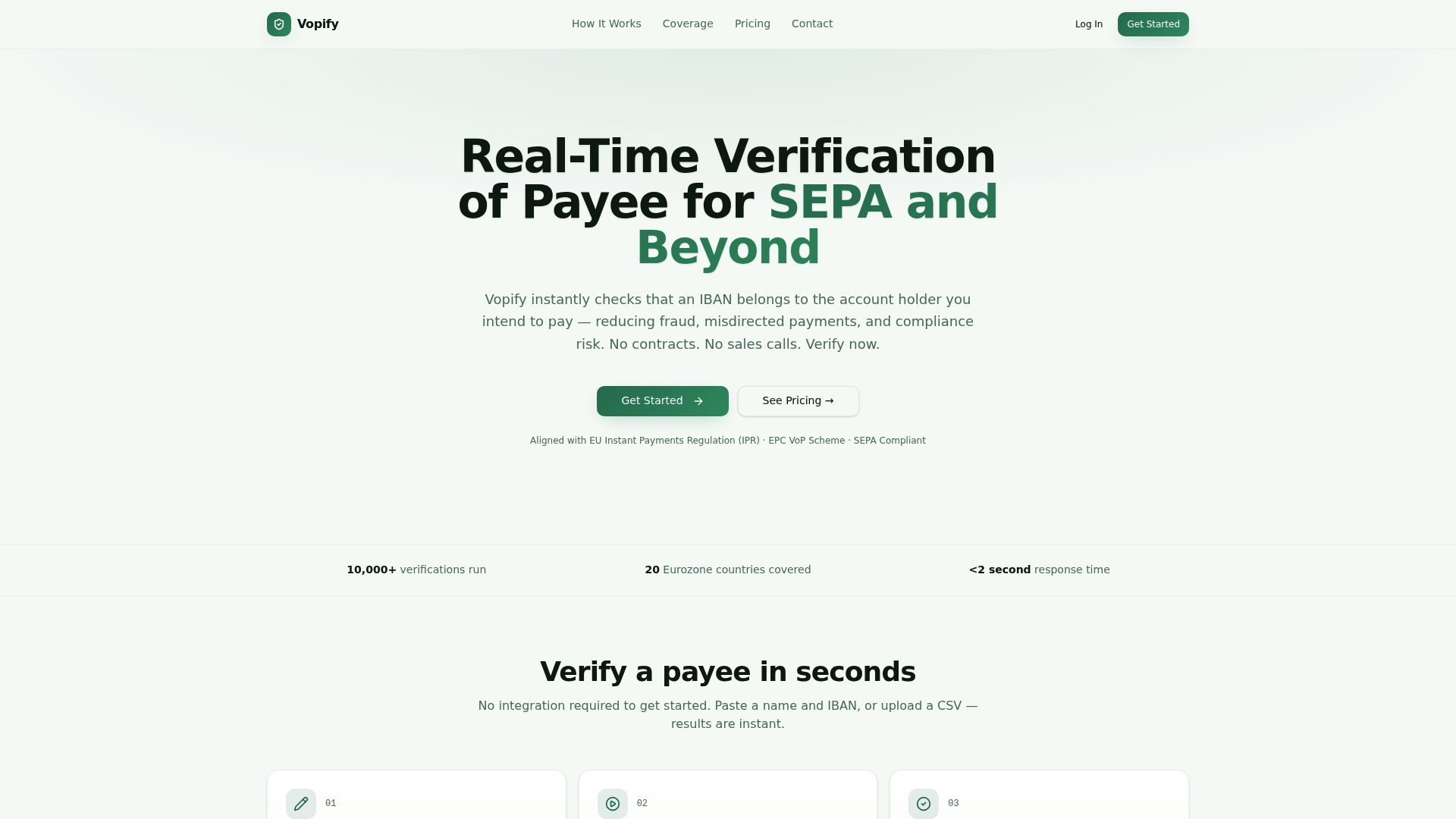
Running a full supplier or contractor list? Use bulk IBAN verification to upload a CSV and check everyone at once. If your team works with AI assistants, the Vopify MCP brings verification into that workflow. API integration for high-volume programmatic checks is planned.
Common mistakes to avoid
- Verifying only at first payment. Bank details change. Re-check on every change.
- Using a trade name. Banks hold legal names. Ask for the exact name on the account.
- Accepting contact details from the invoice. If the invoice is fraudulent, so is its phone number.
- Treating account validation as ownership proof. Open and valid is not the same as belongs to this person.
- Skipping the log. Without a record, you cannot show you had a control in place.
- Letting urgency override a mismatch. Urgent payment requests are a standard fraud tactic. A mismatch always pauses the payment.
For related reading, see our guide to business payee verification and mule account detection, which covers accounts opened to receive diverted funds.
FAQ
Is verifying an individual payee required in the US?
There is no blanket US rule requiring it for every payment. Nacha's minimum account validation applies to WEB debits and does not require an ownership check, and no federal regulation requires banks to verify recipients on FedNow or RTP credit pushes. Nacha does expect originators to run risk-based fraud monitoring, so an ownership check is a sensible, defensible control for individual payees.
What is the difference between payee verification and account validation?
Account validation confirms the account is open and can accept the payment. Payee verification goes further and confirms the account belongs to the named person. For individuals, where impersonation is the main risk, the name match is the more useful part.
How fast can I verify an individual payee?
Microdeposits and prenotes usually take a day or two, and manual callbacks vary. Automated name-matching services return an answer in seconds. Vopify is designed to respond in under two seconds for supported IBANs.
Can I verify a payee paid by IBAN with Vopify?
Yes. Enter the payee's name and IBAN and you get a match result for individual or business accounts. We cover SEPA countries, India, Indonesia, South Korea and China (Alipay). You can run single lookups or upload a CSV.
Sources
- Payee Name Verification, Federal Reserve Financial Services
- How real-time pay is pressuring bank authentication, American Banker
- B2B Payments: How Instant Payments May Facilitate Business Payments, Cleveland Fed
- 6 ways to future-proof FedNow's latest update, Red Compass Labs
- Account Validation: A Tool for Businesses to Improve ACH, Nacha
- Account Validation Frequently Asked Questions, Nacha
- Instant Payments Regulation: EU and US Requirements, Legal Clarity
- Essential guide to making payments in US dollars and euros, Wells Fargo