
Payee verification for South Korea means confirming that the bank account number you were given belongs to the person or company you intend to pay, before the money leaves. You do it by matching the account holder's name to the account, then backing that up with a call to a contact you already trust. Korean banks have strict real-name rules that make this check meaningful. The hard part for a US team is reaching that data quickly, which is where a name-and-account lookup fits.
TL;DR
- Payee verification checks that the account holder name matches the payee you meant to pay. The Federal Reserve notes that institutions can verify a payee's name against account and routing details before issuing a payment.
- South Korea requires financial institutions to verify customers' real names, so accounts are tied to identified holders. That makes a name match a strong signal.
- A match confirms name and account line up. It does not confirm the invoice is genuine or that the supplier's email wasn't hijacked, so pair it with a call-back.
- If the name doesn't match, hold the payment and confirm by phone using a number you already had on file.
- Vopify lists South Korea among the countries it covers, with single lookups and bulk CSV checks.
Table of Contents
- What payee verification means when you pay South Korea
- Why South Korean accounts suit name matching
- What you need to verify a Korean payee
- A verification workflow for AP teams
- What a successful match tells you, and what it doesn't
- When the name doesn't match, or the check fails
- Our perspective
- Checking South Korean payees with Vopify
- Choosing a check by payment type
- FAQ
- Sources
What payee verification means when you pay South Korea
In the US, most payee checks happen after the fact: a returned ACH, a bounced wire, a supplier asking where their money is. Verification moves the check to before payment. You hand over a name and an account number, and you learn whether they belong together.
For cross-border payments to South Korea, the risk profile is different from a domestic ACH. International wires are hard to pull back, and FinCEN notes that e-mail compromise transactions are often irrevocable. The FBI's IC3 has reported exposed losses above $55 billion from business email compromise worldwide across more than a decade. Accounts payable teams paying overseas suppliers, contractors and partners are exactly who fraudsters target.
The typical scenario: a Korean supplier you have paid before sends an "updated" invoice with new bank details. The email looks right. The account may be real, but it belongs to someone else. CISA's alert says most BEC incidents involve a compromised CEO, CFO or vendor email account, with the goal of changing the bank account tied to that vendor, and that funds are primarily sent to Asia.
Why South Korean accounts suit name matching
South Korea's Real Name Financial Transactions Act, enacted in 1993, requires financial institutions to check and verify customers' real names, which effectively rules out anonymous or fictitious-name accounts, according to the Korea Financial Intelligence Unit. In practice, an account number in Korea is linked to a verified identity, so the name on file is worth comparing against.
Inside Korea, this shows up in two common ways.
Account holder name inquiry
The Korea Financial Telecommunications and Clearings Institute runs an account real-name inquiry API for registered institutions. Given an account number plus authentication details, such as a business registration number, it returns the holder's name, account type and bank details. It is built for registered Korean institutions, not for a US accounts payable clerk with a spreadsheet, which is why most US teams reach this kind of check through a verification provider.

The 1-won test deposit
Korean apps and remittance services often send a single won to an account with a short code in the sender field. The account holder reads the code from their deposit history and types it back in. One US-facing remittance help page describes this penny test, with the recipient entering the code in a partner app.

This proves the person controls the account. It works well for consumer onboarding. For a B2B payment, it asks your supplier to take an extra step and slows your cycle, which is why name-matching at the point of payment is the more practical control for AP.
What you need to verify a Korean payee
Have this ready before you request a check or set up a new vendor:
| Item | Why it matters |
|---|---|
| Account holder name exactly as the bank holds it | The name match is the core of the check. For a company, use the registered legal name, not a trade name |
| Account number | Korean account numbers vary in length by bank, so keep them exactly as supplied, without added spaces or dashes you invented |
| Bank name or code | Needed to route the lookup to the right institution |
| Payment purpose and amount | Korean rules ask for documents showing the reason and amount of a payment |
| A contact you already trust | Needed for the call-back, if the match fails or the details just changed |
On the compliance side, the Bank of Korea says payments for current transactions are freely permitted as long as documents certifying the reason and amount are submitted, and only certain payments need prior confirmation or notification. Keep your contract, purchase order and invoice together, since your bank may ask for them.
A verification workflow for AP teams
- Collect details on a document, not only in email. Get the bank details on a signed pro forma invoice or onboarding form. Korea Import Hub advises that the account should be in the supplier's registered company name at a Korean bank.
- Run a name and account check. Compare the holder name to the legal name on your vendor record before the first payment.
- Re-run it on every bank change. A changed account is the highest-risk event in the vendor lifecycle. Our guide on vendor bank change fraud explains why AP should hold the payment first.
- Call back on a known number. CISA recommends verbally confirming payment-instruction changes using a number from a known contact list, not the one in the email.
- Require dual approval. The same CISA alert suggests dual approval for wires involving new trading partners, new account numbers, or countries outside normal patterns. A first payment to Korea usually hits all three.
- Reference the order in the payment. Tie the payment to a purchase order and, for goods, to an inspection or bill of lading, as the Korea Import Hub guide suggests.
For a broader look at the process, see our practical guide to validating vendor bank accounts and the overview of business payee verification.
What a successful match tells you, and what it doesn't
A match tells you that the name you supplied corresponds to the holder of that account at that bank at the time of the check. That is valuable: it rules out typos, wrong-digit transpositions and the most common fraud, where an "updated" account belongs to a stranger.
It does not tell you that:
- the invoice itself is genuine or the goods will ship;
- the person who asked you for payment is authorized by the supplier;
- the account will still be held by the same person tomorrow.
That is why the workflow above layers controls. The name match removes one large class of errors cheaply; the call-back, dual approval and purchase-order matching cover the rest. A third layer, covered in our piece on mule account detection, looks at whether the account's holder fits the payee at all.
When the name doesn't match, or the check fails
Treat a mismatch as a stop sign, not a formality.
- Hold the payment. Do not release it while you investigate.
- Check for innocent causes first. Common ones: a trade name instead of the legal name, an English transliteration of a Korean name that differs from the bank's record, an abbreviation, or a typo in the account number. Ask the payee for the name exactly as printed on their bank statement or account certificate.
- Confirm by phone. Call the supplier on a number from your own files and read the account details back. Do not reply to the email that supplied them.
- Re-run the check with the corrected name or number.
- Escalate if it still fails. If the supplier denies sending a change, tell your security team and your bank right away. FinCEN's advisory recommends a multi-channel verification process for exactly these cases, and a fast call to your bank gives you the best chance of intervening on a wire already sent. Companies in the US can also report to the FBI at IC3.
A failed lookup is different from a mismatch. It can mean a format problem, an unsupported bank, or a temporary network issue. Fix the formatting, retry, and if the result is still unclear, use the phone confirmation as your fallback before paying.
Our perspective
Most teams we talk to treat the first payment to an overseas supplier as a leap of faith, and the account change as a routine email. We see it the other way round. Those two moments carry most of the risk, and they are the two moments where a few seconds of checking is cheapest.
That is why we built Vopify around a simple input: a name and an account number, with a result in under two seconds. No contract negotiations, no integration project before you can run your first check. Finance teams should be able to verify a South Korean payee as easily as they look up a vendor in their ERP.
A name match is not a replacement for good AP discipline. It is the step that makes the rest of your controls faster, because the call-back and approval effort can be focused on the payments that actually raise a flag.
David
Checking South Korean payees with Vopify
Vopify verifies that the name you hold matches the account holder for the account number you were given, for individuals and businesses. South Korea sits alongside SEPA countries, India, Indonesia and China (Alipay) in our coverage, and you can see the supported networks on our coverage page. Run one-off checks in the dashboard, or upload a CSV of supplier records for a bulk review before a payment run.
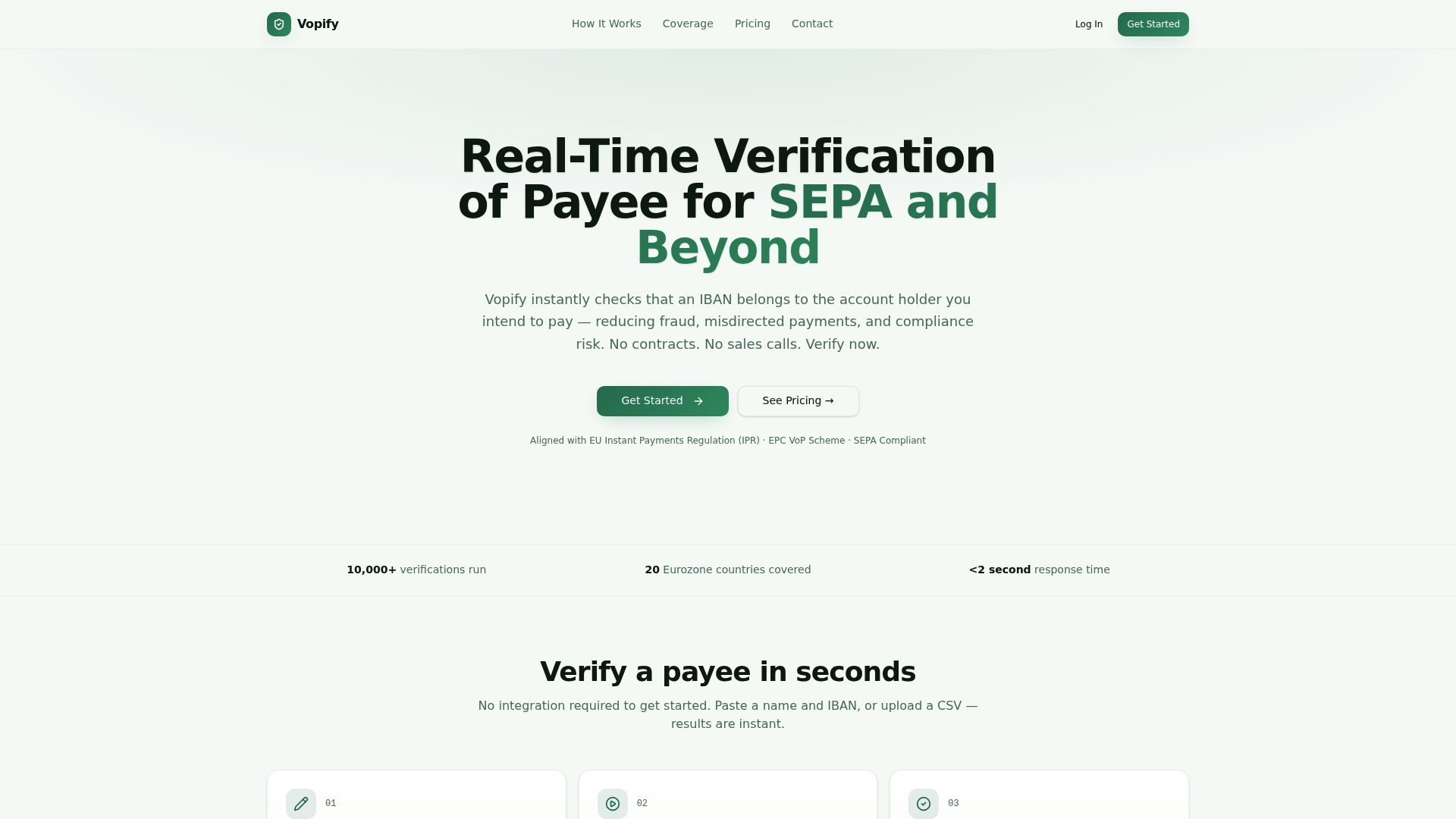
Pricing is pay-as-you-go at $0.70 to $1.00 per verification, or monthly plans: Starter at $240 per month, Growth at $750 per month and Scale at $2000 per month. You can start from the Vopify homepage. API integration for high-volume programmatic checks is planned, and our MCP integration is available for teams who want to use verification from AI assistants. For the wider picture on IBAN-style checks across regions, see our global verification overview.
Choosing a check by payment type
| Situation | Suggested control |
|---|---|
| First payment to a new Korean supplier | Name and account check, onboarding form signed by the supplier, call-back, dual approval |
| Existing supplier changes bank account | Hold payment, call back on a known number, re-run the name check |
| Quarterly vendor master clean-up | Bulk CSV check of all active Korean vendors |
| Recurring contractor payments | Check at setup and after any change to details |
| Large one-off prepayment | All of the above, plus tying the balance to inspection or shipping documents |
Bulk checks pay off most when you inherit a vendor file with years of unverified entries. Errors that have sat quietly in the master file tend to surface as returned payments at the worst time. Our write-up on prepayment verification shows how teams catch these before payment instead of after.
FAQ
Is there a US database to check a South Korean bank account?
No single US database covers Korean accounts. Korean account holder lookups run through Korean financial infrastructure, such as the KFTC open banking API, which is open to registered institutions. A verification service gives US finance teams access to a name-to-account check without building that connection themselves.
Does the 1-won test work for business payments?
It proves the recipient can see deposits on the account, since they must read back a code. That suits onboarding a consumer. For supplier payments, a name match at the time of payment is faster and doesn't depend on your vendor acting on a deposit, though you can still ask the vendor to confirm details by phone.
What if my supplier's English name differs from the bank record?
This is common. Ask for the name exactly as shown on a bank statement or account certificate, and compare it to the registered legal name on your vendor record. If the two still don't align, hold the payment and confirm with the supplier by phone on a number you already have.
Does verification replace a call-back?
No. A match shows the account belongs to the named payee. A call-back shows the request came from them. CISA recommends confirming payment-instruction changes by phone using a trusted number, and the two steps work best together.
Sources
- Payment Fraud Mitigation, Federal Reserve Financial Services
- FinCEN: Advisory to Financial Institutions on E-mail Compromise Fraud Schemes
- FBI IC3: Business Email Compromise, The $55 Billion Scam
- CISA: Business Email Compromise Continues to Swindle and Defraud US Businesses
- Korea Financial Intelligence Unit: AML regime
- KFTC Open API: account real-name inquiry
- Sending money to South Korea, Ria Help Center
- Bank of Korea: Payments and Transactions
- How to Pay Korean Suppliers Safely, Korea Import Hub