
India payee verification means confirming that the account number and IFSC a supplier gave you belong to the name on your invoice, before you send the money. For a U.S. accounts payable team, the practical route is a name-to-account check run before the first payment and again whenever bank details change. Vopify covers India, so you can run this check yourself in seconds instead of waiting for a bounced wire.
This guide covers what to collect, the three ways a name check can be done, why checks fail, and how to build the step into your payment run.
TL;DR
- Payee verification compares a name and account identifier with bank records before payment, which cuts misdirected payments and fraud, according to the Bank for International Settlements.
- For India you need the legal name exactly as it appears on the account, the account number, the IFSC and the bank's SWIFT/BIC, plus a physical beneficiary address for wires.
- Indian banks on RTGS and NEFT were required to offer a beneficiary name lookup by April 1, 2025, so the name data exists in the system.
- Treat a mismatch or an inconclusive result as a stop sign: contact the supplier on a number you already trust, never one from the email that changed the details.
- Verify on onboarding, on every bank-detail change, and in bulk before large payment runs.
Table of Contents
- What payee verification means for a U.S. company paying India
- What you need to collect first
- Three ways to check an Indian payee, and how they differ
- Why a check fails or comes back inconclusive
- The fraud pattern you are guarding against
- U.S. paperwork that sits next to the check
- Perspective
- Run the check with Vopify
- Building the check into your payment process
- FAQ
- Sources
What payee verification means for a U.S. company paying India
Payee verification goes by several names: confirmation of payee, beneficiary check, account name check. The idea is the same. Before the payment leaves, someone checks the payee's name and account identifier against bank records. The BIS describes these pre-validation services as a way to check the accuracy, validity and completeness of payment information before a cross-border payment starts.
Why it matters more on the India route: a U.S. wire to India passes through correspondent banks, takes days, and is hard to pull back once credited. A single transposed digit or a fraudster's replacement account can mean weeks of tracing. Checking first costs a fraction of one failed wire.
Typical triggers for a check:
- A new Indian vendor, contractor or software agency is being set up.
- An existing vendor emails "new bank details."
- You are about to run a large batch that includes Indian suppliers.
- An auditor or controller asks how you confirm payee identity.
What you need to collect first
You cannot verify what you have not collected. U.S. Bank's guidance on INR payments from the U.S. lists the details required: beneficiary bank SWIFT/BIC, account name and number, IFSC, the purpose of payment in detail, and the full physical beneficiary address. PO boxes are not acceptable. For transactions of INR 500 million or more, the legal entity identifier (LEI) is also needed for both the beneficiary and the remitter.
A workable vendor-form checklist:
| Field | What to ask for | Common mistake |
|---|---|---|
| Legal name | Exactly as printed on the bank account | Using a trading name, nickname or initials |
| Account number | From a bank letter or cancelled cheque image | Copying from an email body |
| IFSC | 11-character branch code | Using an old code after a bank merger |
| SWIFT/BIC | Receiving bank's code | Using a code for a different branch or bank |
| Beneficiary address | Full street address | PO box |
| Purpose of payment | Specific description of the service | Vague text such as "payment" |
One practical tip from wire-transfer guidance: verify the SWIFT code against the bank's official website, and check the IFSC against the bank's current site or the recipient's banking app, rather than trusting a code pasted into an invoice.
Three ways to check an Indian payee, and how they differ
There is no single method. Each answers a slightly different question.
1. Ask the supplier's bank through the supplier
The oldest method is a bank letter or cancelled cheque. It proves the account existed at some point and shows a name. It does not prove the details in your system match, and a forged document looks the same as a real one. Use it as supporting evidence, not as the control.
2. Penny drop
In a penny drop, a platform sends a very small amount, historically Re. 1, to the account over a domestic rail and reads back the account holder name from the bank's response. A guide to penny drop describes the sequence: the user enters the account number and IFSC, a small transfer is made, the bank's response returns the registered name, and the platform compares it with the name on record.
This works well for Indian onboarding flows. For a U.S. AP team, it means you depend on a provider with Indian rail access, and the result is only as good as the name comparison logic.
3. Bank name lookup and live name matching
India's central bank pushed this approach into the banking system. The RBI directed banks participating in RTGS and NEFT to offer a beneficiary account name lookup by April 1, 2025. Using the account number and IFSC, the facility fetches the beneficiary's name from the bank's core banking system. According to a summary of the circular, it is offered during beneficiary registration and one-time transfers, it is free for customers, and banks keep logs of queries and responses.
Two details matter to you. First, the facility sits inside Indian banking channels, so a U.S. company does not log in to it directly; you reach it through your bank or a verification provider. Second, if the name cannot be displayed, the remitter may still proceed at their own discretion, so a blank result is not a pass.
Which one to use
| Method | Proves account exists | Proves name matches | Speed | Fits AP workflow |
|---|---|---|---|---|
| Bank letter or cheque | Partly | Only on paper | Days | Supporting evidence |
| Penny drop | Yes | Yes, via returned name | Seconds to minutes | Good, if you have a provider |
| Live name-to-account match | Yes | Yes | Seconds | Best for repeat and bulk checks |
Why a check fails or comes back inconclusive
A failed check is not always fraud. These are the usual causes, roughly in order of how often AP teams meet them:
- Name formatting. The bank holds "Sharma Rajesh Kumar" and your vendor master says "R. K. Sharma." Indian names often have different ordering, initials or one name only. The fix is to ask the supplier for the name exactly as it appears on the account.
- Trading name versus legal name. A business invoices as a brand but the account sits in the registered company name.
- Wrong or outdated IFSC. Bank mergers and branch changes make older codes unreliable. Check against the bank's current site.
- Typo in the account number. One wrong digit usually returns no match or an unrelated name.
- Account type or status. Dormant, closed or restricted accounts may not return a name.
- Name not displayed. As the RBI circular summary notes, there are cases where the beneficiary name cannot be shown. That is an inconclusive result, and you resolve it by another route.
How to respond to each outcome:
- Match: record the result with date and reference, and proceed.
- Close match: compare the two names manually, then ask the supplier to confirm in writing from a known contact.
- No match: do not pay. Call the supplier on a number from your original contract or onboarding file.
- Inconclusive: try a different method, such as a verified bank letter, and hold the payment until one source confirms.
If you want to understand how match levels are interpreted in a related scheme, our guide to name match codes and IBAN checks shows how AP teams treat full, partial and no-match results.
The fraud pattern you are guarding against
The classic scam is a change-of-bank-details email that appears to come from a real supplier. Everything looks right: the invoice, the logo, the thread. Only the account differs. A name check catches it because the new account almost never carries the supplier's legal name. Related risks include accounts used as pass-throughs for stolen funds, which we cover in our piece on mule account detection.
A control that works in practice:
- Any bank-detail change triggers a fresh name check, not just a callback.
- The callback uses contact details held before the change request.
- The person who updates the vendor master is not the person who approves the payment.
- Every check result is stored with the payment record.
The broader principle, verifying before money moves, is the same one we discuss in prepayment verification for AP.
U.S. paperwork that sits next to the check
Verification confirms who gets paid. It does not replace tax and compliance steps. Remitly's guide to paying an Indian business notes that businesses often collect Form W-8BEN-E from foreign entities, or W-8BEN from individuals, to certify foreign status, which may support the position that U.S. withholding does not apply. Whether it applies to your payment is a question for your tax advisor.
Sanctions screening is a separate control again. OFAC's settlement with PayPal cited inadequate screening technology and procedures for identifying potential sanctions targets, a reminder that name checks and sanctions screening are different jobs and both belong in the process.

Keep the evidence together: agreements or purchase orders, tax forms, invoices, payment confirmations and the exchange rate applied. Good records simplify tax reporting and support an audit. If you want a lightweight way to organize them, these invoicing and payment tracking practices are a sensible starting point, and a verification result with a date belongs in the same file.
Perspective
Most AP teams we talk to treat Indian vendors as a special case: slower, riskier, handled by whoever knows the bank. We think that is backwards. The name data already exists inside the Indian banking system, and what has been missing for U.S. companies is a simple way to ask for it.
That is why we built Vopify around one question: does this name belong to this account? You give us a name and the account details, and you get a result in under two seconds, with no contract, no platform fee and no integration project to start. We designed it for finance teams who need an answer before the payment run, not after the wire has failed.
Our view is that verification should be routine, not exceptional. Check every new supplier. Check every change. Check the whole vendor file in bulk before the big batch. When it takes seconds, the control stops being a bottleneck and becomes a habit, and habits are what stop fraud.
David
Run the check with Vopify
Vopify verifies payees by matching the account holder name against the account, for individuals and businesses, and our coverage includes India alongside the Eurozone, Indonesia, South Korea and China (Alipay). See the supported networks for what each country needs as input.
The options:
- Single lookups from the dashboard, for a new supplier or a changed detail.
- Bulk CSV verification for checking a supplier file before a payment run.
- API integration is planned for programmatic, high-volume checks, and our MCP integration lets AI assistants run checks inside your workflow.
Pricing is published: pay-as-you-go verifications cost 0.70-1.00 USD each, and subscriptions are Starter at 240 USD per month, Growth at 750 USD per month and Scale at 2000 USD per month.
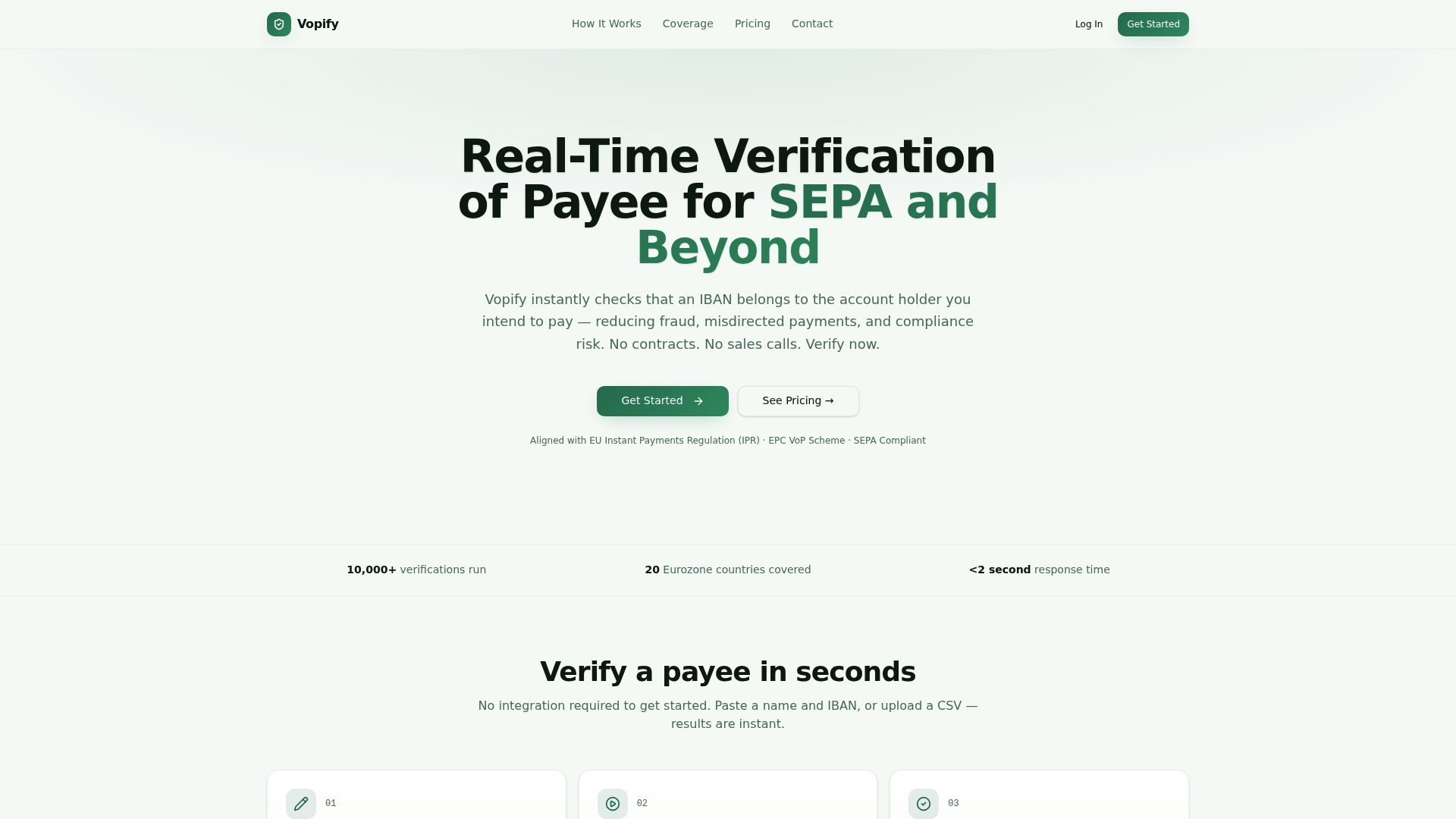
Start verifying payees at Vopify and see a result before your next payment goes out.
Building the check into your payment process
A process beats good intentions. A simple version for Indian suppliers:
- Onboard. Collect the fields in the table above, with a bank letter or cancelled cheque as supporting evidence.
- Verify. Run a name-to-account check on the legal name. Store the result, date and reference.
- Resolve. Handle close matches, no matches and inconclusive results as described earlier, with a callback to a known number.
- Approve. The approver sees the verification status next to the invoice.
- Re-verify. Any change in name, account, IFSC or bank triggers step 2 again.
- Batch check. Before large runs, verify the whole supplier list in bulk and review exceptions.
For teams also paying Europe, the same logic applies under the SEPA scheme; our cross-border payment systems guide explains how instant checks fit an AP workflow, and the BIC versus SWIFT explainer clears up a confusion that also shows up on Indian forms.
A note on expectations: U.S. Bank calls India a challenging market for cross-border payments because of unpredictable regulatory and tariff policy. Rules change, so confirm current requirements with your bank before a first payment, and keep your verification step independent of whichever rail you use.
FAQ
Can a U.S. company verify an Indian bank account name before sending a wire?
Yes. Indian banks on RTGS and NEFT were required to offer a name lookup using the account number and IFSC by April 1, 2025. As a U.S. business, you reach it through a verification provider or your bank. Run it before the first payment and after any detail change.
What details do I need to verify an Indian payee?
Collect the legal name as it appears on the account, the account number, the IFSC and the bank's SWIFT/BIC. For wires you also need the full physical address of the beneficiary and a specific purpose of payment. A PO box is not accepted.
What should I do if the name does not match?
Do not send the payment. Contact the supplier using a phone number from your original contract, ask for the exact name on the account and a bank letter, then run the check again. If the supplier changed bank details by email, treat the request as suspect until confirmed.
Is a penny drop the same as payee verification?
Penny drop is one way to do it: a small transfer returns the account holder name from the bank. Payee verification is the wider control of comparing the name you hold with bank records, however the lookup is done.
How much does it cost to verify a payee with Vopify?
Pay-as-you-go verifications cost 0.70-1.00 USD each. Subscriptions run 240 USD per month for Starter, 750 USD for Growth and 2000 USD for Scale. See Vopify for what each plan includes.
Sources
- BIS CPMI: Safety and efficiency through payment pre-validation
- Reserve Bank of India: beneficiary account name lookup notification
- TaxGuru: RBI introduces bank account name look-up facility
- U.S. Bank: Managing cross-border payments in emerging markets
- Required details for sending a wire transfer: U.S. guide
- Penny drop bank verification: what it is and how to fix errors
- Remitly: How to pay a business in India for the first time
- OFAC settlement agreement
- ExpressPlanner: Best practices for invoicing and payment tracking