
Data quality for payments means that every detail a payment depends on is accurate, complete, consistent, timely and valid before money moves. For accounts payable teams, the detail that matters most is the payee: does this account number really belong to the supplier you intend to pay? Check that at the moment of entry, not after a return or a fraud loss, and most other payment data problems become much easier to manage.
This guide covers what the term means, where payment data goes wrong, what the rules in the US and EU expect, and a practical set of checks your team can run.
TL;DR
- Reliable payment data is accurate, complete, consistent, timely and valid. Payee bank details are the field where an error costs the most.
- Typos, manual entry, system silos and tampered vendor records are the usual causes of bad payment data, and faster settlement leaves less time to fix them.
- Validate at the point of entry and again before release: format checks, account validation, and a name-to-account match where a network supports it.
- Track a few simple metrics, such as returned payments and manual corrections, so you can see whether quality is improving.
- For euro payments, Verification of Payee is now the standard way to confirm the name matches the IBAN. We built Vopify to run that check in seconds.
Table of Contents
- What data quality means in a payment workflow
- Where payment data goes wrong
- What bad payee data costs
- Checks to run before you pay a supplier
- Rules that affect payment data quality
- How to measure whether payment data quality is improving
- Why reliable payment data pays off beyond fewer errors
- Our perspective
- Run the check before the payment leaves
- FAQ
- Sources
What data quality means in a payment workflow
In payments, data quality is the accuracy, reliability and usability of transaction information, to the point that systems can trust it and act on it without a person stepping in. One industry guide breaks reliable payment data into five characteristics:
| Characteristic | What it means for a payment | Example failure |
|---|---|---|
| Accuracy | Amounts and details are correct | A transposed digit in an account number |
| Completeness | No required field is missing | A beneficiary record with no bank country |
| Consistency | The same value reads the same across systems | Supplier name differs in ERP and bank portal |
| Timeliness | Data is available and current when needed | A supplier changed banks, your record did not |
| Validity | Values conform to required formats and standards | An IBAN with the wrong length for its country |
SWIFT makes the same point from the bank side: data has to be accurate, complete and up to date to allow straight-through processing, and it is also critical for anti-money-laundering and sanctions screening. The Association of Payment Professionals goes further and frames data quality as a compliance and risk issue, not only a technical one, with a simple rule: garbage in, garbage out.
For an AP team, that rule translates into one question. If the payee record is wrong, how many good controls downstream will still send the money to the wrong place?
Where payment data goes wrong
Bad payment data rarely has one cause. One fintech analysis describes it as emerging from the interaction of several systems with different schemas and timing, so errors pass through silently. The common sources are well documented.
Manual entry and typos
The plainest cause is a person typing a number. Nacha has noted that an ACH problem can be as simple as a typo in an account number. When the number is invalid, receiving banks can return the entry using code R03 (no account or unable to locate account) or R04 (invalid account number structure), as Nacha explains. A return is the lucky outcome. The unlucky one is a typo that happens to match a real account belonging to someone else.
Silos, formats and integrations
The same guide lists legacy system silos, manual data entry, missing standard formats, complex third-party integrations and mergers as typical root causes. If your vendor master lives in the ERP, your bank details live in a treasury portal, and onboarding forms arrive as PDFs, three copies of the truth will drift apart.
Mismatched and badly formatted fields in card data
Card payments have their own version of the problem. Visa's data quality program points to missing Level III fields, badly formatted line-item quantities or unit costs, and wrong handling of tax, shipping or discounts as issues that impair validation. Visa's dispute guide adds that data sent at authorization can differ from data at settlement, which can trigger disputes even when the purchase was legitimate.
Context fields fail too. A Visa fleet-card white paper cites an audit that found incorrect odometer readings in 34% of transactions in the studied period, caused by wrong codes and inconvenient entry at the pump.

Stale or manipulated vendor records
Vendor payment fraud thrives on weak data processes. Business email compromise and similar schemes frequently exploit account-maintenance processes, trying to slip fraudulent account details into a legitimate payment run. A criminal does not need to hack your bank. They only need your vendor record to change.
What bad payee data costs
The cost shows up in four places:
- Failed and returned payments. A January 2025 survey of 500 US financial decision-makers found 25% cited data-quality errors as a major payment-operations problem, and 24% cited returns, refunds or failures.
- Manual rework. The same survey put protracted, manual reconciliation at 24% and reconciliation errors at 23%. Clean data is the foundation for automated reconciliation with less rework.
- Misdirected funds and fraud. Money sent to the wrong or a fraudulent account is hard to recover, and recall is never guaranteed.
- Compliance exposure. Wrong or missing tax identifiers carry penalties, as covered below.
Speed makes all of this worse. PYMNTS argues that automation and faster settlement magnify existing data weaknesses, because shorter settlement windows leave less time to repair a bad beneficiary record after a payment starts. The only reliable fix is earlier: validate before you initiate.
Checks to run before you pay a supplier
Think of payee data quality as layers. Each layer catches a different kind of error, and none replaces the others.
Layer 1: Format validation at entry
Data validation checks information against predefined rules as it is entered, for example IBAN structure, routing numbers and payment references. It catches typos and impossible values instantly and costs almost nothing. It cannot tell you whether a well-formed account number belongs to your supplier.
Layer 2: Account validation
Account validation confirms that an account exists, is open and can accept payments. In the US, Nacha says it can reduce returned and fraudulent payments and customer service calls. Some originators use micro-entries, which are ACH credits of less than $1 sent to verify a receiver's account. Our walkthrough on micro-deposit verification for AP teams shows how that compares with instant checks, and our five steps to prepayment Nacha account validation covers the US workflow.
Layer 3: Name-to-account matching
The strongest check asks whether the name you hold matches the name the bank has on the account. The Bank for International Settlements notes that pre-validation services improve security and transparency, letting payers and their providers spot problems before funds move. This is the layer that stops a correctly formatted, real, open account that simply belongs to the wrong party.
Layer 4: Change control on vendor records
Whenever a supplier's bank details change, treat it as a risk event. Verify the new details through an independent channel, run the name-to-account check again, and keep an audit trail of who approved the change. Our guide on how to validate vendor bank accounts lays out the steps in AP terms, and our piece on mule account detection explains why account ownership matters for fraud.
Layer 5: Tax and identity data
For US tax reporting, payors must collect and report correct taxpayer identification numbers, such as SSNs or EINs, and failure can bring penalties and backup withholding. The same IRS instructions require payors to keep information from Forms W-9 and W-8 confidential and use it only for tax compliance. A supplier onboarding checklist should therefore cover bank details and tax identifiers together, with careful access control.
Rules that affect payment data quality
United States
Nacha's rules push originators toward validation. Originators of WEB debit entries must use a commercially reasonable fraud detection system that includes account validation, confirming the account is open and can accept ACH entries. Non-consumer originators must also apply risk-based procedures to identify fraud, and Nacha argues these can be strengthened by applying account validation across all ACH SEC codes, not only WEB debits. Check the current rule text with your bank or Nacha for how it applies to your entries.
European Union
If you pay euro suppliers, the rules are more specific. The EU Instant Payments Regulation requires a Verification of Payee service: providers must check payee details, meaning name and account information, before a credit transfer is processed, effective 9 October 2025 in the euro area. When details do not match, the payer's provider must notify the payer. In an almost-match case, the provider must indicate the name associated with the account identifier before authorization.
For a US company, that means your euro suppliers' banks and your payment providers are working under this regime. Our explainers on SEPA confirmation of payee and VoP match codes and IBAN checks show how to read the results in an AP process.

How to measure whether payment data quality is improving
You do not need a data science team. Pick measures that connect to cash and effort, and review them monthly:
- Return and failure rate: returned or failed payments as a share of payments sent, by reason code where you can (for ACH, the R03 and R04 codes point to account number problems).
- Manual correction rate: how many payment files or supplier records a person has to fix before release.
- Vendor change verification rate: the share of bank detail changes that went through an independent check.
- Reconciliation exceptions: items that could not be matched automatically.
- Time to repair: how long a bad record takes to correct.
Some providers also score payment data across categories such as general structure, handling of personal data, attribution to the right instrument and transaction metadata, as Kani's data scorecard does for processors. Whatever you choose, set a baseline first, so a fall in returns is something you can show.
Why reliable payment data pays off beyond fewer errors
Clean data compounds. Payments that pass validation need fewer exceptions, reconciliation runs faster, and support teams field fewer "where is my money" emails. The same logic applies in other payment-heavy operations: a property manager who keeps rent records tidy, for example, finds rental payment reconciliation far less painful. For AP, the benefit is more direct. Suppliers get paid on time, and your controls have evidence behind them when an auditor asks how you know the account was right.
Our perspective
Most teams treat payee data as a one-time onboarding task. We see it as a live control that has to run at the moment of payment, because that is the moment the risk becomes real.
The reason is simple. Format checks tell you an IBAN is well formed. They do not tell you whose account it is. The only check that answers the question your CFO actually cares about is whether the name you intend to pay matches the account holder. That is why we built Vopify around exactly that: a name and an IBAN in, a match result out, in under two seconds, for individuals and businesses alike.
We also think verification should not need a procurement project. No lengthy contracts, platform fees or integration work should stand between an AP clerk and a safer payment. Single lookups and bulk CSV uploads cover supplier lists today, and API integration is planned for teams that want to verify programmatically at volume.
As instant settlement spreads, the window to catch an error shrinks to nothing. Teams that verify before release will spend their time on exceptions that matter, not on chasing payments that have already left.
David
Run the check before the payment leaves
If your suppliers are paid in euros, you can add the name-to-account layer today. Vopify matches a payee name against an IBAN and returns a result in under two seconds. It works for individual and business accounts, and it has processed over 10,000 verifications across the 20 Eurozone countries. Coverage also extends to India, Indonesia, South Korea and China (Alipay); see the supported networks.
Pricing is simple. Pay-as-you-go verification is $0.70 to $1.00 per check. If you verify regularly, plans run at $240 per month (Starter), $750 per month (Growth) and $2,000 per month (Scale).
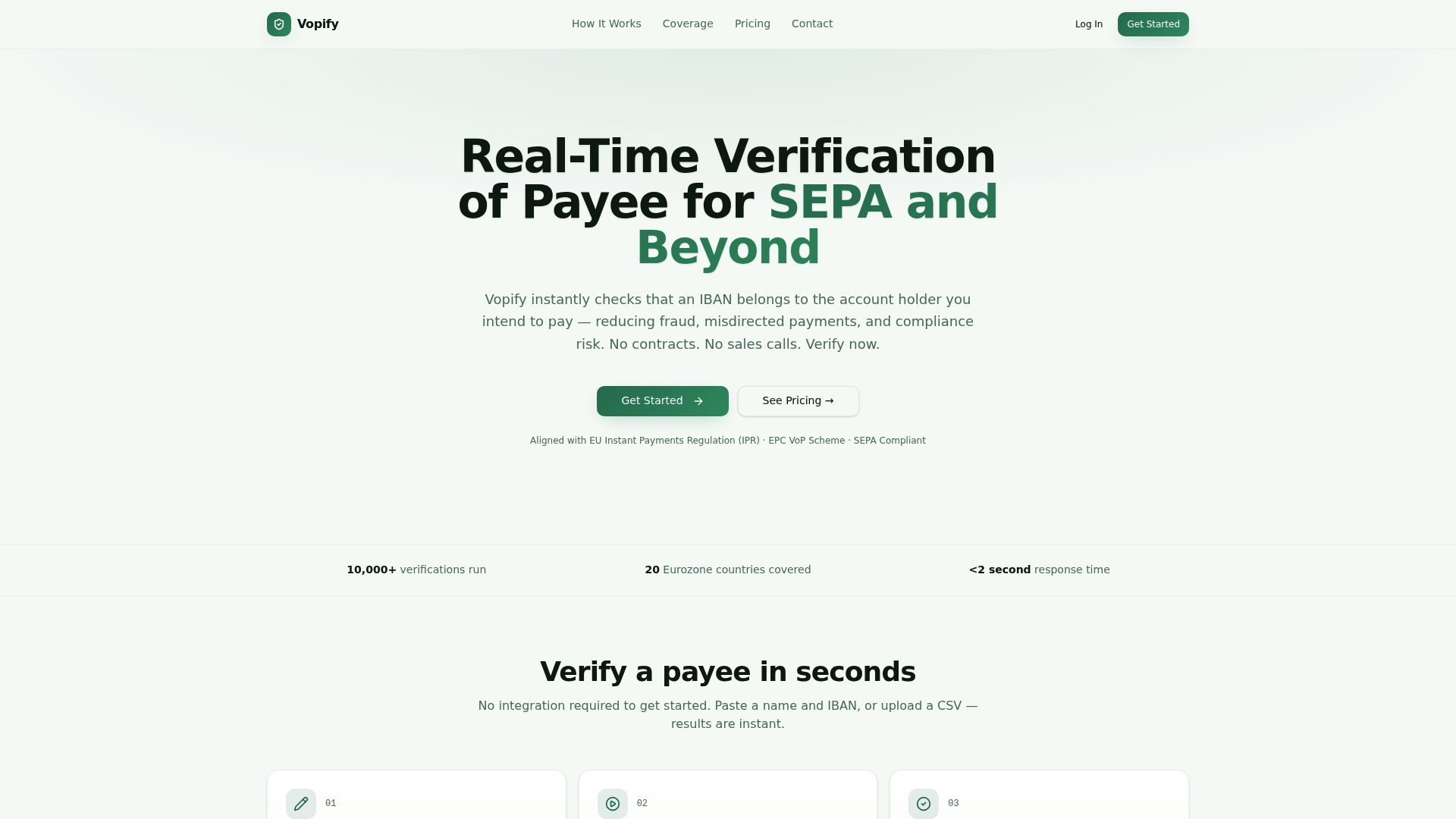
For a full supplier list, use bulk IBAN verification with a CSV upload. For one-off checks, see IBAN and bank account verification. If your team works with AI assistants, the Vopify MCP brings the same check into those workflows.
FAQ
What are the five characteristics of data quality?
Accuracy, completeness, consistency, timeliness and validity. In payments, that means correct amounts and details, no missing required fields, matching values across systems, data that is current when needed, and values that follow required formats. Payee bank details are where a failure on any of the five has the highest cost.
What are the most common payment data quality issues?
Typos in account numbers, manual entry, siloed systems, inconsistent formats and outdated vendor records top the list. Card payments add missing or badly formatted Level III fields and authorization-to-settlement mismatches. Tampered vendor details in business email compromise schemes are the most damaging for AP teams.
How do I check a supplier's bank details before paying?
Layer your checks. Validate the format at entry, confirm the account exists and can receive payments, and match the supplier name to the account holder where the network supports it. Verify any change request through an independent channel. For euro IBANs, Vopify returns a name match result in under two seconds.
Does the EU Verification of Payee rule affect US companies?
It applies to payment service providers in the euro area, which became effective on 9 October 2025. A US company paying euro suppliers will see the effects through its payment providers and its suppliers' banks, such as mismatch notices before a transfer is authorized. Running your own name-to-IBAN check earlier in the process gives your team the same signal sooner.
Sources
- Payment Data Quality: Why It Matters for Banks and Fintechs
- Industry standards and collaboration provide key to greater efficiency (SWIFT)
- Navigating the Payment Industry Alphabet: Q is for Quality Data
- Financial Data Quality in Fintech: Operational Accuracy
- How Nacha Enforces Rules, Promotes ACH Network Quality
- Return for Questionable Transaction (Nacha)
- Visa Business Solutions Launches Data Quality Program
- Visa Dispute Management Guide for Merchants
- Innovation in US Fleet Cards, Visa white paper
- Why Bad Bank Account Data Still Breaks B2B Payments (PYMNTS)
- 9 in 10 Companies Struggle with Payment Operations (Modern Treasury)
- Tackling data quality challenges in payment reconciliation
- Account Validation: A Tool for Businesses to Improve ACH (Nacha)
- Micro-Entries (Nacha)
- Safety and efficiency through payment pre-validation (BIS)
- 2022 General Instructions for Certain Information Returns (IRS)
- Supplementing Fraud Detection Standards for WEB Debits (Nacha)
- Beyond WEB Debits: Why Account Validation Deserves a Broader Role (Nacha)
- Second workshop on implementation of Instant Payments (European Commission)
- Kani's Data Scorecard
- Rental Payment Reconciliation: A Property Manager's Guide