
A treasury verification API is a programmatic check that confirms a payee's bank account belongs to the name you were given, before money leaves your account. In the U.S. the phrase covers several different tools, from a federal agency service to Federal Reserve fraud products, and most of them serve banks or government payers. If your finance team pays suppliers in Europe or Asia, Vopify matches the payee name to the IBAN in real time, one at a time or in bulk from a CSV file, with no contract or integration project. It is also built for the programmatic workflows an API call would serve.
TL;DR
- "Treasury verification API" means different things in the U.S.: a federal Account Verification Service, Federal Reserve payee name tools, and FedNow risk data. Each serves a specific type of payer.
- A good payee check returns a clear result (match, close match, no match) from the account number plus the name, before you authorize the payment.
- Euro-area banks have had to offer a free verification-of-payee check since 9 October 2025, so your European suppliers' accounts can be checked against live data.
- Vopify verifies a name and IBAN in under two seconds, covers 20 Eurozone countries plus India, Indonesia, South Korea and China (Alipay), and starts at $0.70 to $1.00 per verification.
Table of Contents
- What a treasury verification API actually is
- What a verification check looks at
- Why the check belongs before the payment
- Where U.S. teams meet the European requirement
- How to verify payees step by step
- Security and compliance for the verification step
- Choosing a verification approach: what matters
- Perspective
- Start verifying payees with Vopify
- FAQ
- Sources
What a treasury verification API actually is
Search for the term and you will see three kinds of pages: Federal Reserve payment rails, treasury-management software and federal payment portals. They share a word, not a job. Sorting them out is the first step to picking the right control for your accounts payable process.
Payment rail APIs move money. The FedNow Service connects financial institutions to the Federal Reserve so payments clear and settle within seconds. The service's transaction limit was raised from $500,000 to $10 million, which makes business-to-business supplier payments realistic on the rail. A rail API sends the payment. It does not tell you whether the name on the invoice matches the account.
Treasury-management APIs connect your ERP and banking portal so cash positions and payment files flow without manual re-keying. They automate the workflow around a payment, again without confirming who owns the destination account.
Verification APIs and services answer one question: does this account belong to this person or company? That is the control that stops a payment going to the wrong party. In the U.S. there are several of them, each with a defined audience:
- The Bureau of the Fiscal Service's Account Verification Service, reached through the Do Not Pay Portal API, lets federal agencies verify account status and authenticate account owners for personal and business accounts before they pay.
- The Federal Reserve's Payee Name Verification, part of its FedDetect portfolio, lets financial institutions check an intended payee's name against a routing and account number before issuing a payment, drawing on 12 months of historical transaction data.
- The FedNow Network Intelligence API, announced for early adopters from April 28, 2026, gives participants account-level data observed on FedNow to help assess the risk of a payment.
The pattern is clear. The federal service is for agencies, and the Federal Reserve tools are offered to financial institutions. A corporate finance team that pays suppliers by wire or SEPA transfer needs a verification check it can run itself, today, on the accounts it is about to pay.
What a verification check looks at
The federal AVS is a useful model for what a good check involves. It requires at least the account and routing numbers, with the payee name, tax identifier or business name as optional extras. It supports two kinds of request: verification of account status, and authentication of the account owner. Responses come back as a summary (Validated, Inconclusive, Account Issue or Owner Mismatch) or in full detail.
Two ideas matter for your own process:
- Status is not ownership. Knowing an account is open and can receive funds does not tell you it belongs to your supplier. Ownership is what a fraudster's account fails.
- The answer must be graded. A name like "Müller Logistik GmbH" will not always be typed exactly as the bank holds it. A result that distinguishes a full match, a close match and a mismatch lets your team approve, query or stop.
The European standard works the same way. Under the EU Instant Payments Regulation, the verification-of-payee service returns match, close match, no match or other, and if a payer authorizes a transfer after being warned that the identifier looks wrong, the payer is liable for the transfer to the unintended recipient. For a U.S. company paying euro suppliers, that liability shifts the risk of ignoring a warning onto you. Our guide to bank account ownership verification methods goes deeper into how each method differs.
Why the check belongs before the payment
Payment fraud usually does not break your systems. It persuades someone to change a number. In the J.P. Morgan and AFP Payments Fraud and Control Survey, 80 percent of organizations had experienced business email compromise in 2018, and 54 percent reported financial losses from it. The same survey recorded ACH credit fraud rising from 13 to 20 percent that year. Those figures are dated, but the mechanism has not changed: a convincing email asks accounts payable to update bank details, and the next payment goes to a stranger.
The same weakness hits honest mistakes. A transposed digit in a supplier's IBAN, or a payee name copied from the wrong invoice, sends funds to someone else just as surely. A check run at the moment of payment catches both. It is the cheapest control in the process because it happens before settlement, when nothing has to be recovered.
For the supplier-master side of this problem, see our notes on prepayment verification and on spotting mule accounts in real time.

Where U.S. teams meet the European requirement
If any of your suppliers sit in the euro area, the verification-of-payee rule matters to you even though you are a U.S. business. From 9 October 2025, EU payment service providers must offer payers a free verification-of-payee service before authorizing credit transfers. It covers SEPA credit transfers, not just instant ones. Providers outside the euro area have until 9 July 2027, and the service must be available in customer channels, including APIs, with results in seconds.
In practice, your European suppliers' banks are now part of a network that can answer name and IBAN questions. A U.S. finance team that wants the same answer, without waiting for its own bank's channel to expose it, needs a tool that queries that network directly. That is the gap we built Vopify to fill. Our page on verification of payee for SEPA explains how the service works, and our article on SEPA confirmation of payee is written for compliance teams.
How to verify payees step by step
Whether you call it a treasury verification API or a payee check, the routine is the same. Here is how to run it, and what we do at each step.
1. Collect the right inputs
You need the payee's legal name and the full account identifier. For a SEPA payment that is the IBAN. For a U.S. federal check it would be routing and account numbers. Take the name from a contract or onboarding form rather than the invoice that carries the new bank details, since an invoice is the very document a fraudster controls.
With Vopify you enter just a name and an IBAN. It works for individual and business accounts, so you do not need a tax identifier, a contract or a platform integration to run the first check.
2. Run the check before approval
The check belongs between invoice approval and payment release, and again whenever bank details change. Run it on the account you are about to pay, not on the one in your master file from last year.

Vopify queries live payment networks and returns the result in under two seconds. A single lookup is available in the dashboard when one payment needs a second opinion.
3. Read the grade, not just the pass
Treat the three outcomes differently:
| Result | What it means | What to do |
|---|---|---|
| Match | The name corresponds to the account holder | Release the payment |
| Close match | The name is similar, such as an abbreviation or a legal form difference | Confirm the correct name with the supplier through a known contact, then proceed |
| No match | The name does not correspond to the account | Hold the payment and call the supplier on a number you already have |
The call-back in the last row matters. Use a phone number from your own records, never one printed on the message that asked for the change.
4. Verify in bulk when you onboard or clean up
Checking suppliers one at a time stops being practical once you have hundreds. Vopify supports bulk CSV upload, so you can run a whole supplier file before a payment run or when migrating to a new ERP. Our bulk IBAN verification page describes the workflow.
5. Record the result
Keep the result with the payment approval so that an auditor, or your own team a year later, can see that the account was confirmed before funds moved. The dashboard shows results for each check.
6. Plan for automation
Teams that release payments from an ERP eventually want the check to fire automatically at the moment of approval. API integration for programmatic, high-volume verification is planned at Vopify, and the dashboard and bulk upload cover the work until then. For teams working with AI assistants, Vopify MCP brings verification into that workflow.
If you are designing an automated flow, the federal Do Not Pay implementation guide is a useful reference for how a verification API is specified: it allows up to 15 entities per call for approved multi-entity searches. Batch sizes, request types and response codes are the things to settle before you build.
Security and compliance for the verification step
A verification call sends a name and an account number to a third party, so it falls under your information security program. Three U.S. reference points apply.
The Gramm-Leach-Bliley Act's Safeguards requirements, implemented in Part 314, require FTC-jurisdiction financial institutions to keep a written information security program with administrative, technical and physical safeguards suited to their size and the sensitivity of the data. The rule also requires oversight of service providers, so vendor due diligence belongs in your procurement file for any verification tool.
The FFIEC's 2011 supplement on internet banking authentication recommends layered controls for business customers, including out-of-band verification for transactions, positive pay, and limits on payment recipients and transaction values. A payee check is a natural part of that layer, because it validates the recipient rather than only the user.
When you add any tool to your payment workflow, map where data goes and who can see it. An AI integration checklist helps you walk through systems, owners and monitoring before you connect something new. Our article on payment verification privacy explains how payee checks can limit the personal identification you need to share.
If your company is subject to the Safeguards Rule or a contractual security standard, confirm the specifics with your compliance officer or counsel. They can tell you which obligations apply to your size and activities.
Choosing a verification approach: what matters
When you compare options, these are the criteria that decide whether the control works in your process:
- Who can use it. Federal and Federal Reserve services are scoped to agencies and financial institutions. Check that your team is eligible before you plan around one.
- Where the payee is. A U.S. routing-number service does not tell you anything about an IBAN in Lyon. Vopify covers SEPA (the Eurozone), India, Indonesia, South Korea and China through Alipay. See the coverage page for the networks.
- Speed. A check that takes a day will be skipped when a payment is urgent. Under two seconds keeps it inside the approval step.
- Contract friction. Vopify requires no contract, platform fee or integration to start, so the first check can happen the same day.
- Grading. Look for match, close match and no match, not a yes or no.
- Volume pricing. Cost per check should be predictable as your supplier base grows.
Our overview of real-time bank account verification for AP teams and the explainer on the IBAN validation API go through these in more detail. The article on business payee verification covers company accounts specifically.
Perspective
We built Vopify because the check that matters most in accounts payable is also the one most teams skip: confirming, in the moment, that the name on the invoice is the name on the account.
Most of what is labeled treasury verification in the U.S. is built for institutions. A finance team with a supplier in Germany or South Korea and a payment run on Friday needs something different: type a name and an IBAN, see the answer, and move on. No procurement cycle, no integration project.
More than 10,000 verifications have gone through Vopify, with responses in under two seconds across 20 Eurozone countries and the other networks we cover. That speed is the point. A control that fits inside the approval step is a control that gets used every time, not only when someone is suspicious.
We would rather your team verify every first payment and every changed bank detail than rely on memory and email. That habit, more than any single tool, is what keeps money where it is meant to go.
David
Start verifying payees with Vopify
Vopify gives finance and accounts payable teams an instant answer on whether a payee's name matches their IBAN. Pay as you go at $0.70 to $1.00 per verification, or choose a monthly plan: Starter at $240 per month, Growth at $750 per month, or Scale at $2,000 per month. Single lookups and bulk CSV uploads run from the dashboard, and API integration is planned for high-volume programmatic use.
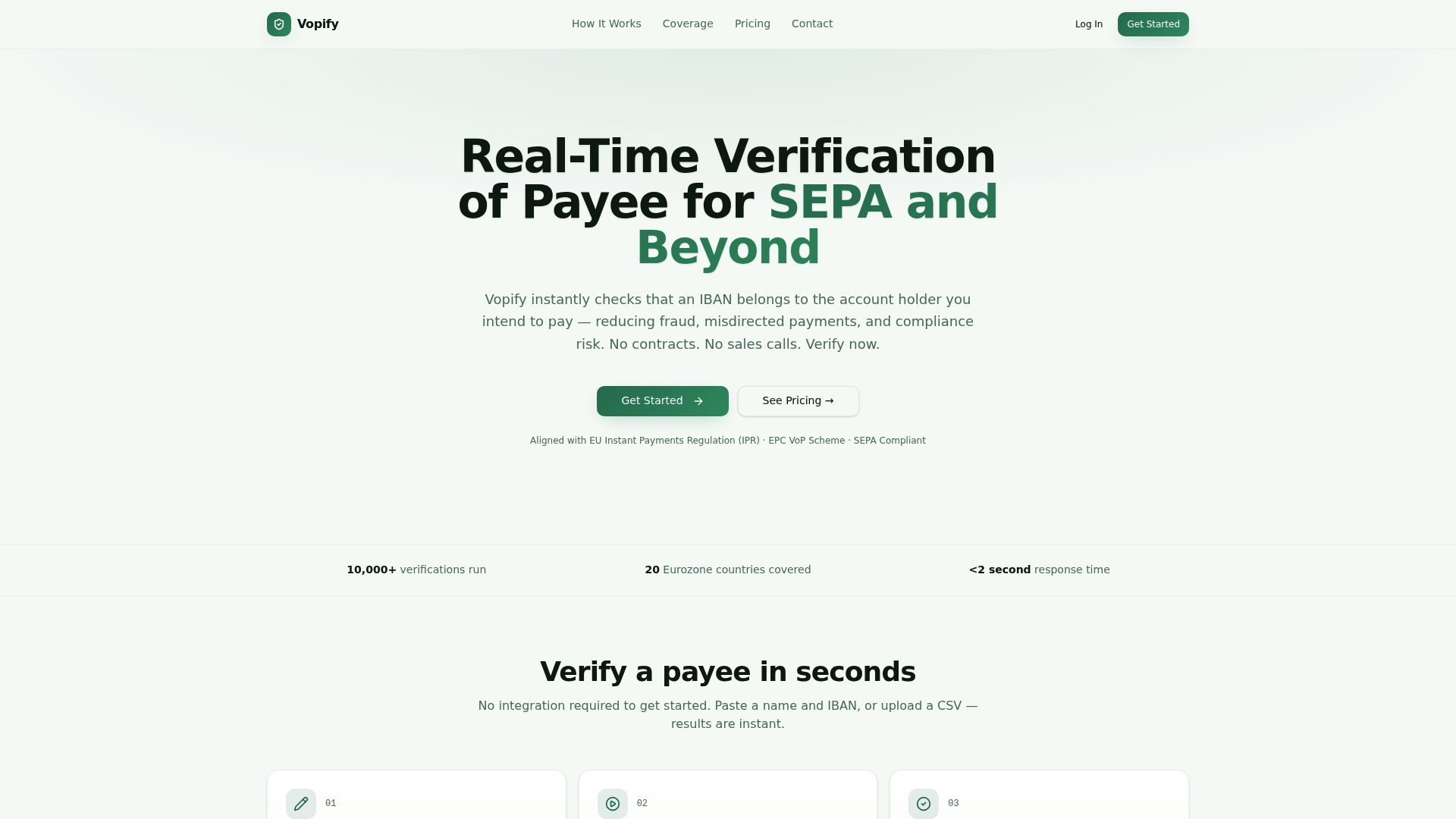
Run your first check on Vopify, or check a whole supplier file with bulk IBAN verification.
FAQ
What is a treasury verification API?
It is a programmatic service that confirms a payee's bank account is open and, ideally, that it belongs to the named recipient before a payment is made. In the U.S. the term is used for federal and Federal Reserve services, and also loosely for treasury-management integrations that do not check ownership at all. The ownership check is the part that prevents misdirected and fraudulent payments.
Does Vopify offer an API today?
Vopify runs from a dashboard with single lookups, bulk CSV uploads and credit bundles or subscriptions. API integration for programmatic, high-volume verification is planned. Vopify MCP is available for teams that work with AI assistants.
Which countries does Vopify cover?
Vopify covers SEPA across 20 Eurozone countries, plus India, Indonesia, South Korea and China through Alipay. It works with individual and business accounts and returns results in under two seconds. The coverage page lists the supported networks.
Who needs to verify payees before paying?
Any team that pays new suppliers or acts on a change of bank details benefits, particularly accounts payable and treasury staff handling cross-border payments. Under the EU rules, a payer who authorizes a transfer after receiving a warning is liable for it, which makes the check especially relevant for payments into the euro area.
How much does a verification cost?
A single verification costs $0.70 to $1.00 on a pay-as-you-go basis. Monthly plans are $240 for Starter, $750 for Growth and $2,000 for Scale. Bulk and API pricing is not published, so contact us through vopify.io for your volumes.
Sources
- Do Not Pay Portal Quick Reference Card, Account Verification Service
- Do Not Pay API Agency Implementation Guide
- Payee Name Verification, Federal Reserve Financial Services
- New News About the FedNow Service, Independent Banker
- FedNow Network Intelligence API announcement, Business Wire
- Verification of Payee requirements under the EU Instant Payments Regulation, PwC Legal
- Payments Fraud and Control Survey Report, J.P. Morgan and AFP
- Gramm-Leach-Bliley Act (GLB Act)
- FFIEC Supplement to Authentication in an Internet Banking Environment, CEO Memo 389
- AI Integration Checklist for Small Business